

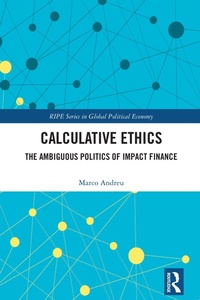
Calculative Ethics
The Ambiguous Politics of Impact Finance
1st Edition
Published on 22. January 2026
236 pages
978-1-040-53520-2 (ISBN)
Description

Calculative Ethics examines social and development impact bonds as a form of ethical finance that adopts a fact-centred approach to addressing social ills. Impact bonds are shown to recast benevolent investing through evidence-based governing, tying investor returns to demonstrated positive social outcomes in domains such as health and education. The book argues that this logic of fact-based financing is increasingly institutionalised, reshaping investment and donor practices across ethical and development finance.
Drawing on three case studies-addressing homelessness and chronic illness in the UK, and educational outcomes for girls and boys in India-Calculative Ethics traces how impact bonds bring together financial tools, scientific evaluation methods (such as randomised controlled trials), and performance management into programmatic responses to poverty-related issues. Rather than simply advancing financial interests under an ethical banner, impact bonds are shown to reconfigure both finance and ethics. They give rise to a calculative reasoning in which investments are organised around numerical evidence of improved well-being of vulnerable populations. The book argues that this reveals more complex power configurations than marketisation accounts typically suggest, while also interrogating the conceptual and political issues that emerge when 'facts' become the organising principle of ethical investing.
Calculative Ethics will appeal to scholars and students of international political economy- particularly those studying ethical finance and the financialisation of welfare and development-as well as researchers in economic sociology, public policy, development studies, and human geography.
Drawing on three case studies-addressing homelessness and chronic illness in the UK, and educational outcomes for girls and boys in India-Calculative Ethics traces how impact bonds bring together financial tools, scientific evaluation methods (such as randomised controlled trials), and performance management into programmatic responses to poverty-related issues. Rather than simply advancing financial interests under an ethical banner, impact bonds are shown to reconfigure both finance and ethics. They give rise to a calculative reasoning in which investments are organised around numerical evidence of improved well-being of vulnerable populations. The book argues that this reveals more complex power configurations than marketisation accounts typically suggest, while also interrogating the conceptual and political issues that emerge when 'facts' become the organising principle of ethical investing.
Calculative Ethics will appeal to scholars and students of international political economy- particularly those studying ethical finance and the financialisation of welfare and development-as well as researchers in economic sociology, public policy, development studies, and human geography.
Reviews / Votes
'Typically celebrated or condemned, impact bonds are treated to careful and insightful analysis. A must-read for researchers interested in the possibilities and problems of ethical finance.'Professor Paul Langley, Durham University, UK
'Much has been written and debated about impact finance, yet Marco Andreu's groundbreaking new book brings truly innovative and powerful insights into the topic. Through a selection of well-chosen case studies, it presents a compelling perspective on what he terms 'factivist finance'-an approach shown to reconfigure ethics into a system of metrics that measure social outcomes, legitimizing profit driven responsibility. Essential reading for those in public policy to better grasp the core and nuances of "ethical investment".'
Professor Lena Lavinas, Institute of Economics, Federal University of Rio de Janeiro, Brasil
'Marc Andreu's Calculative Ethics offers a compelling, empirically grounded account of how impact bonds reshape the practice and politics of social innovation. The book critically illuminates both their promise and ambiguity for practitioners by unpacking the rationalities behind these financial instruments. A must-read for those seeking to understand and responsibly advance the evolving intersection of finance, ethics, and social change.'
Johanna Mair, Academic Editor Stanford Social Innovation Review and Professor at the Hertie School, Germany
'Marco Andreu's sharp and timely analysis reveals how impact bonds function as a mechanism that is at once financial and ethical-to then unpack their inherent contradictions. With a perspective that moves beyond reductionist critiques of marketisation, this book is indispensable for understanding the politics of outcomes-based finance / impact finance.'
Professor Alex Nicholls, Said Business School, University of Oxford, UK
More details
Series
Edition
1. Auflage
Language
English
Place of publication
London
United Kingdom
Publishing group
Taylor & Francis Ltd
Target group
College/higher education
Professional and scholarly
Illustrations
1 Tables, black and white; 4 Line drawings, black and white; 4 Illustrations, black and white
File size
6,73 MB
ISBN-13
978-1-040-53520-2 (9781040535202)
Copyright in bibliographic data and cover images is held by Nielsen Book Services Limited or by the publishers or by their respective licensors: all rights reserved.
Schweitzer Classification
Other editions
Additional editions
Book
approx. 01/2026
1st Edition
Routledge
€211.10
Not yet published
Person
Dr Marco Andreu is the Deputy Head of International Cooperation at the Representative Office of Switzerland in the Occupied Palestinian Territory and an Honorary Research Fellow at the University of Warwick.
Content
Introduction: Impact Bonds and the Financialisation of Social Programmes 1. The Social Turn of Finance and the Financialisation of Welfare 2. From Technologies of Power to an Experimental Investigation: A Governmentality Method 3. The Emergence of Impact Bonds to Finance Welfare and Development 4. Factivist Finance: A New Repertoire for Public Action 5. The Perpetuation of Testing 6. The Politics of Life Conclusion: The Ambiguous Politics of Factivist Finance
