

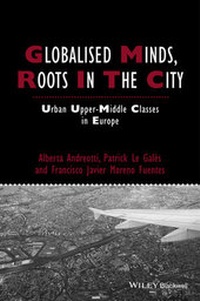
Globalised Minds, Roots in the City
Description

* Presents new empirical evidence collected through an originalcomparative research about professionals and managers in fourEuropean cities in three countries
* Features an innovative combination of approaches, methods, andtechniques in its analyses of European post-national societies
* Reveals how segments of Europe's urban populationare adopting "exit" or "partial exit"strategies in respect to the nation state
* Utilises approaches from classic urban sociology, globalizationand mobility studies, and spatial class analysis
* Includes in depth interviews, social networking techniques, andclassic questions of political representation and values
More details
Other editions
Additional editions
Persons
Patrick Le Galès is CNRS Research Professor ofPolitics and Sociology at Sciences Po Paris, Centred'études Européennes and Co-Chair of the"Cities Are Back in Town" research group.
Francisco Javier Moreno Fuentes is Research Fellow at theInstitute of Public Goods and Policies (IPP-CSIC).
Content
Introduction (pages 1-14)
Chapter 1 Comparing Upper-Middle-Class Managers in Four Cities (pages 15-59)
Chapter 2 Managers in the City (pages 60-106)
Chapter 3 Three Ways of Living in a Globalised World (pages 107-148)
Chapter 4 Managers' Social Networks (pages 149-172)
Conclusion (pages 173-188)
Bibliography (pages 189-207)
Methodological Appendix (pages 208-212)
Questionnaire (pages 213-240)
Index (pages 241-245)
Preface
Comparative research is a fascinating endeavour, but it takes time to get funding, to work on categories, to understand each other's societies, to design a common questionnaire, to deal with the interpretation of quantitative and qualitative data in four cities in three countries, to visit and gain an understanding of 16 neighbourhoods, and to write with six hands in a common language that is not the mother tongue of any of us. With these preemptive justifications, we can see how the research and the book took eight years to be finished.
The research started at Sciences Po when Alberta Andreotti and Francisco Javier Moreno Fuentes spent some time as post-docs within the European Research and Training Network UrbEurope financed by the EU. It was led by Enzo Mingione and Yuri Kazepov and brought together seven universities. Enzo and Yuri have always encouraged us during the research and drafting of the book, providing critical comments at different stages of the process.
Together with François Bonnet, at that time a promising PhD candidate, we worked on a project that was initially financed by the research branch of the French ministry of infrastructure, the Plan Urbanisme Construction Architecture. We acknowledge the support of Anne Querrien, Evelyne Perrin, Nicole Rousier and most crucially François Menard, for their support, the funds, the seminars they run and their interest in our research. The first analyses of the data came out as a Plan Urbanisme Construction Architecture report in 2008 (Les cadres supérieurs et la globalisation, Mobilité, ancrage, ségrégation et exit partiel dans les villes européennes. Une enquête exploratoire). The report was written with the help of François Bonnet and the support of Odile Gautier-Voituriez, who helped in many respects. Gina Sandanassamy was, as usual, great in helping us deal with managing the budget.
On top of these European and French funds, we aggregated various sources of money from Consejo Superior de Investigaciones Científicas (CSIC) in Madrid, from Milan-Bicocca and from Sciences Po, where our research group 'Cities are back in town' benefited from the resources made available by Bruno Latour and the administrative infrastructure from the Centre d'Etudes Européennes. We thank Bruno Latour, Renaud Dehousse and the Centre d'Etudes Européennes's administrative staff, Linda Amrani, Sophie Jacquot, Samia Saadi and Katia Rio, for their help. Francisco Javier Moreno Fuentes and Patrick Le Galès obtained some resources from the Picasso Spanish-French research cooperation scheme, and we thank them profusely for this as well. We also thank our colleagues and staff at Institute of Public Goods and Policies at the CSIC in Madrid, as well as at the department of Sociology of the university of Milan-Bicocca for support and insights. Patrick Le Galès also acknowledges the support of the Max Planck Institute for the Study of Societies in Cologne. Final revisions of chapters were carried out while he was a scholar in Residence in Cologne at the invitation of Jens Beckert and Wolfgang Streeck.
Our first thanks goes to the 480 managers from four different cities in three different countries who kindly agreed to spend some of their scarce time talking to us about their personal and professional trajectories, and often reflecting with us about life and its complexities. Without their availability and generosity, this research would not have been possible.
Carrying out nearly 500 face-to-face interviews requires quite a bit of logistics, and it was only thanks to the help of many colleagues and institutions who collaborated, in one way or another, in this project that it was at all possible. Viviane Le Hay was central to helping us design the quantitative part of the research, and the framework for the data analysis, while Alberta Andreotti remained in charge of the design of the network analysis. Vincent Tiberj checked questions on values and made the connections with European Social Survey surveys. Patrick Le Galès started the initial stages of the research by designing the questionnaire with Alberta Andreotti and François Bonnet for the Parisian case. He supervised the Paris case and worked in Le Vésinet. Alberta Andreotti conducted the interviews in the 10th arrondissement of Paris, while Brigitte Fouilland, in charge of the urban masters at Sciences Po, worked in the 15th arrondissement. Charlotte Halpern and Julie Pollard dealt with the 17th arrondissement. Barbara De Roit and Stefania Sabatinelli (who came to Paris as PhD candidates and post-docs also within the Research and Training Network-UrbEurope project) both conducted interviews in Fontenay Sous Bois. Mathieu Zagrodski helped to complete some interviews and coded a large part of the survey data. In Lyon, François Bonnet led a team of young researchers in conducting the interviews. We also like to thank Hugo Bertillot (Sciences Po) for the interviews in this city.
The research in Milan was performed under the supervision of Alberta Andreotti, and several people collaborated very actively in the process of generating the interviews in that city. Thus, Chiara Respi conducted the interviews in Vimercate; Mariagrazia Gambardella, Roberta Bosisio, Marco Pizzoni and Laura Boschetti conducted the interviews in the city centre of Milan and Lorenteggio; and Adele Falbo together with Alessandra Armellin conducted the interviews in Arese. We thank the Fondazione Bignaschi for logistic and administrative support during this process. We would also like to thank ManagerItalia, and in particular Marisa Montegiove and Gianpaolo Bossini, for their help in finding managers to interview. The alumni association of the Politecnico di Milano, the Comune di Milano (in particular Maria Luisa Cavallazzi), the Attività Educative e Supporto Pedagogico, Settore Servizi all'Infanzia and the General Director of the Comune di Vimercate all helped us in different ways and capacities in the complex process of finding managers to include in our sample.
The case study of Madrid was carried out by Francisco Javier Moreno Fuentes, with the support of a group of young colleagues who conducted interviews with managers from the four neighbourhoods included in this case. Thus, María José Mateo Risueño, Pilar Moreno Vera, María Garrote de Marcos and José Fernández Núñez conducted a series of interviews, and 'Andaira', a cooperative of sociologists (including Ariadna de la Rubia Rodríguez, Nuria Sánchez Díaz and Beatriz Garde Lobo), conducted another big chunk of interviews. As in the other cases, contacting managers that would fit the profile we were searching for, and who would be willing to participate in this initiative, constituted one of the biggest challenges of the research. In this respect, the collaboration of a series of institutions was central. We must particularly thank the alumni association of the ESADE Business School, the alumni association of the La Caixa scholarships and the Colegio de Ingenieros de Caminos, Canales y Puertos of Madrid. They did a great job at mobilising their members and asking for volunteers to participate in this initiative, a call to which many of their members generously answered.
In addition to being a close friend and a wonderful intellectual colleague, Edmond Préteceille provided us with early and crucial methodological and theoretical advice, and inspired us with his great typology of neighbourhoods in Paris. He is one of the most sophisticated comparative urban sociologists of the time, and it has been a luxury to count on his support. The project was also very much influenced by a rich interaction and intellectual exchange with Michael Savage. His book Globalisation and Belonging, written together with Bagnall and Longhurst, has been a constant source of inspiration and reference for us. While he was a Visiting Professor at Sciences Po, at the same time that Alberta and Francisco Javier were there, his comments were very important for the launch of the project. We published our first piece about this research in the book Networked Urbanism he edited with Talja Blockland.
Tim Butler, has been a constant intellectual support for this project, and he shared with us his questionnaires, his data on London, many references, good ideas and jokes. As a regular Visiting Professor at Sciences Po from King's College London, where he is normally based, he, more than anybody else, has witnessed the ups and downs of this project. Adrian Favell, then at UCLA, was another source of intellectual inspiration and support for us. His book 'Eurostars and Eurocities' constitutes, in many ways, the other side of the coin of the social phenomenon we are studying, so we greatly benefited from discussions with him about methods, references and concepts to develop our research. Now at Sciences Po, Adrian has also greatly helped us during the final stages of writing the book.
Neil Fligstein and Juan Díez Medrano, together with Jurgen Gerhards, Ettore Recchi, Steffen Mau and Virginie Guiraudon, constitute a new generation of sociologist aiming at thinking and developing research about the making of elements of a European society, and they were a constant reference for us. We were fortunate to participate in some of their research endeavours, and to publish a chapter in Favell and Guiraudon's volume on the Sociology of the European Union.
Once a first draft of this book was completed, we asked a group of...
