

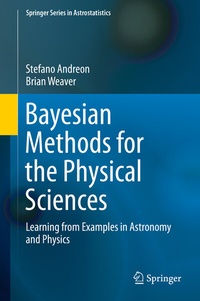
Bayesian Methods for the Physical Sciences
Description

Statistical literacy is critical for the modern researcher in Physics and Astronomy. This book empowers researchers in these disciplines by providing the tools they will need to analyze their own data. Chapters in this book provide a statistical base from which to approach new problems, including numerical advice and a profusion of examples. The examples are engaging analyses of real-world problems taken from modern astronomical research. The examples are intended to be starting points for readers as they learn to approach their own data and research questions. Acknowledging that scientific progress now hinges on the availability of data and the possibility to improve previous analyses, data and code are distributed throughout the book. The JAGS symbolic language used throughout the book makes it easy to perform Bayesian analysis and is particularly valuable as readers may use it in a myriad of scenarios through slight modifications.
This book is comprehensive, well written, and will surely be regarded as a standard text in both astrostatistics and physical statistics.
Joseph M. Hilbe, President, International Astrostatistics Association, Professor Emeritus, University of Hawaii, and Adjunct Professor of Statistics, Arizona State University
Reviews / Votes
"Andreon and Weaver . have written a book that could be a valuable component in the new Computational Data Analysis course. . Bayesian Methods for the Physical Sciences begins with basic probability calculus and introduces complex models and concepts as it goes along. . Most of the content is presented through real-world examples that could easily be adopted or adapted to new tasks." (David W. Hogg, Physics Today, Issue 6, June, 2016)
More details
Other editions
Additional editions
Persons
Stefano Andreon is an astronomer of the National Institute of Astrophysics, Brera Observatory (Milan, Italy). Stefano's research is focused on understanding the evolution of galaxies and of galaxy clusters, near and far, and adopting Bayesian methods. He also teaches Bayesian methods to PhD students of various Italian and French Universities, is a Member of the Executive Board of International Astrostatistics Association, and is first author of more than 50 referred papers.
Brian Weaver is a scientist with the Statistical Sciences group at Los Alamos National Laboratory. His research interests include Monte Carlo methods, parallel computing, Bayesian design of experiments, dynamic linear models, model calibration, and applying statistics to the physical and engineering sciences. He is a mentor to both graduate and undergraduate students in statistics at Los Alamos and is a recipient of the Llyod S. Nelson award.
