

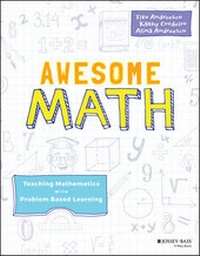
Awesome Math
Teaching Mathematics with Problem Based Learning
1st Edition
Published on 13. November 2019
288 pages
978-1-119-57571-9 (ISBN)
Description

Help your students to think critically and creatively through team-based problem solving instead of focusing on testing and outcomes.
Professionals throughout the education system are recognizing that standardized testing is holding students back. Schools tend to view children as outcomes rather than as individuals who require guidance on thinking critically and creatively. Awesome Math focuses on team-based problem solving to teach discrete mathematics, a subject essential for success in the STEM careers of the future. Built on the increasingly popular growth mindset, this timely book emphasizes a problem-solving approach for developing the skills necessary to think critically, creatively, and collaboratively.
In its current form, math education is a series of exercises: straightforward problems with easily-obtained answers. Problem solving, however, involves multiple creative approaches to solving meaningful and interesting problems. The authors, co-founders of the multi-layered educational organization AwesomeMath, have developed an innovative approach to teaching mathematics that will enable educators to:
* Move their students beyond the calculus trap to study the areas of mathematics most of them will need in the modern world
* Show students how problem solving will help them achieve their educational and career goals and form lifelong communities of support and collaboration
* Encourage and reinforce curiosity, critical thinking, and creativity in their students
* Get students into the growth mindset, coach math teams, and make math fun again
* Create lesson plans built on problem based learning and identify and develop educational resources in their schools
Awesome Math: Teaching Mathematics with Problem Based Learning is a must-have resource for general education teachers and math specialists in grades 6 to 12, and resource specialists, special education teachers, elementary educators, and other primary education professionals.
Professionals throughout the education system are recognizing that standardized testing is holding students back. Schools tend to view children as outcomes rather than as individuals who require guidance on thinking critically and creatively. Awesome Math focuses on team-based problem solving to teach discrete mathematics, a subject essential for success in the STEM careers of the future. Built on the increasingly popular growth mindset, this timely book emphasizes a problem-solving approach for developing the skills necessary to think critically, creatively, and collaboratively.
In its current form, math education is a series of exercises: straightforward problems with easily-obtained answers. Problem solving, however, involves multiple creative approaches to solving meaningful and interesting problems. The authors, co-founders of the multi-layered educational organization AwesomeMath, have developed an innovative approach to teaching mathematics that will enable educators to:
* Move their students beyond the calculus trap to study the areas of mathematics most of them will need in the modern world
* Show students how problem solving will help them achieve their educational and career goals and form lifelong communities of support and collaboration
* Encourage and reinforce curiosity, critical thinking, and creativity in their students
* Get students into the growth mindset, coach math teams, and make math fun again
* Create lesson plans built on problem based learning and identify and develop educational resources in their schools
Awesome Math: Teaching Mathematics with Problem Based Learning is a must-have resource for general education teachers and math specialists in grades 6 to 12, and resource specialists, special education teachers, elementary educators, and other primary education professionals.
More details
Other editions
Additional editions
Titu Andreescu | Kathy Cordeiro | Alina Andreescu
Awesome Math: Teaching Mathematics with Problem Based Learning
Teaching Mathematics with Problem Based Learning
Book
11/2019
1st Edition
Jossey-Bass
€26.50
Shipment within 15-20 days
Content
- Cover
- Title Page
- Contents
- Acknowledgments
- About the Authors
- Introduction
- Section I Why Problem Solving?
- Chapter 1 Rewards for Problem-Based Approach: Range, Rigor, and Resilience
- Range Ignites Curiosity
- Rigor Taps Critical Thinking
- Resilience Is Born Through Creativity
- Chapter 2 Maximize Learning: Relevance, Authenticity, and Usefulness
- Student Relevance
- Mathematical Relevance
- Mathematical Relevance: The Math Circle Example
- Curriculum Relevance
- Authenticity: The Cargo Cult Science Trap
- Authenticity in Learning
- Usefulness
- Chapter 3 Creating a Math Learning Environment
- Know Yourself: Ego and Grace
- Know Your Students
- Know Your Approach
- Chapter 4 What Is the Telos?
- Autonomy to Solve Your Problems
- Mastery Through Inquiry
- Purpose with Competitions
- Quadrants of Success
- Chapter 5 Gains and Pains with a Problem-Based Curriculum
- Teachers
- Students
- Parents
- Section II Teaching Problem Solving
- Chapter 6 Five Steps to Problem-Based Learning
- Start with Meaningful Problems
- Utilize Teacher Resources
- Provide an Active Learning Environment
- Understand the Value of Mistakes
- Recognize That Everyone Is Good at Math
- Chapter 7 The Three Cs: Competitions, Collaboration, Community
- Competitions
- Collaboration
- Community
- Aspire to Inspire: Stories from Awesome Educators
- Chapter 8 Mini-Units
- Relate/Reflect/Revise Questions
- Roman Numeral Problems
- Cryptarithmetic
- Squaring Numbers: Mental Mathematics
- The Number of Elements of a Finite Set
- Magic Squares
- Toothpicks Math
- Pick's Theorem
- Equilateral versus Equiangular
- Math and Chess
- Area and Volume of a Sphere
- Section III Full Units
- Chapter 9 Angles and Triangles
- Learning Objectives
- Definitions
- Angles and Parallel Lines
- Summary
- Chapter 10 Consecutive Numbers
- Learning Objectives
- Definitions
- Chapter 11 Factorials!
- Learning Objectives
- Definitions
- Chapter 12 Triangular Numbers
- Learning Objectives
- Definitions
- Chapter 13 Polygonal Numbers
- Learning Objectives
- Definitions
- Chapter 14 Pythagorean Theorem Revisited
- Learning Objectives
- Definitions
- Pythagorean Theorem
- Rectangular Boxes
- Euler Bricks
- Assessment Problems
- Chapter 15 Sequences
- Learning Objectives
- Definitions
- Introduce a Geometric Progression
- Chapter 16 Pigeonhole Principle
- Learning Objectives
- Definitions
- Chapter 17 Viviani's Theorems
- Learning Objectives
- Definition
- Chapter 18 Dissection Time
- Learning Objectives
- Definitions
- Chapter 19 Pascal's Triangle
- Learning Objective
- Summary
- Chapter 20 Nice Numbers
- Learning Objectives
- Definitions
- Index
- EULA
