

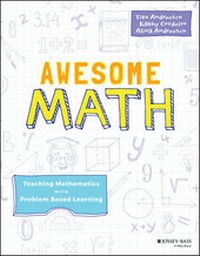
Awesome Math
Description

Professionals throughout the education system are recognizing that standardized testing is holding students back. Schools tend to view children as outcomes rather than as individuals who require guidance on thinking critically and creatively. Awesome Math focuses on team-based problem solving to teach discrete mathematics, a subject essential for success in the STEM careers of the future. Built on the increasingly popular growth mindset, this timely book emphasizes a problem-solving approach for developing the skills necessary to think critically, creatively, and collaboratively.
In its current form, math education is a series of exercises: straightforward problems with easily-obtained answers. Problem solving, however, involves multiple creative approaches to solving meaningful and interesting problems. The authors, co-founders of the multi-layered educational organization AwesomeMath, have developed an innovative approach to teaching mathematics that will enable educators to:
* Move their students beyond the calculus trap to study the areas of mathematics most of them will need in the modern world
* Show students how problem solving will help them achieve their educational and career goals and form lifelong communities of support and collaboration
* Encourage and reinforce curiosity, critical thinking, and creativity in their students
* Get students into the growth mindset, coach math teams, and make math fun again
* Create lesson plans built on problem based learning and identify and develop educational resources in their schools
Awesome Math: Teaching Mathematics with Problem Based Learning is a must-have resource for general education teachers and math specialists in grades 6 to 12, and resource specialists, special education teachers, elementary educators, and other primary education professionals.
More details
Other editions
Additional editions
Content
CHAPTER 1
Rewards for Problem-Based Approach: Range, Rigor, and Resilience
Range Ignites Curiosity
As educators, we understand the importance of depth and breadth in learning. For beginning piano players, listening to a concert pianist perform can ignite curiosity and inspire them to practice more. In mathematics, there seems to be a reticence to hear the symphony for fear that it will be too much, too soon, and by limiting the range, we limit curiosity and growth.
Our AwesomeMath Enrichment programs are filled with students whose schools placed a ceiling on their mathematics education and they are seeking outside resources. Sometimes, this is because the school is concerned that if students are accelerated too quickly, they won't have the maturity to truly understand what is being taught. Other times, the school is concerned that if students move two or three levels ahead, by the time they are seniors they will have run out of classes to take. Another common reason our parents provide is that the school thinks it will be too much information for the student at too young an age and will spoil their performance in future classes. With a problem-based curriculum, there is no ceiling on learning and there is ample depth and breadth of subjects to keep students challenged throughout their lifetime. The real danger of not giving students adequate challenge and range to satiate their curiosity is that they will turn off on mathematics and learning altogether. Students need to hear the beauty and art that is mathematics to kindle their joy of learning.
Why Is a Collaborative Problem-Based Approach Worthwhile?
Dr. Emily Herzig: Collaboration in the classroom has many benefits. Research has demonstrated that active learning improves performance on exams, and the effect is especially large for disadvantaged students. Currently, education is not equitably accessible to all students, with students from underserved populations and first-generation college students in particular facing additional obstacles to entering, navigating, and excelling in higher education. Thus, collaborative learning in the classroom could be key to closing the achievement gap and allowing capable but underprepared students to reach greater success in math.
Furthermore, a collaborative and problem-based approach gives younger students a more accurate impression of what higher-level math entails. Students too often carry the belief that success in math is based in rote memorization and drilling problems. While those skills are certainly useful for efficiently carrying out the basic mechanics of solving problems, it is equally important that students are able to formulate and interpret more complex problems, and work with their colleagues to develop and execute problem-solving strategies. Arguably, this process is also what makes math such an enticing subject. A focus on collaborative problem solving is a great way to attract students to and prepare them for careers in math.
Even the terms used for learning piano and learning mathematics are different: Students play piano and work on math problems. There needs to be a fundamental shift in approach and exposure to a range of problems that are harder and more interesting so that students can see where math can take them. So much of math education today is about waiting:
- Wait until high school, and then what you've been learning in middle school will be useful.
- Wait until college, and then what you've been learning in high school will be useful.
- Wait until you learn topic x before you can see the beauty of topic y or z or beyond.
- Wait until you learn a subject, like geometry, in isolation before you have the ability to learn how it connects and contributes to other areas such as algebra, engineering, art, science, etc.
And so on..
A mathematician, like a painter or poet, is a maker of patterns. If his patterns are more permanent than theirs, it is because they are made with ideas.
G.H. Hardy
Students need to work together to weave a pattern of ideas with what they know and can add more as their knowledge base grows. To fully appreciate the full tapestry of mathematics is not by adding one color of thread at a time, but weaving a picture with various thread colors within a group of learners who are just as excited by the beauty as you are.
Collaborative problem-based learning holds the key to unlocking abilities and mathematical growth. The collaboration nurtures interpersonal skills, leadership traits, and conflict resolution, while providing interesting problems gives students a common goal to work toward where they can connect and share ideas. Students can see the fun and beauty in mathematics, start to play, and see where math can take them long term.
A fun problem that works well in a group is the following:
- The diagram shows a polygon made by removing six 2 × 2 squares from the sides of an 8 × 12 rectangle. Find the perimeter of this polygon.
The answer is 60. The square removed from the lower-right corner of the rectangle does not change the perimeter of the polygon, but when each of the other five squares is removed, the perimeter is increased by 4. Thus, the perimeter of the polygon is 2 × 8 + 2 × 12 + 5 × 4 = 16 + 24 + 20 = 60.1
Students are allowed to be transported by a musical symphony before understanding individual notes, so why not provide the symphony of mathematics and introduce students to its wonders and challenges? Parents and educators will read books beyond a student's personal reading level so that they can hear the richness of language and be exposed to more intricate sentence structure. There are so many wonderful places an enriching math education can take you.
When educating young math students, you can let them know that they are the captains of their ship, but as their navigator, you can guide them to really interesting destinations and expose them to a wider range of mathematics.
Following are some ideas for increasing range in a mathematics program:
- Logic problems. Thinking through these problems primes the brain for mathematical reasoning.
- Combinatorics. This discrete mathematics field involves counting and probability.
- The mathematics of science. Solving, for example, real-world physics problems adds range and connectivity across academic disciplines.
- Mind benders and puzzles. These are a fun way to introduce mathematical concepts, such as magic squares.
- Game theory. Utilize mathematical modeling to understand the strategies employed by rational game players (decision makers).
- Computational linguistics. Apply computational analysis to language and speech for linguistic phenomena.
And so much more!
There is a world of mathematics to discover, and the playful pursuit will ignite their interest and provide them with the introspection to know their strengths and passions. Context while explaining mathematical concepts is also important, so it's not just range within the topic of mathematics but range outside the topic as well. Knowing the history and story of what they are learning makes a huge difference. Mathematical discoveries were made to solve real-life problems, and if students learn the story, they are more connected with the material.
For example, students will often ask, "When will I ever really need to use algebra?" It's easy to give them the F.U.D. answer (a marketing term that means Fear, Uncertainty, and Doubt to nudge consumers into decisions): "If you don't learn algebra, you won't do well on the SAT, and then you won't get into a good college." That's a lousy answer, and unfortunately is the message heard by many students, either directly or indirectly.
When running a mathematics club, a student asked this exact question, even though her mother had majored in math when she was in college. In response, she was assigned a one- to two-page paper and oral report on the importance of algebra, which, as you can imagine, wasn't initially well received. The paper needed to include:
- Research the story of algebra (why, how, and by whom was it created).
- Describe where algebra is used in life (why, how, and when it is necessary today).
- Explore how algebra would be helpful in her own life.
She was given the resources to get started, and then she knocked this assignment out of the ballpark. Her understanding deepened and her love for the topic, in turn, grew.
Below is an algebra problem that students can also use logic to figure out. These problems help engage the class and get them thinking!
I have two hourglass clocks filled with sand. One empties in 4 minutes, the other in 7 minutes. How can I use them to measure exactly 10 minutes?
Solution: Start both clocks at the same time. When the 4 minute timer runs out, start it again. When the 7 minute timer runs out, turn the 4 minute time over and it will run for the required extra 3 minutes.
(Math Leads for Mathletes, Book 2, page 48)
Providing a range in topics and connecting...
