

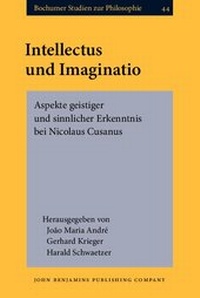
Intellectus und Imaginatio
Aspekte geistiger und sinnlicher Erkenntnis bei Nicolaus Cusanus
1st Edition
Published on 27. April 2006
VIII, 157 pages
978-90-272-8528-7 (ISBN)
Description

Dieser Band stellt einen Beitrag zum Verständnis geistiger und sinnlicher Erkenntnis bei Nicolaus Cusanus dar. Im Mittelpunkt stehen dabei die Begriffe intellectus und imaginatio, deren historischer und sachlicher Zusammenhang untereinander und ihr Verhältnis zu weiteren Aspekten der menschlichen Erkenntnis. Auf diese Weise steht im Ergebnis die Einheit und Ganzheit dieser Erkenntnis zur Debatte. Im Einzelnen geht es ebenso um eine Parallele zwischen Wilhelm von Ockham, Johannes Buridan und Cusanus in bezug auf den conceptus absolutus, um den kontemplativen Intellekt, die Metapher sowohl der "Mauer des Paradieses" als auch des Sehens, eine Kartographie des Erkennens, die Cusanische Symbolphilosophie, den Aspekt der Kreativität, die Musik sowie den Magnetismus und ein weiteres Beispiel zur Veranschaulichung der Funktion und Tragweite des imaginatio. Die Beiträge stammen aus der Feder sowohl anerkannter Cusanus-Interpreten als auch jüngere Forscher. Der Band bietet sowohl zahlreiche neue Gesichtspunkte für fruchtbare Auseinandersetzung mit dem Denken des Kardinals als auch ein Zeugnis für deren Lebendigkeit und Internationalität.
This book represents a contribution to the understanding of both intellectual and sensible cognition in Nicolaus Cusanus. Central to this account are the concepts of intellectus and imaginatio, their historical and factual connection and their relationship to other aspects of human cognition. In this way the unity and totality of this cognition is explored and discussed. In particular, points of comparison are outlined between William of Ockham, John Buridan and Cusanus in regard to the conceptus absolutus. Moreover, various issues are explored in light of these points of comparison. Among them are the contemplative intellect, the metaphors of the "wall of the Paradise" and of visio, a cartography of cognition, the Cusan philosophy of symbols, creativity, music and two examples of the function and the importance of imaginatio. The contributions to this book come from well-known interpreters of Cusanus and also younger scholars. In this way, this book offers both new perspectives on fruitful discussions of the thinking of Cusanus as well as evidence of the vivacity and original character of this discussion.
This book represents a contribution to the understanding of both intellectual and sensible cognition in Nicolaus Cusanus. Central to this account are the concepts of intellectus and imaginatio, their historical and factual connection and their relationship to other aspects of human cognition. In this way the unity and totality of this cognition is explored and discussed. In particular, points of comparison are outlined between William of Ockham, John Buridan and Cusanus in regard to the conceptus absolutus. Moreover, various issues are explored in light of these points of comparison. Among them are the contemplative intellect, the metaphors of the "wall of the Paradise" and of visio, a cartography of cognition, the Cusan philosophy of symbols, creativity, music and two examples of the function and the importance of imaginatio. The contributions to this book come from well-known interpreters of Cusanus and also younger scholars. In this way, this book offers both new perspectives on fruitful discussions of the thinking of Cusanus as well as evidence of the vivacity and original character of this discussion.
More details
Other editions
Additional editions
Joao M. André | Gerhard Krieger | Harald Schwaetzer
Intellectus und Imaginatio
Aspekte geistiger und sinnlicher Erkenntnis bei Nicolaus Cusanus
Book
04/2006
John Benjamins Publishing Co
€105.00
Shipment within 10-20 days
Persons
Content
- Intellectus und Imaginatio
- Editorial page
- Title page
- Copyright page
- Vorwort der Herausgeber
- Hinweise zur Nutzung des Bandes
- Table of contents
- I. Intellectus
- Conceptus absolutus. Zu einer Parallele zwischen Wilhelm von Ockham, Johannes Buridan und Nicolaus Cusanus
- Kontemplativer Intellekt in der Cusanischen Formel "Sis tu tuus et ego ero tuus
- Die Metapher der "Mauer des Paradieses" und die Kartographie des Erkennens bei Nikolaus von Kues
- Intellekt und Imagination in Cusanus' Trialogus de possest
- I. Der Trialog im Überblick
- II. Possest als Dreieinheit (n. 51)
- III. Die Bewegung (nn. 52-53)
- IV. Die IN-Spekulation (nn. 54-56)
- V. Proklos als Inspiration
- VI. Beurteilung der IN-Spekulation (n. 56)
- VII. Die E-Spekulation (n. 57)
- VIII. Das Bild (n. 58)
- IX. Die unendliche Linie (n. 59)
- X. Geometrisches Änigma: Flächenverwandlung (nn. 60-61)
- II. Imaginatio
- Die methodische Begründung der Cusanischen Symbolphilosophie Zum systematischen Verhältnis von imaginatio und visio
- 1. Problemstellung
- 2. Imaginatio im Werk des Cusanus
- 2.1. Die rationale Imagination als adäquate imago der visio
- 2.2. Das Verhältnis von imaginatio zu oculus mentis
- 2.3. Die Überwindung des Bildes im Bild: De visione Dei
- 3. Zusammenfassung
- Imagination als Kreativität nach Nicolaus Cusanus Walter Haug zum 75. Geburtstag
- Einleitung: Von der rezeptiven Imagination des Mittelalters zur produktiven Imagination der Neuzeit
- I. Die klassische Einordnung der Imagination im Aufbau der Erkenntniskräfte
- II. Der Aufstieg der Sinne in die Imagination als Abstieg des Intellekts zu den Sinnen
- III. Die Imagination als Moment der kreishaften Selbstverwirklichungs-Bewegung des Intellekts
- IV. Die Gotteserkenntnis als Potential des menschlichen Intellekts und ihre Verwirklichung mittels der Imagination
- V. Imagination als Kreativität
- VI. Die Cusanischen Aenigmata als imaginative Selbstvermittlungen der Kreativität des Intellekts
- VII. Die Weiterwirkung des Cusanischen Imaginationskonzeptes im neuzeitlichen Gedanken des kreativen Künstlers
- Zusammenfassung
- Funktion und Tragweite der imaginatio bei Cusanus - ein konkretes Beispiel
- I. Verwendung verschiedener Figuren und Metaphern im Cusanischen Denken
- II. Stellung und Bedeutung der Vorstellungskraft bei Cusanus
- III. Der Berg Christi
- IV. Die Cusanische Imaginationslehre als ,Imitatio Christi'
- "Im Anfang war der Magnetismus". Ein Beispiel für Imagination im Sermo CCXII des Nikolaus von Kues
- I. Einführung
- II. Das Bild des Magneten
- 3. Abschließende Überlegungen
- Die Metapher des Sehens bei Nikolaus von Kues
- Nikolaus von Kues über Musik
- Namenregister
- Autorenverzeichnis Kurzbiographien und -bibliographien
- The series Bochumer Studien zur Philosophie
