

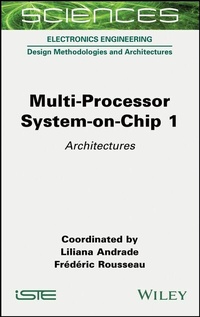
Multi-Processor System-on-Chip 1
Architectures
1st Edition
Published on 12. March 2021
320 pages
978-1-119-81827-4 (ISBN)
Description

A Multi-Processor System-on-Chip (MPSoC) is the key component for
complex applications. These applications put huge pressure on memory,
communication devices and computing units. This book, presented in
two volumes Architectures and Applications therefore celebrates the
20th anniversary of MPSoC, an interdisciplinary forum that focuses on
multi-core and multi-processor hardware and software systems. It is this
interdisciplinarity which has led to MPSoC bringing together experts in
these fields from around the world, over the last two decades.
Multi-Processor System-on-Chip 1 covers the key components of
MPSoC: processors, memory, interconnect and interfaces. It describes
advance features of these components and technologies to build
efficient MPSoC architectures. All the main components are detailed:
use of memory and their technology, communication support and
consistency, and specific processor architectures for general purposes
or for dedicated applications.
complex applications. These applications put huge pressure on memory,
communication devices and computing units. This book, presented in
two volumes Architectures and Applications therefore celebrates the
20th anniversary of MPSoC, an interdisciplinary forum that focuses on
multi-core and multi-processor hardware and software systems. It is this
interdisciplinarity which has led to MPSoC bringing together experts in
these fields from around the world, over the last two decades.
Multi-Processor System-on-Chip 1 covers the key components of
MPSoC: processors, memory, interconnect and interfaces. It describes
advance features of these components and technologies to build
efficient MPSoC architectures. All the main components are detailed:
use of memory and their technology, communication support and
consistency, and specific processor architectures for general purposes
or for dedicated applications.
More details
Other editions
Additional editions
Book
07/2021
1st Edition
ISTE Ltd
€164.50
Shipment within 3-4 weeks
Software
03/2021
Wiley
€172.10
No shipping information available
Persons
Liliana Andrade is Associate Professor at TIMA Lab, Universite Grenoble
Alpes in France. She received her PhD in Computer Science,
Telecommunications and Electronics from Universite Pierre et Marie
Curie in 2016. Her research interests include system-level
modeling/validation of systems-on-chips, and the acceleration of
heterogeneous systems simulation.
Frederic Rousseau is Full Professor at TIMA Lab, Universite Grenoble
Alpes in France. His research interests concern Multi-Processor
Systems-on-Chip design and architecture, prototyping of
hardware/software systems including reconfigurable systems and highlevel synthesis for embedded systems.
Alpes in France. She received her PhD in Computer Science,
Telecommunications and Electronics from Universite Pierre et Marie
Curie in 2016. Her research interests include system-level
modeling/validation of systems-on-chips, and the acceleration of
heterogeneous systems simulation.
Frederic Rousseau is Full Professor at TIMA Lab, Universite Grenoble
Alpes in France. His research interests concern Multi-Processor
Systems-on-Chip design and architecture, prototyping of
hardware/software systems including reconfigurable systems and highlevel synthesis for embedded systems.
Content
- Cover
- Half-Title Page
- Dedication
- Title Page
- Copyright Page
- Contents
- Foreword
- Acknowledgments
- PART 1: Processors
- 1 Processors for the Internet of Things
- 1.1. Introduction
- 1.2. Versatile processors for low-power IoT edge devices
- 1.2.1. Control processing, DSP and machine learning
- 1.2.2. Configurability and extensibility
- 1.3. Machine learning inference
- 1.3.1. Requirements for low/mid-end machine learning inference
- 1.3.2. Processor capabilities for low-power machine learning inference
- 1.3.3. A software library for machine learning inference
- 1.3.4. Example machine learning applications and benchmarks
- 1.4. Conclusion
- 1.5. References
- 2 A Qualitative Approach to Many-core Architecture
- 2.1. Introduction
- 2.2. Motivations and context
- 2.2.1. Many-core processors
- 2.2.2. Machine learning inference
- 2.2.3. Application requirements
- 2.3. The MPPA3 many-core processor
- 2.3.1. Global architecture
- 2.3.2. Compute cluster
- 2.3.3. VLIW core
- 2.3.4. Coprocessor
- 2.4. The MPPA3 software environments
- 2.4.1. High-performance computing
- 2.4.2. KaNN code generator
- 2.4.3. High-integrity computing
- 2.5. Conclusion
- 2.6. References
- 3 The Plural Many-core Architecture - High Performance at Low Power
- 3.1. Introduction
- 3.2. Related works
- 3.3. Plural many-core architecture
- 3.4. Plural programming model
- 3.5. Plural hardware scheduler/synchronizer
- 3.6. Plural networks-on-chip
- 3.6.1. Scheduler NoC
- 3.6.2. Shared memory NoC
- 3.7. Hardware and software accelerators for the Plural architecture
- 3.8. Plural system software
- 3.9. Plural software development tools
- 3.10. Matrix multiplication algorithm on the Plural architecture
- 4 ASIP-Based Multi-Processor Systems for an Efficient Implementation of CNNs
- 4.1. Introduction
- 4.2. Related works
- 4.3. ASIP architecture
- 4.4. Single-core scaling
- 4.5. MPSoC overview
- 4.6. NoC parameter exploration
- 4.7. Summary and conclusion
- 4.8. References
- PART 2: Memory
- 5 Tackling the MPSoC DataLocality Challenge
- 5.1. Motivation
- 5.2. MPSoC target platform
- 5.3. Related work
- 5.4. Coherence-on-demand: region-based cache coherence
- 5.4.1. RBCC versus global coherence
- 5.4.2. OS extensions for coherence-on-demand
- 5.4.3. Coherency region manager
- 5.4.4. Experimental evaluations
- 5.4.5. RBCC and data placement
- 5.5. Near-memory acceleration
- 5.5.1. Near-memory synchronization accelerator
- 5.5.2. Near-memory queue management accelerator
- 5.5.3. Near-memory graph copy accelerator
- 5.5.4. Near-cache accelerator
- 5.6. The big picture
- 5.7. Conclusion
- 5.8. Acknowledgments
- 5.9. References
- 6 mMPU: Building a Memristor-based General-purpose In-memory Computation Architecture
- 6.1. Introduction
- 6.2. MAGIC NOR gate
- 6.3. In-memory algorithms for latency reduction
- 6.4. Synthesis and in-memory mapping methods
- 6.4.1. SIMPLE
- 6.4.2. SIMPLER
- 6.5. Designing the memory controller
- 6.6. Conclusion
- 6.7. References
- 7 Removing Load/Store Helpers in Dynamic Binary Translation
- 7.1. Introduction
- 7.2. Emulating memory accesses
- 7.3. Design of our solution
- 7.4. Implementation
- 7.4.1. Kernel module
- 7.4.2. Dynamic binary translation
- 7.4.3. Optimizing our slow path
- 7.5. Evaluation
- 7.5.1. QEMU emulation performance analysis
- 7.5.2. Our performance overview
- 7.5.3. Optimized slow path
- 7.6. Related works
- 7.7. Conclusion
- 7.8. References
- 8 Study and Comparison of Hardware Methods for Distributing Memory Bank Accesses in Many-core Architectures
- 8.1. Introduction
- 8.1.1. Context
- 8.1.2. MPSoC architecture
- 8.1.3. Interconnect
- 8.2. Basics on banked memory
- 8.2.1. Banked memory
- 8.2.2. Memory bank conflict and granularity
- 8.2.3. Efficient use of memory banks: interleaving
- 8.3. Overview of software approaches
- 8.3.1. Padding
- 8.3.2. Static scheduling of memory accesses
- 8.3.3. The need for hardware approaches
- 8.4. Hardware approaches
- 8.4.1. Prime modulus indexing
- 8.4.2. Interleaving schemes using hash functions
- 8.5. Modeling and experimenting
- 8.5.1. Simulator implementation
- 8.5.2. Implementation of the Kalray MPPA cluster interconnect
- 8.5.3. Objectives and method
- 8.5.4. Results and discussion
- 8.6. Conclusion
- 8.7. References
- PART 3: Interconnect and Interfaces
- 9 Network-on-Chip (NoC): The Technology that Enabled Multi-processor Systems-on-Chip (MPSoCs)
- 9.1. History: transition from buses and crossbars to NoCs
- 9.1.1. NoC architecture
- 9.1.2. Extending the bus comparison to crossbars
- 9.1.3. Bus, crossbar and NoC comparison summary and conclusion
- 9.2. NoC configurability
- 9.2.1. Human-guided design flow
- 9.2.2. Physical placement awareness and NoC architecture design
- 9.3. System-level services
- 9.3.1. Quality-of-service (QoS) and arbitration
- 9.3.2. Hardware debug and performance analysis
- 9.3.3. Functional safety and security
- 9.4. Hardware cache coherence
- 9.4.1. NoC protocols, semantics and messaging
- 9.5. Future NoC technology developments
- 9.5.1. Topology synthesis and floorplan awareness
- 9.5.2. Advanced resilience and functional safety for autonomous vehicles
- 9.5.3. Alternatives to von Neumann architectures for SoCs
- 9.5.4. Chiplets and multi-die NoC connectivity
- 9.5.5. Runtime software automation
- 9.5.6. Instrumentation, diagnostics and analytics for performance, safety and security
- 9.6. Summary and conclusion
- 9.7. References
- 10 Minimum Energy Computing via Supply and Threshold Voltage Scaling
- 10.1. Introduction
- 10.2. Standard-cell-based memory for minimum energy computing
- 10.2.1. Overview of low-voltage on-chip memories
- 10.2.2. Design strategy for areaand energy-efficient SCMs
- 10.2.3. Hybrid memory design towards energyand area-efficient memory systems
- 10.2.4. Body biasing as an alternative to power gating
- 10.2. Standard-cell-based memory for minimum energy computing
- 10.3. Minimum energy point tracking
- 10.3.1. Basic theory
- 10.3.2. Algorithms and implementation
- 10.3.3. OS-based approach to minimum energy point tracking
- 10.4. Conclusion
- 10.5. Acknowledgments
- 10.6. References
- 11 Maintaining Communication Consistency During Task Migrations in Heterogeneous Reconfigurable Devices
- 11.1. Introduction
- 11.1.1. Reconfigurable architectures
- 11.1.2. Contribution
- 11.2. Background
- 11.2.1. Definitions
- 11.2.2. Problem scenario and technical challenges
- 11.3. Related works
- 11.3.1. Hardware context switch
- 11.3.2. Communication management
- 11.4. Proposed communication methodology in hardware context switching
- 11.5. Implementation of the communication management on reconfigurable computing architectures
- 11.5.1. Reconfigurable channels in FIFO
- 11.5.2. Communication infrastructure
- 11.6. Experimental results
- 11.6.1. Setup
- 11.6.2. Experiment scenario
- 11.6.3. Resource overhead
- 11.6.4. Impact on the total execution time
- 11.6.5. Impact on the context extract and restore time
- 11.6.6. System responsiveness to context switch requests
- 11.6.7. Hardware task migration between heterogeneous FPGAs
- 11.7. Conclusion
- 11.8. References
- List of Authors
- Author Biographies
- Index
- EULA
