

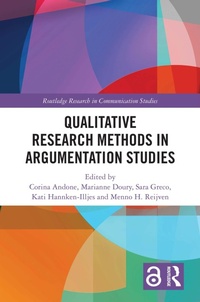
Qualitative Research Methods in Argumentation Studies
1st Edition
Published on 10. December 2025
220 pages
978-1-040-52436-7 (ISBN)
Description

This book explores the core principles, related theories, and conventions of qualitative research methods within the field of argumentation studies.
In each chapter, contributors identify, contextualize, and offer solutions to various issues that a qualitative researcher in argumentation is likely to encounter. In doing so, the book provides a set of guidelines, instruments, and recommendations that enable readers to effectively conduct research and analyze arguments. Furthermore, the book presents discussions of the ethics, validity, and reliability of qualitative research methods as well as the intersections between qualitative and quantitative approaches. Looking to the future, chapters explore what the field could learn from other disciplines and how research could better integrate alternative data sources.
Providing a detailed outline of qualitative data analysis and interpretation, this book will be of interest to scholars and students in the fields of argumentation studies, communication studies, rhetoric, and linguistics.
The Open Access version of this book, available at www.taylorfrancis.com, has been made available under a Creative Commons Attribution-Non Commercial-No Derivatives (CC-BY-NC-ND) 4.0 license.
In each chapter, contributors identify, contextualize, and offer solutions to various issues that a qualitative researcher in argumentation is likely to encounter. In doing so, the book provides a set of guidelines, instruments, and recommendations that enable readers to effectively conduct research and analyze arguments. Furthermore, the book presents discussions of the ethics, validity, and reliability of qualitative research methods as well as the intersections between qualitative and quantitative approaches. Looking to the future, chapters explore what the field could learn from other disciplines and how research could better integrate alternative data sources.
Providing a detailed outline of qualitative data analysis and interpretation, this book will be of interest to scholars and students in the fields of argumentation studies, communication studies, rhetoric, and linguistics.
The Open Access version of this book, available at www.taylorfrancis.com, has been made available under a Creative Commons Attribution-Non Commercial-No Derivatives (CC-BY-NC-ND) 4.0 license.
Reviews / Votes
"This collective volume is a highly recommendable contribution to the qualitative study of argumentation. It thoroughly explores theoretical and methodological problems of qualitative argumentation research. To these problems, this innovative book delivers promising answers. Of course, the respective strengths of qualitative and quantitative methods can also be combined, as some contributions to the volume plausibly show."Manfred Kienpointner, University of Innsbruck, Austria
"Wisely distancing themselves from a dichotomous qualitative/quantitative divide, the authors explore how these two methods can be combined in argumentation research on concrete issues, from reconstructing arguments to ethical issues, from norms, to persuasion, to visual argument and guidelines for data collection."
Christian Plantin, Research Director at Centre National de la Recherche Scientifique, France
More details
Series
Edition
1. Auflage
Language
English
Place of publication
London
United Kingdom
Publishing group
Taylor & Francis Ltd
Target group
College/higher education
Professional and scholarly
Illustrations
1 Tables, black and white; 8 Line drawings, black and white; 8 Illustrations, black and white
File size
2,98 MB
ISBN-13
978-1-040-52436-7 (9781040524367)
Copyright in bibliographic data and cover images is held by Nielsen Book Services Limited or by the publishers or by their respective licensors: all rights reserved.
Schweitzer Classification
Other editions
Additional editions
Corina Andone | Marianne Doury | Sara Greco
Qualitative Research Methods in Argumentation Studies
Book
approx. 12/2025
1st Edition
Routledge
€207.60
Not yet published
Persons
Corina Andone is an Assistant Professor of Language and Communication and a Senior Researcher at the Amsterdam Centre for Language and Communication (ACLC) at the University of Amsterdam, the Netherlands.
Marianne Doury is a Professor in the Language Sciences Department at Paris Cite University, France.
Sara Greco is a Professor of Argumentation and Director of the Institute of Argumentation, Linguistics and Semiotics (IALS) at USI Universita della Svizzera italiana, Switzerland.
Kati Hannken-Illjes is a Professor for Speech Communication at The Philipps University of Marburg, Germany.
Menno Reijven is an Assistant Professor of Argumentation and Communication at the University of Amsterdam, the Netherlands.
Marianne Doury is a Professor in the Language Sciences Department at Paris Cite University, France.
Sara Greco is a Professor of Argumentation and Director of the Institute of Argumentation, Linguistics and Semiotics (IALS) at USI Universita della Svizzera italiana, Switzerland.
Kati Hannken-Illjes is a Professor for Speech Communication at The Philipps University of Marburg, Germany.
Menno Reijven is an Assistant Professor of Argumentation and Communication at the University of Amsterdam, the Netherlands.
Content
1. Descriptive and Analytical Qualitative Research of Argumentative Discourse 2. Theoretical Concepts and Argumentative Practice 3. Grappling with the Descriptive and Normative Dimension of Argumentation 4. Developing Corpora through Data-Mining for Qualitative Argumentation Research 5. A Cognitive Framework for the Analysis of Argumentation 6. Studying Argumentation as Social Interaction 7. Approaching Social Media Argumentation from a Linguistics-Informed Perspective: Methodological Aspects 8. Analyzing the Linguistic Dimension of Argumentative Texts 9. Analysing Multimodal Argumentation: Theoretical and Methodological Considerations 10. Considering Argumentation in Context 11. Political Discourse and Argumentation: Qualitative Approaches 12. The Ethics of Qualitative Research in Argumentation
