

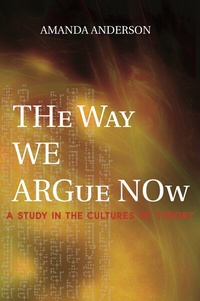
The Way We Argue Now
A Study in the Cultures of Theory
1st Edition
Published on 10. January 2009
224 pages
978-1-4008-2682-7 (ISBN)
Description

How do the ways we argue represent a practical philosophy or a way of life? Are concepts of character and ethos pertinent to our understanding of academic debate? In this book, Amanda Anderson analyzes arguments in literary, cultural, and political theory, with special attention to the ways in which theorists understand ideals of critical distance, forms of subjective experience, and the determinants of belief and practice. Drawing on the resources of the liberal and rationalist tradition, Anderson interrogates the limits of identity politics and poststructuralism while holding to the importance of theory as a form of life.
Considering high-profile trends as well as less noted patterns of argument, The Way We Argue Now addresses work in feminism, new historicism, queer theory, postcolonialism, cosmopolitanism, pragmatism, and proceduralism. The essays brought together here--lucid, precise, rigorously argued--combine pointed critique with an appreciative assessment of the productive internal contests and creative developments across these influential bodies of thought.
Ultimately, The Way We Argue Now promotes a revitalized culture of argument through a richer understanding of the ways critical reason is practiced at the individual, collective, and institutional levels. Bringing to the fore the complexities of academic debate while shifting the terms by which we assess the continued influence of theory, it will appeal to readers interested in political theory, literary studies, cultural studies, gender studies, and the place of academic culture in society and politics.
Considering high-profile trends as well as less noted patterns of argument, The Way We Argue Now addresses work in feminism, new historicism, queer theory, postcolonialism, cosmopolitanism, pragmatism, and proceduralism. The essays brought together here--lucid, precise, rigorously argued--combine pointed critique with an appreciative assessment of the productive internal contests and creative developments across these influential bodies of thought.
Ultimately, The Way We Argue Now promotes a revitalized culture of argument through a richer understanding of the ways critical reason is practiced at the individual, collective, and institutional levels. Bringing to the fore the complexities of academic debate while shifting the terms by which we assess the continued influence of theory, it will appeal to readers interested in political theory, literary studies, cultural studies, gender studies, and the place of academic culture in society and politics.
All prices
More details
Other editions
Additional editions
Book
11/2005
Princeton University Press
€76.88
Article exhausted; check different version
Book
11/2005
Princeton University Press
€35.20
Shipment within 10-20 days
Person
Amanda Anderson is the Caroline Donovan Professor of English Literature and Department Chair at Johns Hopkins University. Her books include The Powers of Distance: Cosmopolitanism and the Cultivation of Detachment (Princeton) and Tainted Souls and Painted Faces: The Rhetoric of Fallenness in Victorian Culture.
Content
Acknowledgments ix
Introduction 1
Part I. Critical Practices
Chapter 1: Debatable Performances: Restaging Contentious Feminisms 21
Chapter 2: The Temptations of Aggrandized Agency: Feminist Histories and the Horizon of Modernity 46
Part II. Living Universalism
Chapter 3: Cosmopolitanism, Universalism, and the Divided Legacies of Modernity 69
Chapter 4: Realism, Universalism, and the Science of the Human 93
Part III. Ethos and Argument
Chapter 5: Pragmatism and Character 115
Chapter 6: Argument and Ethos 134
Chapter 7: Beyond Sincerity and Authenticity 161: The Ethos of Proceduralism
Index 189
Introduction 1
Part I. Critical Practices
Chapter 1: Debatable Performances: Restaging Contentious Feminisms 21
Chapter 2: The Temptations of Aggrandized Agency: Feminist Histories and the Horizon of Modernity 46
Part II. Living Universalism
Chapter 3: Cosmopolitanism, Universalism, and the Divided Legacies of Modernity 69
Chapter 4: Realism, Universalism, and the Science of the Human 93
Part III. Ethos and Argument
Chapter 5: Pragmatism and Character 115
Chapter 6: Argument and Ethos 134
Chapter 7: Beyond Sincerity and Authenticity 161: The Ethos of Proceduralism
Index 189

