

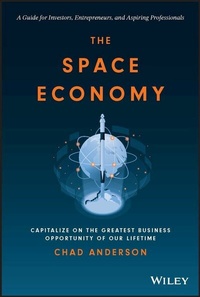
The Space Economy
Description

The new Space Age has already begun, but there is still time for you to get in early. In The Space Economy: Capitalize on the Greatest Business Opportunity of Our Lifetime, accomplished venture capitalist and Space Capital founder Chad Anderson offers investors, entrepreneurs, and aspiring professionals powerful tools and information for understanding how space-based technologies have, and will continue to, transform enterprise, government, and consumer markets for decades to come. Whether you're seeking entrepreneurial ideas worth exploring, a career worth pursuing, or investments worth making, the burgeoning Space Economy represents a hidden opportunity larger than the nascent internet at the dawn of the Millennium. From global positioning, geospatial intelligence, and satellite communications to commercial human spaceflight and interplanetary transportation, this book explains how and why the space economy is the greatest opportunity of our lifetime.
Readers will learn:
* How to develop a thesis for investing in innovation at a global scale
* The major and minor players in a business ecosystem of epic potential--and how to identify and exploit vast areas of blue-sky opportunity still unexplored
* Lessons from entrepreneurs and investors on what it takes to thrive in this new arena, including case studies of exciting startups successfully leveraging space-based technology
* In-depth advice on hiring and retaining out-of-this-world talent in an increasingly competitive landscape
* The in-demand skills and aptitudes of space careers--and tips on networking and getting hired at the hottest companies
* Deep dives into the legal, political, and diplomatic implications of space-based entrepreneurship
A fascinating and accessible treatment of the latest, greatest, and most promising area of business opportunity since the internet, The Space Economy will be essential reading for anyone interested in seizing a brighter future.
More details
Other editions
Additional editions
Person
Content
Introduction xi
1 Space Is the Next Big Thing: To See the Future of Your Job, Your Investments, and the Economy, Look Up 1
2 Mapping the Space Economy: Understanding the Ecosystem and Its Key Players 23
3 Chief Orbital Officer: Profiles in Space Economy Entrepreneurship 49
4 No Overhead: How and Why to Start a Business in the Space Economy 73
5 Charting a Trajectory: Co- founders, Customers, and Capital 91
6 From Apollo to SpaceX and Beyond: The Fall and Rise of American Space Ambitions and the Future of Public-Private Partnerships 109
7 Buy Low, Sell Very High: Investing in the Space Economy 133
8 Navigating Space Careers: Seizing the Opportunity of a Lifetime 145
9 Winning the War for Talent: A Guide to Recruiting and Retaining "The Right Stuff" 165
10 The Future of the Space Economy: What Happens When Orbit Is Cheap, Easy, and Safe? 181
Conclusion 203
Notes 207
About the Author 215
Index 217
Introduction
If you're reading this, you probably have the sneaking suspicion that something big is on the horizon. You may even have glimpsed a harbinger of this coming change: small, low-Earth orbit (LEO) satellites swooping across the sky, parts of the rapidly growing satellite constellations powering the global economy to a greater extent each day.
We use the term Space Economy to encompass every business that relies on orbital access to deliver its value, from Planet Labs,* a company imaging every inch of the ground from space on a daily basis, to Pokémon GO, a hit mobile game that works using GPS signals from satellites.
(An asterisk will mark the first appearance of any company Space Capital has previously invested in.)
For all the media coverage of SpaceX* and its iconoclastic founder, Elon Musk, commercial launch services are just the beginning of the story. The Space Economy is much more than rockets and satellite hardware. Space-based technologies are next-generation digital infrastructure, the "invisible backbone" of the largest global industries. Most people have yet to grasp the genuine, world-changing business implications of lower-cost orbital access. CNBC has called space "Wall Street's next trillion-dollar industry."1 Bank of America predicts that "the growing space economy will more than triple in size in the next decade to become a $1.4 trillion market."2 Morgan Stanley expects a space-based business to create the world's first trillionaire.3
Humanity has operated in space for decades, but, for reasons covered in Chapter 1, only recently has space become a category for investment. Given that this entrepreneurial space age is only a decade old, most of the action is still in the private markets, but we're beginning to see some companies listed on public markets where retail investors can participate. If you think back to the late 1990s, there were a handful of publicly traded technology stocks. Seemingly overnight, "technology" became an investable category to diversify your portfolio. Today, that label has lost its meaning. Every company is a technology company. Space is in the same position that tech was then. One day, "space" as a label will lose its usefulness as every company begins to rely on space-based technology in some way to deliver value.
Space technologies have already delivered massive returns for investors. GPS is a space-based technology that has generated trillions of dollars in economic value, as well as some of the largest venture outcomes in history. As we'll see in Chapter 1, GPS provides a useful playbook for understanding how other space-based technologies will create new investment opportunities across the economy. Two of these-Geospatial Intelligence and Satellite Communications-already play critical roles in most major industries, including agriculture, logistics, telecom, and financial services.
There was a time when terms like "e-commerce" and "blog" began appearing regularly in magazines and nightly news shows. At the time, these bits of unfamiliar lingo were whimsical curiosities to the mainstream, newfangled phenomena relevant to teens, scientists, oddballs, and geeks but of only momentary interest to everyone else. How soon the internet changed things-as much for magazines and news shows as for every other business. Few people understood the scope of that onrushing change, let alone how to harness its potential. Of those who did, you know more than a handful, from Reid Hoffman (Netflix) to Jeff Bezos (Amazon) to, once again, Elon Musk (PayPal).
Chances are a warning bell has been going off in your mind about all the recent interest and activity in space. While you may know something noteworthy is happening, the full implications are still hard to see. This book will give you the lens you need.
Let's say you're a serial entrepreneur, or that you're entertaining the notion of starting something of your own. As a founder, why risk entrepreneurship if you're not going to shoot, literally, for the Moon? Or, at least, in that general direction? Even if you already see the opportunity in this rapidly growing market, however, you have questions: For all the investment capital flooding into the Space Economy, is there any interest in what I can offer? Do I have the necessary qualifications? Do I need a background in avionics or engineering? Should I have worked at NASA first? Will I need to bring a personal fortune to the table, as Elon Musk did with his proceeds from selling PayPal?
The answer to all these questions is a resounding no, but these concerns and others will be addressed in detail here.
Likewise, you may be an investor curious about the potential of these new businesses and industries but unsure how to measure their value-or weigh their risks. How much of this stuff is really happening, as in, likely to turn a profit over the next few years? And which of these new businesses are still Star Trek, not 60 Minutes, despite the assurances of scientists and entrepreneurs? Investors have heard a lot of hype from space "experts" over the last few years. This book will help you separate fact from science fiction.
We're at an inflection point. What's actually happening in space is more astonishing and otherworldly than all the breathless promises of the space crazies, the wild-eyed talking heads who keep promising a Starbucks on Mars by early next year. Fifty years ago, the first glimmers of a global computer network containing all the world's knowledge attracted scant public interest. Meanwhile, jetpacks inspired awe and wonder even though people regularly flew on airplanes. Would jetpacks really have been more important than the World Wide Web? Of course not. To the average person in 1973, however, jetpacks were easier to understand. The same goes for the genuine potential of today's Space Economy. It's more difficult to grasp than the idea of a Mars-based latte, but it's well worth the effort of doing so.
To succeed as an investor in any category, you need to understand not only fundamentals like profit and loss but also the lay of the land where you plan to allocate your resources: the companies and their customers. The markets and the major players. Consider this book your manual and your map. As investors and operators, the team at Space Capital brings a unique combination of in-house technical expertise, entrepreneurial experience, and an investment track record to the table. There is no predicting the future, but some guesses are far more grounded than others. Read on for ours.
If you're not an entrepreneur or an investor yourself, you may be a professional seeking a role in the Space Economy. In fact, you may already be working in a space-related industry, anywhere from incumbent defense contractors to new heavyweights like SpaceX and Planet Labs to one of the many space startups that have been founded over the last few years alone. As a leader, manager, or frontline employee, you will find a wealth of valuable information here, including lessons and advice from CEOs, veteran space industry professionals, space policy experts, visionary technologists, and more. The diversity of perspectives this book provides will give you an unparalleled look at the big picture, along with many actionable takeaways.
***
Here I go, making big promises about the future, just like all those people preselling caffeine on the Red Planet. Why take my word on any of this?
After managing a $50-billion real estate portfolio through the Great Recession, I decided to seek a greater purpose than investment banking. I wanted to make a genuine, lasting impact on the world. Drawn by its Skoll Center for Social Entrepreneurship, I went to Oxford University to earn my MBA at the Saïd Business School. There, I had the opportunity to learn from the brilliant economic sociologist Marc Ventresca.
Ventresca, an authority on technological innovation and market formation, taught me all about the nascent markets that spring up from innovative breakthroughs like the car, the PC, and the mobile phone. In Ventresca's class, I learned what nascent markets look like and how they evolve. Just before I matriculated at Oxford, on May 24, 2012, SpaceX had successfully delivered cargo to the International Space Station (ISS) aboard its Dragon capsule, a first in commercial spaceflight. It would be hard to imagine a more fortuitous piece of serendipity: Learning about market formation, I could see recent evidence of the birth of a bona fide new market.
By successfully completing its ISS cargo mission, SpaceX had done the unthinkable, achieving a feat previously restricted to three world superpowers. Where things went next seemed obvious to me. Market competition would increase efficiency and decrease prices. More and more businesses would be able to participate in the Space Economy. All kinds of unforeseen products and services would crop up. Fortunes would be made (and lost).
At the time, I felt certain I couldn't be the only person who saw a market forming. SpaceX wasn't operating in secret, after all. Musk delighted in trumpeting every milestone on social media. As early as 2003, he declared an unambiguous parallel between space and the internet: "I like to be involved in things that change the world. The Internet did, and space will probably be more responsible...
