

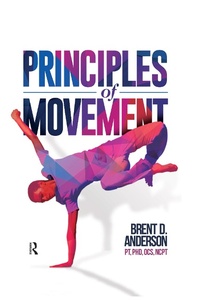
Principles of Movement
1st Edition
Published on 1. June 2024
224 pages
978-1-040-14195-3 (ISBN)
Description

From the founder of Polestar Pilates, Principles of Movement is a practical resource guide on movement science for movement practitioners, therapists, and anyone looking for a practical and easy approach to assess, facilitate, and enhance movement.
With applications in physical therapy, occupational therapy, athletic training, kinesiology, physical education, Pilates training, yoga training, dance education, and more, Principles of Movement is designed to help the movement practitioner improve the quality of their practice by better understanding the integrated model of movement assessment and movement facilitation. The text focuses on how to facilitate the quality of movement-not just the quantity.
Author Dr. Brent Anderson draws upon his 30 years of experience in rehabilitation and movement science, showing the strong correlation between motor control and biomechanics, and integrating new work on fascia, pain interpretation, and behavioral elements associated with movement. Principles of Movement is designed to facilitate problem solving and movement enhancement through a deeper understanding of universal movement principles.
What's included in Principles of Movement:
* How to harness tools such as breath, mobility, dynamic alignment, control, and coordination to improve movement efficiency and performance, minimize injuries, and increase personal satisfaction through successful movement experiences without pain
* Examples, practical applications, and teaching tips for movement practitioners
* A guide to critical reasoning that applies the Principles of Movement algorithm to exercise selection and treatment planning
* Teaching aids and applications that can be immediately integrated into practice, including verbal, tactile, and imagery cueing
Principles of Movement provides students and practitioners alike with a framework to evaluate, facilitate, and optimize the quality of movement.
With applications in physical therapy, occupational therapy, athletic training, kinesiology, physical education, Pilates training, yoga training, dance education, and more, Principles of Movement is designed to help the movement practitioner improve the quality of their practice by better understanding the integrated model of movement assessment and movement facilitation. The text focuses on how to facilitate the quality of movement-not just the quantity.
Author Dr. Brent Anderson draws upon his 30 years of experience in rehabilitation and movement science, showing the strong correlation between motor control and biomechanics, and integrating new work on fascia, pain interpretation, and behavioral elements associated with movement. Principles of Movement is designed to facilitate problem solving and movement enhancement through a deeper understanding of universal movement principles.
What's included in Principles of Movement:
* How to harness tools such as breath, mobility, dynamic alignment, control, and coordination to improve movement efficiency and performance, minimize injuries, and increase personal satisfaction through successful movement experiences without pain
* Examples, practical applications, and teaching tips for movement practitioners
* A guide to critical reasoning that applies the Principles of Movement algorithm to exercise selection and treatment planning
* Teaching aids and applications that can be immediately integrated into practice, including verbal, tactile, and imagery cueing
Principles of Movement provides students and practitioners alike with a framework to evaluate, facilitate, and optimize the quality of movement.
More details
Edition
1. Auflage
Language
English
Place of publication
London
United Kingdom
Publishing group
Taylor & Francis Ltd
Target group
College/higher education
Professional and scholarly
ISBN-13
978-1-040-14195-3 (9781040141953)
Copyright in bibliographic data and cover images is held by Nielsen Book Services Limited or by the publishers or by their respective licensors: all rights reserved.
Schweitzer Classification
Other editions
Additional editions
Brent Anderson
Principles of Movement
Book
12/2023
1st Edition
SLACK Incorporated
€95.00
Shipment within 3-4 weeks
Person
Brent D. Anderson, PT, PhD, OCS, NCPT is a licensed physical therapist and orthopedic certified specialist who has practiced physical therapy for more than 30 years. In 1989, he received his degree in physical therapy from the University of California San Francisco and completed his studies in the Pilates method with Elizabeth Larkam at the Center for Sports Medicine at Saint Francis Memorial Hospital in San Francisco, California. He continued to learn from first- and second-generation Pilates teachers, including Eve Gentry, Carola Trier, Ron Fletcher, Romana Kryzanowska, Kathy Grant, Lolita San Miguel, Mary Bowen, Jean-Claude West, and Alan Herdman.
After graduating, Dr. Anderson moved back to his hometown, Sacramento, California, and started practicing physical therapy; he embarked on a journey filled with continual learning and practice. Several years later, the then-Chair of the Department of Physical Therapy and Rehabilitation Science at the University of California San Francisco, Dr. Nancy N. Byl, PT, MPH, PhD, FAPTA, encouraged him to seek his doctoral degree.
In 1997, Dr. Anderson moved to Miami to pursue his doctoral degree at the University of Miami. It was there that he met his lifelong professional friend and mentor, Dr. Carol M. Davis, DPT, EdD, MS, FAPTA. His doctoral dissertation focused on chronic low back pain and the comparison of active vs passive intervention, as well as the comparison of behavioral vs physical measures and their ability to predict outcomes. In 2005, Dr. Anderson completed his doctorate in physical therapy at the University of Miami.
Dr. Anderson's professional studies did not stop there. His professional growth continued with years of intense manual therapy training and practice combined with more than 30 years of dance medicine and Pilates education, myofascial studies with Dr. Davis, and personal investigation and practice of energy medicine and meditation. His unique skill set has allowed him to create an exciting and holistic approach to health and well-being.
Dr. Anderson is the founder and CEO of Polestar, one of the leading Pilates education companies in the world. At the time of printing, Polestar has provided Pilates education and teacher training in more than 60 countries and in 15 languages since 1992. Dr. Anderson was involved in the development of the Pilates Method Alliance (PMA) Pilates Certification Program and the PMA Certification Examination and served on the PMA (now the National Pilates Certification Program) Certification Commission.
Dr. Anderson has become a renowned lecturer at national and international symposia and consults with physical therapists, dance companies, universities, and other educational bodies throughout the world. He is a leading authority in performing arts medicine, Pilates for rehabilitation, pain management through movement, and spine health. He is currently an assistant professor at the University of St. Augustine for Health Sciences, and serves on the board of directors for the School of the Arts for Boys Academy and Bgood.org, a community-empowering organization. He has served as president of the Performing Arts Special Interest Group of the orthopaedic section of the American Physical Therapy Association and is the past chairman of the board of directors for Shake-a-Leg Miami.
After graduating, Dr. Anderson moved back to his hometown, Sacramento, California, and started practicing physical therapy; he embarked on a journey filled with continual learning and practice. Several years later, the then-Chair of the Department of Physical Therapy and Rehabilitation Science at the University of California San Francisco, Dr. Nancy N. Byl, PT, MPH, PhD, FAPTA, encouraged him to seek his doctoral degree.
In 1997, Dr. Anderson moved to Miami to pursue his doctoral degree at the University of Miami. It was there that he met his lifelong professional friend and mentor, Dr. Carol M. Davis, DPT, EdD, MS, FAPTA. His doctoral dissertation focused on chronic low back pain and the comparison of active vs passive intervention, as well as the comparison of behavioral vs physical measures and their ability to predict outcomes. In 2005, Dr. Anderson completed his doctorate in physical therapy at the University of Miami.
Dr. Anderson's professional studies did not stop there. His professional growth continued with years of intense manual therapy training and practice combined with more than 30 years of dance medicine and Pilates education, myofascial studies with Dr. Davis, and personal investigation and practice of energy medicine and meditation. His unique skill set has allowed him to create an exciting and holistic approach to health and well-being.
Dr. Anderson is the founder and CEO of Polestar, one of the leading Pilates education companies in the world. At the time of printing, Polestar has provided Pilates education and teacher training in more than 60 countries and in 15 languages since 1992. Dr. Anderson was involved in the development of the Pilates Method Alliance (PMA) Pilates Certification Program and the PMA Certification Examination and served on the PMA (now the National Pilates Certification Program) Certification Commission.
Dr. Anderson has become a renowned lecturer at national and international symposia and consults with physical therapists, dance companies, universities, and other educational bodies throughout the world. He is a leading authority in performing arts medicine, Pilates for rehabilitation, pain management through movement, and spine health. He is currently an assistant professor at the University of St. Augustine for Health Sciences, and serves on the board of directors for the School of the Arts for Boys Academy and Bgood.org, a community-empowering organization. He has served as president of the Performing Arts Special Interest Group of the orthopaedic section of the American Physical Therapy Association and is the past chairman of the board of directors for Shake-a-Leg Miami.
Content
Dedication Acknowledgments About the Author Preface Foreword by Carol M. Davis, DPT, EdD, MS, FAPTA Introduction Photo Credits Chapter 1 Introduction to Principles of Movement Chapter 2 Qualitative Versus Quantitative Movement Chapter 3 Breath Chapter 4 Mobility Chapter 5 Alignment Chapter 6 Control Chapter 7 Movement Integration Chapter 8 Applications of the Principles of Movement and Conclusion Appendix 8-1: The Polestar Assessment Tool (PAT) Index
