

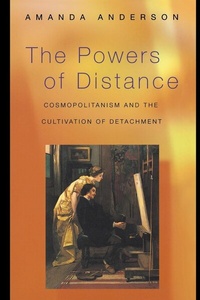
The Powers of Distance
Cosmopolitanism and the Cultivation of Detachment
1st Edition
Published on 19. November 2018
208 pages
978-0-691-18806-5 (ISBN)
Description

Combining analysis of Victorian literature and culture with forceful theoretical argument, The Powers of Distance examines the progressive potential of those forms of cultivated detachment associated with Enlightenment and modern thought. Amanda Anderson explores a range of practices in nineteenth-century British culture, including methods of objectivity in social science, practices of omniscience in artistic realism, and the complex forms of affiliation in Victorian cosmopolitanism. Anderson demonstrates that many writers--including George Eliot, John Stuart Mill, Charlotte Brontë, Matthew Arnold, and Oscar Wilde--thoughtfully address the challenging moral questions that attend stances of detachment. In so doing, she offers a revisionist account of Victorian culture and a tempered defense of detachment as an ongoing practice and aspiration.
The Powers of Distance illuminates its historical object of study and provides a powerful example for its theoretical argument, showing that an ideal of critical detachment underlies the ironic modes of modernism and postmodernism as well as the tradition of Enlightenment thought and critical theory. Its broad understanding of detachment and cultivated distance, together with its focused historical analysis, will appeal to theorists and critics across the humanities, particularly those working in literary and cultural studies, feminism, and postcolonialism. Original in scope and thesis, this book constitutes a major contribution to literary history and contemporary theory.
The Powers of Distance illuminates its historical object of study and provides a powerful example for its theoretical argument, showing that an ideal of critical detachment underlies the ironic modes of modernism and postmodernism as well as the tradition of Enlightenment thought and critical theory. Its broad understanding of detachment and cultivated distance, together with its focused historical analysis, will appeal to theorists and critics across the humanities, particularly those working in literary and cultural studies, feminism, and postcolonialism. Original in scope and thesis, this book constitutes a major contribution to literary history and contemporary theory.
More details
Other editions
Additional editions
Book
08/2001
Princeton University Press
€36.70
Shipment within 10-20 days

Book
08/2001
Princeton University Press
€71.80
Article exhausted; check different version
Person
Amanda Anderson is Professor of English at The Johns Hopkins University and the author of Tainted Souls and Painted Faces: The Rhetoric of Fallenness in Victorian Culture.
Content
- Cover
- Title Page
- Copyright Page
- Contents
- Acknowledgments
- INTRODUCTION: Forms of Detachment
- CHAPTER ONE: Gender, Modernity, and Detachment
- Domestic Ideals and the Case of Charlotte Bronte's Villette
- CHAPTER TWO: Cosmopolitanism in Different Voices
- Charles Dickens's Little Dorrit and the Hermeneutics of Suspicion
- CHAPTER THREE: Disinterestedness as a Vocation
- CHAPTER FOUR: The Cultivation of Partiality
- CHAPTER FIVE: "Manners Before Morals
- Oscar Wilde and Epigrammatic Detachment
- CONCLUSION: The Character of Theory
- Bibliography
- Index
