

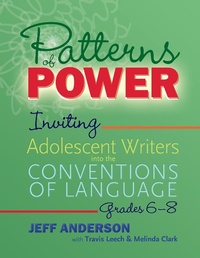
Patterns of Power, Grades 6-8
Inviting Adolescent Writers into the Conventions of Language
1st Edition
Published on 10. October 2023
448 pages
978-1-003-83297-3 (ISBN)
Description

Authors Jeff Anderson, Travis Leech, and Melinda Clark lead a vibrant approach to grammar instruction in Patterns of Power, Grades 6-8: Inviting Adolescent Writers into the Conventions of Language. Here, young, emergent writers are invited to notice the conventions of the English language and build off them in this inquiry-based approach to instructional grammar. The book comes with standards-aligned lessons that can be incorporated in just 10 minutes a day. Patterns of Power's responsive, invitational approach puts students in an involved role and has them explore and discuss the purpose and meaning of what they read. Students study short, authentic texts and are asked to share their findings out loud, engaging in rich conversations to make meaning. Inside you'll find:
Ready-to-use lesson plan sets that include excerpts from authentic and diverse mentor texts curated for grades 6-8
Real-life classroom examples, tips, and Power Notes gleaned from the authors' experiences that can be applied to any level of writer
Resources, including a Patterns of Power Planning Guide and musical soundtracks, to use in classroom instruction or as handouts for student literacy notebooks
Patterns of Power, Grades 6-8 provides a simple classroom routine that is structured in length and approach, but provides teachers flexibility in choosing the texts, allowing for numerous, diverse voices in the classroom. The practice helps students build cognitive recognition and provides a formative assessment for teachers on student progress. With these short lessons, students will gain confidence and move beyond limitation to produce effortless writing in your class and beyond. The Patterns of Power series also includes Patterns of Power, Grades 1-5: Inviting Young Writers into the Conventions of Language; Patterns of Power en Espanol, Grades 1-5: Inviting Bilingual Writers into the Conventions of Spanish; Patterns of Power, Grades 9-12: Teaching Grammar Through Reading and Writing; and Patterns of Wonder, Grades PreK-1: Inviting Emergent Writers to Play with the Conventions of Language.
Ready-to-use lesson plan sets that include excerpts from authentic and diverse mentor texts curated for grades 6-8
Real-life classroom examples, tips, and Power Notes gleaned from the authors' experiences that can be applied to any level of writer
Resources, including a Patterns of Power Planning Guide and musical soundtracks, to use in classroom instruction or as handouts for student literacy notebooks
Patterns of Power, Grades 6-8 provides a simple classroom routine that is structured in length and approach, but provides teachers flexibility in choosing the texts, allowing for numerous, diverse voices in the classroom. The practice helps students build cognitive recognition and provides a formative assessment for teachers on student progress. With these short lessons, students will gain confidence and move beyond limitation to produce effortless writing in your class and beyond. The Patterns of Power series also includes Patterns of Power, Grades 1-5: Inviting Young Writers into the Conventions of Language; Patterns of Power en Espanol, Grades 1-5: Inviting Bilingual Writers into the Conventions of Spanish; Patterns of Power, Grades 9-12: Teaching Grammar Through Reading and Writing; and Patterns of Wonder, Grades PreK-1: Inviting Emergent Writers to Play with the Conventions of Language.
Reviews / Votes
"For years, students have been handed sets of "I said so" rules as the standard means of learning language conventions. Patterns of Power moves beyond prescriptive rules to offer a series of steps that, instead, help students to recognize and internalize language conventions in a way that makes them better readers, writers, listeners, and speakers. Notice the patterns in sentences. Compare them with others. Try them yourself. Apply them. Edit them. I love how this book teaches students to really think about language."-Kelly Gallagher
"Patterns of Power will free you from the tyranny of old school grammar instruction and show you a process to guide adolescents toward joyful exploration and experimentation of crafting, creating, and conveying meaning. Whether you're a grammar "phobe" or an expert sentence diagrammer, you will love this book."
-Cris Tovani
"In a Patterns of Power classroom, the conventions of language become possibilities. Here, rules are replaced by invitations as our "wired to be inspired" middle school learners engage in honest inquiry, asking themselves and each other What can this convention do for me as a writer?"
-Lisa Thibodeaux, Director of Secondary Curriculum, TX
"Jeff Anderson is going to make me return to teaching middle school English Language Arts. This is the kind of book that would have made me feel like I could provide concrete, meaningful writing instruction to my students. I am grateful, however, that as an administrator I have the power to put this tool in the hands of all my teachers and allow the work of these authors to reach thousands of students."
-Chad Everett, Middle School Principal
"Patterns of Power, 6-8 is a must-have for every teacher who longs to get their adolescents hooked on grammar. It gives middle grade teachers a simple, student-centered process that showcases what grammatical patterns do for readers and writers and how they lead to stellar writing."
-Jodi Ramos, Middle School Teacher, Department Chair, and New York Times education contributor
"Jeff Anderson, Travis Leech, and Melinda Clark have crafted a gift for middle school literacy teachers and their students. Patterns of Power, 6-8 provides abundant lesson ideas for engaging student readers and writers in ways that improve comprehension, communication and self-expression, as well as a deeper look at why this approach works. Through students' observations of authentic texts and focused exploration of writers' craft and language use, you can increase their reading and writing confidence and skill. Clear, empowering, and effective!"
-Donalyn Miller, Texas educator and author
More details
Edition
1. Auflage
Language
English
Place of publication
London
United Kingdom
Publishing group
Taylor & Francis Ebooks
Target group
Professional and scholarly
ISBN-13
978-1-003-83297-3 (9781003832973)
Copyright in bibliographic data and cover images is held by Nielsen Book Services Limited or by the publishers or by their respective licensors: all rights reserved.
Schweitzer Classification
Other editions
Additional editions
Jeff Anderson | Travis Leech | Melinda Clark
Patterns of Power, Grades 6-8
Inviting Adolescent Writers into the Conventions of Language
Book
03/2021
1st Edition
Stenhouse Publishers
€73.50
Shipment within 3-4 weeks
Persons
For over thirty years, Jeff Anderson has inspired writers and teachers of grades K-8 with the power and joy of the writing and grammar. He has written eight books for Stenhouse Publishers. He also writes middle-grade novels.
Travis Leech, coauthor of Patterns of Power: Inviting Adolescent Writers into the Conventions of Language, is currently a middle school instructional coach in Northside Independent School District in San Antonio, TX. He has thirteen years of experience in education, including teaching middle school English Language Arts and as a gifted and talented specialist. He has presented about engaging literacy practices and technology integration at the district, regional, and state levels.
Melinda Clark, coauthor of Patterns of Power: Inviting Adolescent Writers into the Conventions of Language, is currently the Academic Program Coordinator at John Jay High School in San Antonio, Texas. She has 31 years experience in education, including teaching middle school and high school English Language Arts, instructional coaching, independent consulting, and presenting at the district, regional, and state levels.
Travis Leech, coauthor of Patterns of Power: Inviting Adolescent Writers into the Conventions of Language, is currently a middle school instructional coach in Northside Independent School District in San Antonio, TX. He has thirteen years of experience in education, including teaching middle school English Language Arts and as a gifted and talented specialist. He has presented about engaging literacy practices and technology integration at the district, regional, and state levels.
Melinda Clark, coauthor of Patterns of Power: Inviting Adolescent Writers into the Conventions of Language, is currently the Academic Program Coordinator at John Jay High School in San Antonio, Texas. She has 31 years experience in education, including teaching middle school and high school English Language Arts, instructional coaching, independent consulting, and presenting at the district, regional, and state levels.
Content
Introduction; Part 1: Getting Started with the Patterns of Power Process; 1: Into Planning: What Do You Need to Do Before Teaching the Invitations?; 2: Into the Classroom: How Do You Teach Conventions with the Invitation Process?; 3: Into Application: How Do You Nudge Writers to Apply Conventions?; Part 2: Into the Lessons with the Patterns of Power Process; 4: How Do Writers and Readers Use SENTENCES?; 5: Why Do Writers and Readers Need COMPOUND SENTENCES?; 6: How Do Writers and Readers Use COMPLEX SENTENCES?; 7: How Do Writers and Readers Use PHRASES and CLAUSES?; 8: What Does the MOOD of a VERB Do for Writers and Readers?; 9: How Do Writers and Readers Use VERBALS?; 10: What Does PUNCTUATION Do for Writers and Readers?; 11: What Do PRONOUNS Do for Writers and Readers?; 12: How do Writers and Readers Continue Using CAPITALIZATION?; 13: What Other Amazing Things Can Writers and Readers Do?; Conclusion
