

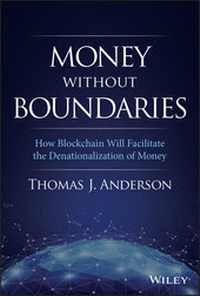
Money Without Boundaries
Description

More details
Other editions
Additional editions
Content
Preface
"All money is a matter of belief."
- Adam Smith
Money Without Boundaries is about the creation of a new global currency. Unlike traditional currencies, such as the dollar, yen, or euro, this currency strives to be a risk-free store of value. And unlike bitcoin, which tethers to a finite number of units, this store of value tethers to zero risk. As a result, it is constrained not by an arbitrary number of units, but by market forces of supply and demand.
The foundational ideas are not new and are not unique. A privately controlled, market-based currency striving for zero risk is arguably the holy grail of multiple influential thinkers and Nobel laureates and the basis for many monetary and investment theories. What is new is that advancements in capital markets, when combined with new technologies, make it possible for society to facilitate old ideas in new ways. Money Without Boundaries is about bringing some of the greatest economic theories to reality. This book is a bridge connecting old ideas to new technologies.
The Paradox of Money
If you've studied any economics, you're probably familiar with the concept that money has three different roles in society:
- A unit of value (how much something costs)
- A medium of exchange (a way to transact)
- A store of value (a safe place to store your earnings)
For as important as money is in our society, these concepts are surprisingly abstract. What, exactly, is a dollar, a euro, or a yen? Why can't anyone, from my friends to economic commentators, agree about whether gold is valuable or worthless? Is bitcoin a bubble waiting to crash, or is it the future of money? And what about other cryptocurrencies?
This is a paradox beyond paradoxes. People not only work hard for and fight over, but also beg, steal, and cheat to obtain something that really is an abstract concept. The deeper I dive, the more I realize I have dedicated my career and studies to something that has a fundamentally flawed foundation. I came to realize I don't know what money is, that I can't truly define it. Explain to me, what, exactly, makes that piece of paper in your wallet or that digital figure in your online bank account something unique - something special?
Our inability to easily define "money" is in some ways thousands of years old and in some ways a relatively new phenomenon. Neither Julius Caesar, Christopher Columbus, George Washington, Abraham Lincoln, nor Franklin Roosevelt would have found the question "What is money?" all that challenging. In large part, this is because throughout much of time, money tied to a gold standard and as such the unit of value, medium of exchange, and store of value were all closely related. As recently as the 1920s, our dollars were in fact bearer notes, convertible into gold and silver. However, once the world cut the cord to that tether, we began to drift endlessly in an open sea, with no anchor and no clear path ahead. What was a relatively abstract concept increasingly became much more abstract. So, I began a personal quest to understand "money" in this new world.
"There is no answer in the available literature to the question why a government monopoly of the provision of money is universally regarded as indispensable.. It has the defects of all monopolies."
-Friedrich Hayek, Denationalisation of Money
"Underlying most arguments against the free market is a lack of belief in freedom itself."
-Milton Friedman
Breaking Down My Quest
There are hundreds of countries around the world with hundreds of corresponding currencies. Perhaps much like you, I have visited several of them. I've never had any concern about my ability to travel or my ability to quickly and easily convert my dollars into any unit of value when I do. People in different countries use different monies, which they exchange to buy things at different prices. These prices can be converted quickly and easily from one currency to another. There are good reasons that many, if not most, governments choose to create a common unit of value for their territory. The concept of a unit of value is simple enough and does not preoccupy me.
Similarly, I have traveled to many countries for a short period of time and put the vast majority of my expenses on my credit card. Cash is not needed much these days, and if it is, I can get it quickly and easily at an ATM most anywhere in the world. As such, I have no problem understanding that my primary medium of exchange is my credit card or my debit card, which I use to access cash and buy goods and services around the world. Here again, while there are some complexities behind the technologies that make this possible, the concept itself is simple enough. I have had no sleepless nights worrying if my credit card will work in Paris, Tokyo, or Tulum.
As I peeled back the onion, I realized the paradox for me - what keeps me up at night -has to do with money as a store of value. What is it that makes a certain currency valuable to a certain group of people? Why, exactly, is the $100 bill in my wallet worth more than the $5 bill? And what about when these pieces of paper move into the digital world as bits and bytes? What then, exactly, is in your checking account, and who, exactly, determines its value or purchasing power?
Equally importantly, I wanted to understand when and why the role of money breaks down in society. Throughout time, paper money has been valued one day and then, virtually the next day, wheelbarrows of cash are not enough for a simple trip to the grocery store. There are multiple examples of hyperinflations throughout the world - in this century - in which money as it was known became as worthless as trash, wiping out the savings of the people. Something so important should not be so fragile.
I had a goal of what I wanted to understand, but first I had to ask a more important question: If a risk-free store of value - a new "money" - could be created, does it matter, and would anybody care? My intuition said this is an important and timely topic, and after taking the deep dive, I'm increasingly confident that it does not matter, in the short term, to society, if money is a good store of value.
There are two reasons society generally cares little about the value of currency:
- It is generally viewed as a social construct upon which people believe they have little to no control.
- They are not incentivized to care because most people do not have much "money."
Most people have a view that large and complex systems are simply out of their control. Bystanders, we are. My view is that large, rigid social constructs are their own paradox, the hardest and easiest things to change. While some constructs, such as language, evolve over long periods of time, others, like empires, rise and then fall very quickly. I believe a revolution is underfoot and this rigid construct of a government monopoly on money will change, and when the change takes place, it will happen quickly. This is in part facilitated by new technologies that add considerable value to society, which are being adapted at stunningly fast rates.
The second point is more nuanced. The basis of people's lack of incentive to care about money is a function of perspective, depending on whether they're spenders or savers. While some people, and some societies, save at high rates, most people rely on income (from a job, a pension, or Social Security), which they primarily consume month to month. Globally, most people live paycheck to paycheck. If people spend most of the money they earn, they likely don't see why they would need to worry about money as a store of value. In the United States, a relatively wealthy society, as much as 78 percent of people live paycheck to paycheck, and the majority saves less than $100 per month, according to a survey conducted by Career Builder.1
Not only does the majority of the population live paycheck to paycheck, but they also have some form of debt. According to the same Career Builder survey, 71 percent of all US workers are in debt.2 Because of these debts, "money" as a store of value is viewed negatively when netted against credit cards, student loans, car loans, mortgages, and most other forms of debt. Typically, money is a holding that destroys value because, in most cases, borrowers earn less on their money than their cost of borrowing. Borrowers are generally seeking to be debt free more than they are seeking a safe store of value.
Few people live primarily off of their savings, though there are some. I confidently, and naively, thought this group must care about "money" as a store of value. However, I cannot find much evidence that a risk-free store of value or even the value of the dollar remaining high is on their list of concerns. Statistical data suggests this group tends to hold little "money" as a percentage of their overall net worth. They tend to convert what was "money" into other assets like stocks, bonds, real estate - you name it - everything except "money." Those who do hold large amounts of "money" tend to do so as a part of a broader strategy such as going to "cash" in anticipation of being able to buy other assets at a lower price in the future.
Individuals who hold...
