

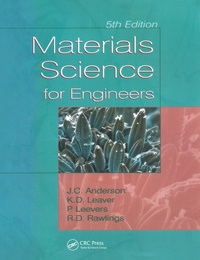
Materials Science for Engineers
5th Edition
Published on 1. June 2004
678 pages
978-0-203-50262-4 (ISBN)
Description

This fifth edition of a successful textbook continues to provide students with an introduction to the basic principles of materials science over a broad range of topics. The authors have revised and updated this edition to include many new applications and recently developed materials.
The book is presented in three parts. The first section discusses the physics, chemistry, and internal structure of materials. The second part examines the mechanical properties of materials and their application in engineering situations. The final section presents the electromagnetic properties of materials and their application. Each chapter begins with an outline of the relevance of its topics and ends with problems that require an understanding of the theory and some reasoning ability to resolve. These are followed by self-assessment questions, which test students' understanding of the principles of materials science and are designed to quickly cover the subject area of the chapter.
This edition of Materials Science for Engineers includes an expanded treatment of many materials, particulary polymers, foams, composites and functional materials. Of the latter, superconductors and magnetics have received greater coverage to account for the considerable development in these fields in recent years. New sections on liquid crystals, superalloys, and organic semiconductors have also been added to provide a comprehensive overview of the field of materials science.
The book is presented in three parts. The first section discusses the physics, chemistry, and internal structure of materials. The second part examines the mechanical properties of materials and their application in engineering situations. The final section presents the electromagnetic properties of materials and their application. Each chapter begins with an outline of the relevance of its topics and ends with problems that require an understanding of the theory and some reasoning ability to resolve. These are followed by self-assessment questions, which test students' understanding of the principles of materials science and are designed to quickly cover the subject area of the chapter.
This edition of Materials Science for Engineers includes an expanded treatment of many materials, particulary polymers, foams, composites and functional materials. Of the latter, superconductors and magnetics have received greater coverage to account for the considerable development in these fields in recent years. New sections on liquid crystals, superalloys, and organic semiconductors have also been added to provide a comprehensive overview of the field of materials science.
Reviews / Votes
"The whole book is an easy-to-read introduction into some of the most important and interesting parts of materials science. It focuses on the main issues and treats these in a clear and precise manner ... . A number of end-of-chapter problems and well-selected self-assessment questions (with answers) will enable students to test their understanding of the text ... . [Some] textbooks ... try to introduce microstructural characterization and micromechanical modelling at the undergraduate stage, but many statements ... turn out to be incorrect ... . This is what the present book carefully avoids and what might be a key to its success."- Materials World, Vol. 13, No. 7, July 2005
More details
Edition
5th New edition
Language
English
Place of publication
Baton Rouge
United States
Publishing group
Taylor & Francis Inc
Target group
College/higher education
Engineering Students and Professors
Edition type
New edition
ISBN-13
978-0-203-50262-4 (9780203502624)
Copyright in bibliographic data and cover images is held by Nielsen Book Services Limited or by the publishers or by their respective licensors: all rights reserved.
Schweitzer Classification
Other editions
Additional editions
J.C. Anderson | Keith D. Leaver | Rees D. Rawlings
Materials Science for Engineers
Book
06/2003
5th Edition
Nelson Thornes Ltd
€103.80
Shipment within 10-20 days
Persons
J.C. Anderson, Keith D. Leaver, Rees D. Rawlings, Patrick S. Leevers
Content
PART I: PHYSICS, CHEMISTRY AND STRUCTURE
The Basis of Materials Science
The Smallest Building Blocks: Electrons, Photons and Their Behaviour
The Simplest Atom: Hydrogen
Atoms with Many Electrons: The Periodic Table
Molecules and Interatomic Bonding
The Internal Structure of Crystals
Thermal Properties: Kinetic Theory, Phonons and Phase Changes
Crystal Defects
PART II: MECHANICAL PROPERTIES AND APPLICATIONS
Mechanical Properties
Phase Diagrams and Microstructure of alloys
Ceramics
Polymers and Plastics
Multiphase Materials and Composites
PART III: ELECTROMAGNETIC PROPERTEIES AND APPLICATIONS
Electrical Conduction in Metals
Semiconductors
Semiconductor Materials Processing
Magnetic Materials
Dielectric, Piezoelectric, Ferroelectric and Pyroelectric Materials
Optical Materials
The Basis of Materials Science
The Smallest Building Blocks: Electrons, Photons and Their Behaviour
The Simplest Atom: Hydrogen
Atoms with Many Electrons: The Periodic Table
Molecules and Interatomic Bonding
The Internal Structure of Crystals
Thermal Properties: Kinetic Theory, Phonons and Phase Changes
Crystal Defects
PART II: MECHANICAL PROPERTIES AND APPLICATIONS
Mechanical Properties
Phase Diagrams and Microstructure of alloys
Ceramics
Polymers and Plastics
Multiphase Materials and Composites
PART III: ELECTROMAGNETIC PROPERTEIES AND APPLICATIONS
Electrical Conduction in Metals
Semiconductors
Semiconductor Materials Processing
Magnetic Materials
Dielectric, Piezoelectric, Ferroelectric and Pyroelectric Materials
Optical Materials
