

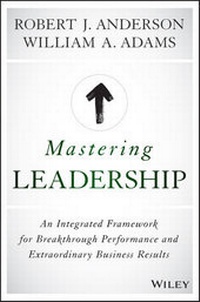
Mastering Leadership
An Integrated Framework for Breakthrough Performance and Extraordinary Business Results
Published on 4. November 2015
384 pages
978-1-119-14720-6 (ISBN)
Description

Is your leadership a competitive advantage, or is it costing you? How do you know? Are you developing your leadership effectiveness at the pace of change?
For most leaders today, complexity is outpacing their personal and collective development. Most leaders are in over their heads, whether they know it or not. The most successful organizations over time are the best led. While this has always been true, today escalating global complexity puts leadership effectiveness at a premium. Mastering Leadership involves developing the effectiveness of leaders--individually and collectively--and turning that leadership into a competitive advantage. This comprehensive roadmap for optimal leadership features:
* Breakthrough research that connects increased leadership effectiveness with enhanced business performance
* The first fully integrated Universal Model of Leadership--one that integrates the best theory and research in the fields of Leadership and Organizational Development over the last half century
* A free, online self-assessment of your leadership, using the Leadership Circle Profile, visibly outlining how you are currently leading and how to develop even greater effectiveness
* The five stages in the evolution of leadership--Egocentric, Reactive, Creative, Integral, and Unitive--along with the organizational structures and cultures that develop at each of these stages
* Six leadership practices for evolving your leadership capability at a faster pace
* A map of your optimal path to greater leadership effectiveness
* Case stories that facilitate pragmatic application of this Leadership Development System to your particular situation
This timeless, authoritative text provides a systemic approach for developing your senior leaders and the leadership system of your organization. It does not recommend quick fixes, but argues that real development requires a strategic, long-term, and integrated approach in order to forge more effective leaders and enhanced business performance. Mastering Leadership offers a developmental pathway to bring forth the highest and best use of yourself, your life, and your leadership. By more meaningfully deploying all of who you are every day, individually and collectively, you will achieve a leadership legacy consistent with your highest aspirations.
More details
Other editions
Additional editions
Robert J. Anderson | William A. Adams
Mastering Leadership
An Integrated Framework for Breakthrough Performance and Extraordinary Business Results
Book
12/2015
Wiley
€30.00
Shipment within 15-20 days
Persons
ROBERT J. ANDERSON is the Founder and Chairman of The Leadership Circle and the Full Circle Group. He has been a pacesetter and visionary in the leadership development field for 30 years.
WILLIAM A. ADAMS is the CEO of The Leadership Circle and the Full Circle Group. He has been a practice leader in the field for 30 years. His clients include the CEOs and teams of major Fortune 500 corporations (public and private) and private equity start-up businesses.
With The Leadership Circle and Full Circle Group team.
Content
1 - Mastering LEADERSHIP [Seite 9]
2 - Contents [Seite 13]
3 - Acknowledgements [Seite 19]
4 - Introduction: A Universal Model of Leadership and the Leadership Circle Profile Assessment [Seite 23]
5 - Chapter 1 The Promise of Leadership: Meeting the High Bar of Expectations [Seite 35]
5.1 - High Bar of Experience and Expectations [Seite 36]
5.2 - Leadership Matters [Seite 36]
5.3 - Four Universal Promises of Leadership [Seite 38]
5.3.1 - Promise 1: Set the right direction and create meaningful work [Seite 38]
5.3.2 - Promise 2: Engage all stakeholders and hold them accountable [Seite 40]
5.3.3 - Promise 3: Ensure that processes and systems facilitate focus and execution [Seite 40]
5.3.4 - Promise 4: Lead effectively [Seite 41]
5.4 - Broken Leadership Promises [Seite 43]
5.5 - Keeping the Promise [Seite 43]
5.6 - The Leadership Agenda [Seite 44]
6 - Chapter 2 Leadership Effectiveness and Business Performance: The Primary Competitive Advantage [Seite 47]
6.1 - What the Research Shows [Seite 47]
6.2 - What is Your Leadership Quotient? [Seite 51]
6.3 - Provocative Questions [Seite 52]
6.4 - Collective Effectiveness [Seite 53]
6.5 - Collective Effectiveness and Intelligence [Seite 56]
7 - Chapter 3 Mastery and Maturity, Consciousness and Complexity: The Leadership Development Agenda [Seite 61]
7.1 - Triumph and Failure of the Inner Game [Seite 62]
7.2 - Competency is Only Half the Game [Seite 63]
7.3 - Two Games of Leadership [Seite 63]
7.4 - Inner Game Runs the Outer Game [Seite 65]
7.5 - Litany of the Literature [Seite 67]
7.6 - Four Foundational Premises [Seite 69]
7.6.1 - Premise 1: Structure determines performance [Seite 69]
7.6.2 - Premise 2: You are a structure [Seite 70]
7.6.3 - Premise 3: Consciousness is the operating system of performance [Seite 70]
7.6.4 - Premise 4: To achieve higher performance, you must be restructured [Seite 71]
7.7 - Consciousness and Complexity [Seite 72]
7.8 - Understanding Complexity: Redundant Polarities and Problems [Seite 74]
7.9 - Non-Obvious Points of Leverage [Seite 75]
7.10 - The Leadership Imperative [Seite 76]
7.11 - The Core Argument [Seite 77]
7.12 - Uncommon Sense [Seite 78]
7.13 - Collective Wisdom [Seite 79]
7.14 - A Global Leadership Imperative [Seite 80]
8 - Chapter 4 Stages of Development: The Backbone of the Universal Model of Leadership [Seite 81]
8.1 - Stages of Development Framework [Seite 82]
8.2 - The Universal Model of Leadership [Seite 83]
8.3 - Correlation Conclusions [Seite 87]
8.4 - Trajectory of Life-Long Development [Seite 89]
8.5 - Childhood: Seeing Development the Easy Way [Seite 90]
8.6 - Identity is at the Core [Seite 92]
9 - Chapter 5 Five Levels of Leadership: Structures of Mind and Performance [Seite 95]
9.1 - Egocentric Leadership [Seite 97]
9.2 - Reactive Leadership [Seite 100]
9.3 - Creative Leadership [Seite 109]
9.4 - Integral Leadership [Seite 116]
9.5 - Unitive Leadership [Seite 119]
10 - Chapter 6 The Universal Model and Metrics: Global Leadership, Cross-Cultural, and Gender Application [Seite 121]
10.1 - Task and Relationship-Horizontal Axis [Seite 121]
10.2 - A Dynamic Model [Seite 123]
10.3 - Optimal Leadership [Seite 126]
10.4 - Link to Performance and Effectiveness [Seite 127]
10.5 - Dynamic Polarities [Seite 130]
10.6 - Universality of the Model [Seite 133]
10.7 - Case in Point: Cross-Cultural Application in Rural Uganda [Seite 136]
10.8 - Gender and the Universal Model [Seite 138]
10.9 - Stage of Development Research [Seite 140]
10.10 - Conclusions and Implications [Seite 146]
11 - Chapter 7 The Leadership System: The Central Organizing System [Seite 149]
11.1 - Six Systems of Organizational Effectiveness [Seite 150]
11.2 - Whole Systems Approach to Developing Leadership [Seite 154]
11.3 - Four Compelling Case Studies [Seite 156]
11.3.1 - Case 1: EverBank Commercial Finance [Seite 157]
11.3.2 - Case 2: Global Shared Services, McDonalds Corporation [Seite 172]
11.3.3 - Case 3: Honda Precision Parts of Georgia (HPPG) [Seite 175]
11.3.4 - Case 4: Technology Service Provider [Seite 182]
11.4 - Owning Development from the Top [Seite 185]
12 - Chapter 8 Reactive Leadership: An Insufficient Triumph of Development [Seite 189]
12.1 - Performance Review [Seite 191]
12.2 - Leave Your Ego at the Door [Seite 191]
12.3 - I Dare You to Tell Me the Truth [Seite 191]
12.4 - Two Primary Movements [Seite 194]
12.4.1 - First Movement: Purpose and Safety, Love and Fear [Seite 195]
12.4.2 - Second Movement: From Outside-In to Inside-Out [Seite 199]
12.5 - Structure of Reactive Mind [Seite 203]
12.6 - Core Operating Beliefs [Seite 210]
12.7 - Putting It All Together [Seite 213]
12.8 - The Leadership Agenda [Seite 214]
13 - Chapter 9 Reactive Leadership at Work: From Patriarchy to Partnership [Seite 217]
13.1 - Moving from Patriarchy to Partnership [Seite 217]
13.2 - Navigating Two Journeys [Seite 219]
13.3 - Three Core Reactive Types [Seite 220]
13.4 - Gifts of Each Type [Seite 223]
13.5 - Gifts Hung on a Reactive Structure [Seite 225]
13.6 - Reactive Dynamics-True to Type [Seite 228]
13.7 - Reactive Type Dynamics in the Universal Model [Seite 232]
13.8 - Natural Selection Process-Creating Collective Patterns of Patriarchy [Seite 234]
14 - Chapter 10 Creative Leadership: Fulfilling the Promise of Leadership [Seite 239]
14.1 - Performance Review [Seite 239]
14.2 - The Heros Journey [Seite 241]
14.3 - What the Transition Looks Like [Seite 243]
14.4 - Talking About It Without Knowing It [Seite 245]
14.5 - Creative Structure [Seite 247]
14.6 - Creative Structure of Identity [Seite 250]
14.7 - Restructuring Identity Beliefs [Seite 250]
14.8 - Designed for Leading Change [Seite 254]
14.9 - Creative Mind and Performance [Seite 255]
14.10 - Alignment [Seite 257]
14.11 - Path of Development-Move Toward Your Near Enemy [Seite 258]
14.12 - Type Through Stage [Seite 263]
14.13 - Creative Organizations [Seite 263]
14.14 - Integration [Seite 264]
14.15 - Literacy in the Pathways of Transformation [Seite 265]
14.16 - Two Currents of Transformation [Seite 266]
15 - Chapter 11 Six Leadership Practices: Spiritual Boot Camp for Leaders [Seite 273]
15.1 - Practice 1: Discerning Purpose [Seite 273]
15.1.1 - I Am Not Becoming Who I Am [Seite 274]
15.1.2 - Stalking Your Longing [Seite 276]
15.1.3 - Connecting the Dots [Seite 277]
15.1.4 - Creative Leadership [Seite 278]
15.2 - Practice 2: Distilling Vision [Seite 279]
15.2.1 - Five Elements of Vision [Seite 280]
15.3 - Practice 3: Knowing Your Doubts and Fears [Seite 282]
15.4 - Practice 4: Engage in Authentic, Courageous Dialogue [Seite 286]
15.5 - Practice 5: Develop Intuition, Open to Inspiration [Seite 289]
15.6 - Practice 6: Think Systemically [Seite 293]
15.7 - Path of Mastering Leadership [Seite 296]
16 - Chapter 12 Integral Leadership: Built for Complexity, Designed for Transformation [Seite 299]
16.1 - Brief Summary of Stages [Seite 301]
16.2 - Servant of the System [Seite 302]
16.3 - Maturing Intuition [Seite 302]
16.4 - Seeing the Entire Development Spectrum [Seite 303]
16.5 - Holding Unresolvedness, Conflict, and Tension [Seite 304]
16.6 - As Within, So Without [Seite 305]
16.7 - A Meeting of Twin Opposites [Seite 306]
16.8 - Have You Ever Once Asked Me What I Want? [Seite 306]
16.9 - Shadow Side of the Universal Model [Seite 308]
16.9.1 - Shadow Boxing [Seite 311]
16.9.2 - Shadow Flags [Seite 312]
16.9.3 - Harvesting the Shadow [Seite 315]
16.9.4 - Path of Development-Gifts in Shadow [Seite 318]
16.10 - Fierce Compassion, The Dance of Enemies [Seite 321]
16.11 - Why is Change so Difficult? [Seite 325]
16.12 - Integral Leadership Imperative [Seite 326]
17 - Chapter 13 Unity: Journey's End, Development Turned Upside Down [Seite 329]
17.1 - Waves on the Ocean [Seite 330]
17.2 - No Self, All God [Seite 331]
17.3 - Development Turned Upside Down [Seite 333]
17.4 - Two Arguments for Development [Seite 334]
17.5 - Not Me, Not Me [Seite 334]
17.6 - Unity Leadership [Seite 335]
18 - Appendix 1 Leadership Circle Profile Dimensions [Seite 337]
19 - Appendix 2 Theorists Integrated into The Leadership Circle Universal Model of Leadership [Seite 343]
20 - References [Seite 349]
21 - About the Authors [Seite 357]
22 - Index [Seite 361]
23 - EULA [Seite 377]
2 - Contents [Seite 13]
3 - Acknowledgements [Seite 19]
4 - Introduction: A Universal Model of Leadership and the Leadership Circle Profile Assessment [Seite 23]
5 - Chapter 1 The Promise of Leadership: Meeting the High Bar of Expectations [Seite 35]
5.1 - High Bar of Experience and Expectations [Seite 36]
5.2 - Leadership Matters [Seite 36]
5.3 - Four Universal Promises of Leadership [Seite 38]
5.3.1 - Promise 1: Set the right direction and create meaningful work [Seite 38]
5.3.2 - Promise 2: Engage all stakeholders and hold them accountable [Seite 40]
5.3.3 - Promise 3: Ensure that processes and systems facilitate focus and execution [Seite 40]
5.3.4 - Promise 4: Lead effectively [Seite 41]
5.4 - Broken Leadership Promises [Seite 43]
5.5 - Keeping the Promise [Seite 43]
5.6 - The Leadership Agenda [Seite 44]
6 - Chapter 2 Leadership Effectiveness and Business Performance: The Primary Competitive Advantage [Seite 47]
6.1 - What the Research Shows [Seite 47]
6.2 - What is Your Leadership Quotient? [Seite 51]
6.3 - Provocative Questions [Seite 52]
6.4 - Collective Effectiveness [Seite 53]
6.5 - Collective Effectiveness and Intelligence [Seite 56]
7 - Chapter 3 Mastery and Maturity, Consciousness and Complexity: The Leadership Development Agenda [Seite 61]
7.1 - Triumph and Failure of the Inner Game [Seite 62]
7.2 - Competency is Only Half the Game [Seite 63]
7.3 - Two Games of Leadership [Seite 63]
7.4 - Inner Game Runs the Outer Game [Seite 65]
7.5 - Litany of the Literature [Seite 67]
7.6 - Four Foundational Premises [Seite 69]
7.6.1 - Premise 1: Structure determines performance [Seite 69]
7.6.2 - Premise 2: You are a structure [Seite 70]
7.6.3 - Premise 3: Consciousness is the operating system of performance [Seite 70]
7.6.4 - Premise 4: To achieve higher performance, you must be restructured [Seite 71]
7.7 - Consciousness and Complexity [Seite 72]
7.8 - Understanding Complexity: Redundant Polarities and Problems [Seite 74]
7.9 - Non-Obvious Points of Leverage [Seite 75]
7.10 - The Leadership Imperative [Seite 76]
7.11 - The Core Argument [Seite 77]
7.12 - Uncommon Sense [Seite 78]
7.13 - Collective Wisdom [Seite 79]
7.14 - A Global Leadership Imperative [Seite 80]
8 - Chapter 4 Stages of Development: The Backbone of the Universal Model of Leadership [Seite 81]
8.1 - Stages of Development Framework [Seite 82]
8.2 - The Universal Model of Leadership [Seite 83]
8.3 - Correlation Conclusions [Seite 87]
8.4 - Trajectory of Life-Long Development [Seite 89]
8.5 - Childhood: Seeing Development the Easy Way [Seite 90]
8.6 - Identity is at the Core [Seite 92]
9 - Chapter 5 Five Levels of Leadership: Structures of Mind and Performance [Seite 95]
9.1 - Egocentric Leadership [Seite 97]
9.2 - Reactive Leadership [Seite 100]
9.3 - Creative Leadership [Seite 109]
9.4 - Integral Leadership [Seite 116]
9.5 - Unitive Leadership [Seite 119]
10 - Chapter 6 The Universal Model and Metrics: Global Leadership, Cross-Cultural, and Gender Application [Seite 121]
10.1 - Task and Relationship-Horizontal Axis [Seite 121]
10.2 - A Dynamic Model [Seite 123]
10.3 - Optimal Leadership [Seite 126]
10.4 - Link to Performance and Effectiveness [Seite 127]
10.5 - Dynamic Polarities [Seite 130]
10.6 - Universality of the Model [Seite 133]
10.7 - Case in Point: Cross-Cultural Application in Rural Uganda [Seite 136]
10.8 - Gender and the Universal Model [Seite 138]
10.9 - Stage of Development Research [Seite 140]
10.10 - Conclusions and Implications [Seite 146]
11 - Chapter 7 The Leadership System: The Central Organizing System [Seite 149]
11.1 - Six Systems of Organizational Effectiveness [Seite 150]
11.2 - Whole Systems Approach to Developing Leadership [Seite 154]
11.3 - Four Compelling Case Studies [Seite 156]
11.3.1 - Case 1: EverBank Commercial Finance [Seite 157]
11.3.2 - Case 2: Global Shared Services, McDonalds Corporation [Seite 172]
11.3.3 - Case 3: Honda Precision Parts of Georgia (HPPG) [Seite 175]
11.3.4 - Case 4: Technology Service Provider [Seite 182]
11.4 - Owning Development from the Top [Seite 185]
12 - Chapter 8 Reactive Leadership: An Insufficient Triumph of Development [Seite 189]
12.1 - Performance Review [Seite 191]
12.2 - Leave Your Ego at the Door [Seite 191]
12.3 - I Dare You to Tell Me the Truth [Seite 191]
12.4 - Two Primary Movements [Seite 194]
12.4.1 - First Movement: Purpose and Safety, Love and Fear [Seite 195]
12.4.2 - Second Movement: From Outside-In to Inside-Out [Seite 199]
12.5 - Structure of Reactive Mind [Seite 203]
12.6 - Core Operating Beliefs [Seite 210]
12.7 - Putting It All Together [Seite 213]
12.8 - The Leadership Agenda [Seite 214]
13 - Chapter 9 Reactive Leadership at Work: From Patriarchy to Partnership [Seite 217]
13.1 - Moving from Patriarchy to Partnership [Seite 217]
13.2 - Navigating Two Journeys [Seite 219]
13.3 - Three Core Reactive Types [Seite 220]
13.4 - Gifts of Each Type [Seite 223]
13.5 - Gifts Hung on a Reactive Structure [Seite 225]
13.6 - Reactive Dynamics-True to Type [Seite 228]
13.7 - Reactive Type Dynamics in the Universal Model [Seite 232]
13.8 - Natural Selection Process-Creating Collective Patterns of Patriarchy [Seite 234]
14 - Chapter 10 Creative Leadership: Fulfilling the Promise of Leadership [Seite 239]
14.1 - Performance Review [Seite 239]
14.2 - The Heros Journey [Seite 241]
14.3 - What the Transition Looks Like [Seite 243]
14.4 - Talking About It Without Knowing It [Seite 245]
14.5 - Creative Structure [Seite 247]
14.6 - Creative Structure of Identity [Seite 250]
14.7 - Restructuring Identity Beliefs [Seite 250]
14.8 - Designed for Leading Change [Seite 254]
14.9 - Creative Mind and Performance [Seite 255]
14.10 - Alignment [Seite 257]
14.11 - Path of Development-Move Toward Your Near Enemy [Seite 258]
14.12 - Type Through Stage [Seite 263]
14.13 - Creative Organizations [Seite 263]
14.14 - Integration [Seite 264]
14.15 - Literacy in the Pathways of Transformation [Seite 265]
14.16 - Two Currents of Transformation [Seite 266]
15 - Chapter 11 Six Leadership Practices: Spiritual Boot Camp for Leaders [Seite 273]
15.1 - Practice 1: Discerning Purpose [Seite 273]
15.1.1 - I Am Not Becoming Who I Am [Seite 274]
15.1.2 - Stalking Your Longing [Seite 276]
15.1.3 - Connecting the Dots [Seite 277]
15.1.4 - Creative Leadership [Seite 278]
15.2 - Practice 2: Distilling Vision [Seite 279]
15.2.1 - Five Elements of Vision [Seite 280]
15.3 - Practice 3: Knowing Your Doubts and Fears [Seite 282]
15.4 - Practice 4: Engage in Authentic, Courageous Dialogue [Seite 286]
15.5 - Practice 5: Develop Intuition, Open to Inspiration [Seite 289]
15.6 - Practice 6: Think Systemically [Seite 293]
15.7 - Path of Mastering Leadership [Seite 296]
16 - Chapter 12 Integral Leadership: Built for Complexity, Designed for Transformation [Seite 299]
16.1 - Brief Summary of Stages [Seite 301]
16.2 - Servant of the System [Seite 302]
16.3 - Maturing Intuition [Seite 302]
16.4 - Seeing the Entire Development Spectrum [Seite 303]
16.5 - Holding Unresolvedness, Conflict, and Tension [Seite 304]
16.6 - As Within, So Without [Seite 305]
16.7 - A Meeting of Twin Opposites [Seite 306]
16.8 - Have You Ever Once Asked Me What I Want? [Seite 306]
16.9 - Shadow Side of the Universal Model [Seite 308]
16.9.1 - Shadow Boxing [Seite 311]
16.9.2 - Shadow Flags [Seite 312]
16.9.3 - Harvesting the Shadow [Seite 315]
16.9.4 - Path of Development-Gifts in Shadow [Seite 318]
16.10 - Fierce Compassion, The Dance of Enemies [Seite 321]
16.11 - Why is Change so Difficult? [Seite 325]
16.12 - Integral Leadership Imperative [Seite 326]
17 - Chapter 13 Unity: Journey's End, Development Turned Upside Down [Seite 329]
17.1 - Waves on the Ocean [Seite 330]
17.2 - No Self, All God [Seite 331]
17.3 - Development Turned Upside Down [Seite 333]
17.4 - Two Arguments for Development [Seite 334]
17.5 - Not Me, Not Me [Seite 334]
17.6 - Unity Leadership [Seite 335]
18 - Appendix 1 Leadership Circle Profile Dimensions [Seite 337]
19 - Appendix 2 Theorists Integrated into The Leadership Circle Universal Model of Leadership [Seite 343]
20 - References [Seite 349]
21 - About the Authors [Seite 357]
22 - Index [Seite 361]
23 - EULA [Seite 377]
