

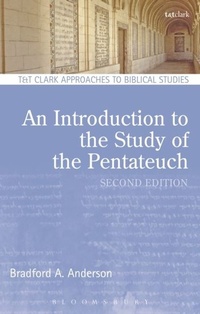
An Introduction to the Study of the Pentateuch
2nd Edition
Published on 23. February 2017
208 pages
978-0-567-65637-7 (ISBN)
Description

The Pentateuch (or the Torah) consists of the first five books of the Bible and is a foundational scripture for millions of people, both Jews and Christians. In this book Paula Gooder and Brad Anderson provide a clear and accessible introduction for those beginning Bible study. Key themes such as creation and the flood, exodus and liberation, as well as covenant and law are presented and analyzed. These themes are explored in their ancient context and from the standpoint of contemporary concerns such as liberation theology, gender issues and ecology.
For this new edition introductory sections on the five books of the Pentateuch have been expanded and supplemented, while recent developments in the quest for the origins of the Pentateuch have also been updated. A new chapter on academic approaches to the study of the Pentateuch has been added, along with a section on the 'afterlife' of the Pentateuch which focuses on its place in the history of interpretation, as well as in the arts and culture. Reading lists and references have been updated throughout to take account of the most recent scholarship.
For this new edition introductory sections on the five books of the Pentateuch have been expanded and supplemented, while recent developments in the quest for the origins of the Pentateuch have also been updated. A new chapter on academic approaches to the study of the Pentateuch has been added, along with a section on the 'afterlife' of the Pentateuch which focuses on its place in the history of interpretation, as well as in the arts and culture. Reading lists and references have been updated throughout to take account of the most recent scholarship.
More details
Series
Edition
2nd edition
Language
English
Place of publication
London
United Kingdom
Publishing group
Bloomsbury Publishing PLC
Target group
College/higher education
ISBN-13
978-0-567-65637-7 (9780567656377)
Copyright in bibliographic data and cover images is held by Nielsen Book Services Limited or by the publishers or by their respective licensors: all rights reserved.
Schweitzer Classification
Other editions
Additional editions
Bradford A. Anderson | Paula Gooder
An Introduction to the Study of the Pentateuch
Book
02/2017
2nd Edition
T.& T.Clark Ltd
€50.94
Shipment within 3-4 weeks
Bradford A. Anderson | Paula Gooder
An Introduction to the Study of the Pentateuch
Book
02/2017
2nd Edition
T.& T.Clark Ltd
€111.80
Shipment within 3-4 weeks
Persons
Paula Gooder is a Lecturer in Biblical Studies and is Theologian in Residence at The Bible Society, UK.
Brad Anderson is Lecturer in Biblical Studies at Dublin City University, Ireland.
Brad Anderson is Lecturer in Biblical Studies at Dublin City University, Ireland.
Content
Preface
Acknowledgements
Introduction
Part One: Getting to Know the Pentateuch
1. The Pentateuch: Introductory Issues
2. The Book of Genesis
3. The Book of Exodus
4. The Book Leviticus
5. The Book of Numbers
6. The Book of Deuteronomy
Part Two: Thematic and Critical Explorations
7. The Origins and Formation of the Pentateuch
8. Academic Approaches to Reading and Studying the Pentateuch
9. The Primeval History (Genesis 1-11)
10. The Ancestral Narratives (Genesis 12-50)
11. Moses and the Exodus Traditions (Exodus 1-5)
12. 'The Law' in Exodus-Deuteronomy
13. The Wilderness Wanderings
14. The Reception of the Pentateuch: The Use, Impact, and Influence of the Five Books
Bibliography
General Index
Acknowledgements
Introduction
Part One: Getting to Know the Pentateuch
1. The Pentateuch: Introductory Issues
2. The Book of Genesis
3. The Book of Exodus
4. The Book Leviticus
5. The Book of Numbers
6. The Book of Deuteronomy
Part Two: Thematic and Critical Explorations
7. The Origins and Formation of the Pentateuch
8. Academic Approaches to Reading and Studying the Pentateuch
9. The Primeval History (Genesis 1-11)
10. The Ancestral Narratives (Genesis 12-50)
11. Moses and the Exodus Traditions (Exodus 1-5)
12. 'The Law' in Exodus-Deuteronomy
13. The Wilderness Wanderings
14. The Reception of the Pentateuch: The Use, Impact, and Influence of the Five Books
Bibliography
General Index
