

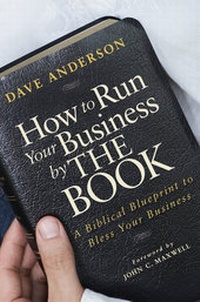
How to Run Your Business by The Book
A Biblical Blueprint to Bless Your Business
Published on 22. July 2009
240 pages
978-0-470-52748-1 (ISBN)
Description

How to use Bible-based leadership principles to improve businessperformance
In How to Run Your Business by THE BOOK, famed leadershipguru Dave Anderson reveals biblical lessons to help transform thepeople, culture, and results of your business. Not only will youmaster timeless business principles based on the world'sbestselling book, you'll build a foundation for your business thatleads to long-term success.
This is a refreshing return to commonsense business basics,based on leadership lessons peppered throughout the Good Book. Inthese turbulent times, quality leadership is the key to survivingand thriving in the business world. You'll learn what the Bible hasto say about hiring and training people, managing money, creating aleadership vision, balancing work and life, and achieving your mostambitious business goals.
* Includes practical, proven business guidance gleaned from theBible
* Features smart business guidance like the Ten Commandments forelevating your people skills
* Shows you four vital steps for creating a tough-love culture ofaccountability
* Dave Anderson is also the author of Up Your Business!, IfYou Don't Make Waves, You'll Drown and How to Deal withDifficult Customers
Best of all, you don't need to be familiar with the Bible toprofit from these wise and timeless principles. All you need is aheart open to biblical wisdom and a willingness to lead withcourage.
More details
Other editions
Additional editions
Book
09/2009
1st Edition
Wiley
€21.90
Article exhausted; check for reprint
Persons
Dave Anderson is President of Dave Anderson's Learn to Lead and has given over 1,000 leadership presentations in thirteen countries. He is the author of If You Don't Make Waves, You'll Drown; Up Your Business!; How to Deal with Difficult Customers; and the TKO business series, all from Wiley. He and his wife Rhonda are cofounders of The Matthew 25.35 Foundation, which helps feed, educate, and house destitute people throughout the world. For more information, visit www.learntolead.com.
Content
Preface.
Acknowledgements.
Foreword.
A Six Pack of Principles from a King and the KING.
Four Mandates to Maximize Your Time.
How to Overcome the #1 Cause of Management Failure.
Five Steps to Build a Rock Solid Character.
The "High Five" Principles to Elevate Your People Skills.
Four Keys to Create Life-Work Balance.
How to Manage Your Money By THE BOOK.
Four Steps to Build a Team By THE BOOK.
Appendix.
Notes.
References.
About the Author.
CHAPTER 1 A Six Pack of Principles from a King and the King
When I was promoted from salesperson to a sales manager, I thought that my new title officially announced to the world that I was a leader. I was wrong. In fact, I quickly learned three things: 1. A title doesn’t make you a leader. It merely affords you an opportunity to become one. 2. As a leader, you don’t automatically have followers; you have subordinates, and how you act as a leader determines whether a subordinate ever becomes a follower. 3. Leadership is performance and not position. It is a choice you make and not a place where you sit. Eager to excel in my new position, I worked hard on my job but I abused my body, swelling to 40 pounds overweight and earning my “new manager’s merit badge”—an ulcer—in the process. To my credit, I was good at closing deals for my sales team, scheduling, forecasting, and writing daily memos for my bulging procedures manual. In a given day, I spent most of my time with “stuff,” which I’ve since come to categorize as everything in my job that has nothing to do with people. In fact, I preferred the stuff over the people because I wasn’t very good with people! I managed through intimidation, substituted rules for relationships, and had a hair-trigger temper that was a catalyst for creating a culture of fear. Although I had never attended a university, coworkers rightly claimed that I had a Masters Degree in Disempowerment and a Bachelor’s in Bullying. Then one day everything changed. Norm Albertson, the pastor of my church, stopped by my office and brought with him two leadership training programs by John Maxwell, a guy I had never heard of. One of the programs was on leadership priorities and the other explained key differences between being a manager and a leader, which I had wrongly thought were synonymous terms. Listening to Maxwell talk about leadership humbled me because I realized I was, at best, a ceremonial leader. All I had was a new title, which I wrongly assumed made me more competent! His teachings stirred up in me a desire to become a better leader. Frankly, I was tired of doing too much work by myself because I trusted no one else to share the load. I was also discouraged that I wasn’t doing enough to help my people to reach their potential. Perhaps what I was most excited about was that he said that the principles he taught were biblically based. This meant a lot to me because I had become a Christian at age 12 and had great respect for the Bible, even though I didn’t spend a lot of time reading it at the time. After reviewing the tapes several times, I began reading the Bible for business wisdom as well as for life-wisdom. As a result, I changed my leadership style, priorities, and thinking. I began using the Bible as a filter to make decisions ranging from personnel to customer care issues. In the aftermath of implementing these changes, my career shifted from a slow shuffle up a steep staircase to an express elevator to the top. As a student of the Bible, I have found that both success and failure leave clues, and you don’t have to invent leadership principles to become more successful any more than you must suffer countless disappointments through personal trial and error to learn what doesn’t work. Instead, you can learn from some of the best and worst leaders of all time who preceded you on this journey, as described in the Bible, and apply timeless, proven principles to improve every aspect of your organization. Think about it this way: The Bible is a slice of God’s mind! How foolish do we have to be to continue to labor under our own intuition or to chase the fads of others in pursuit of greater success when the source of infinite wisdom is so readily available to us? In this chapter, you’ll learn from two of the best leaders in the Bible—a king and The King. You can certainly argue that there are additional or different leaders that I could have chosen to highlight in the following pages. And I would agree with you. In reality, there are too many to list and enough lessons from their lives to fill volumes of books. Thus, I’ve chosen two I believe you will gain the most benefit from in the shortest amount of time to begin running your business by THE BOOK. Caution: Your natural tendency might be to use these principles to first try and fix the people or broken systems and strategies that surround you. That would be a serious error because nothing is going to get much better in your organization until you do! You’ll be relieved to know that, in the next 20 minutes, David and Jesus will offer six insightful steps on how you can make this happen. By THE BOOK Blessing Leadership is developed more than it is discovered. You work on it, and then it works for you.
David was the second king of Israel, reigned for 40 years, and is considered to be its best ruler. His reign preceded the birth of Christ by approximately 1,000 years. Like many leaders, David made major mistakes in the midst of his enormous successes. We can learn from both.
Critical Success Factor #1: David Assumed the Traits of a Leader Before He Was in the Leadership Position Over the years, I’ve heard this common chorus from nonmanagement employees aspiring to be promoted: “Dave, I would like to be considered for the new management position that has opened up. I’ve been here a long time, I’ve been loyal, and I believe that I’ve earned a shot.” I would then ask them the following: “How many management books have you read and how many leadership courses have you attended?” The predictable response was a sheepish and defensive, “None. I’m not a manager yet,” to which I’d respond, “Wouldn’t you agree that the best time to prepare yourself for the next step up is before you’re in that position? After all, I don’t want you to play a costly game of ‘amateur hour’ with our people. Learn about management before you’re a manager. And while you’re at it, show me that you can manage your own time, your own emotions, character choices, and discipline now, in the position you’re currently in. Because if you cannot manage yourself, how do you expect me to give you an opportunity to manage others?” By THE BOOK Blessing The first obligation of a leader is to grow. The process should start before you’re in an official leadership position and continue for a lifetime once you’re there. BY THE BOOK LESSON IN LEADERSHIP DAVID LED BEFORE HE HAD A TITLE Historians estimate that David was a teenager when he fought Goliath. The Bible describes him as a “youth” when he decides to fight Goliath. He was willing to take action while King Saul and his professional soldiers quaked in their sandals as Goliath left his Philistine camp for 40 straight days to taunt the Israelis and challenge them to fight him. While others uttered excuses, David offered a solution. This is what leaders do. They begin thinking and acting like leaders before they’re in a leadership position. And if they are already in a leadership position, they’ll begin thinking and acting like the person would think and act who is in the next higher position to which they aspire. If you want to own the company you work for, begin to think and act like an owner would think and act, even if you’re currently sweeping floors and cleaning toilets. Allow me to relate a brief example of how this mindset works in the business arena. While being given a tour of his operations by the CEO of a $300,000,000 retail organization who had worked his way into ownership from the ground floor, I noticed that he’d stop, stoop, and scoop up every piece of trash in his path. When he noticed my amusement with his meticulous housekeeping he explained, “Most people think that I pick up the trash on this property because I own the company. What they don’t realize is that I own the company because I’ve had a mindset from the day I started here that has never allowed me to walk past a piece of trash on this property without picking it up.” In some regards, not much has changed since the time of David. The largest corporations in the world emulate the Israeli army and King Saul by recognizing that their version of Goliath is a problem but taking no action against it. A key aspect of leadership mandates that you move beyond problem-finding to solution-providing. In fact, a key difference between winners and whiners in any organization is that, although both groups point out problems and areas for improvement, the winners will also offer and implement remedies. A second lesson we can learn from David’s emergence as a leader is that he faced Goliath with more than just a great attitude, by repeating affirmations, or the power of positive thinking. While all of these can add value, they are not a substitute for preparation and execution. Perhaps the most telling aspect of this well-known story is found in 1 Samuel 17:40, where THE BOOK reports that, before facing the giant, David stopped by a brook and chose five smooth stones for battle. He didn’t know if he’d need one or five; it was also rumored that Goliath had four brothers. Either way, he was ready! As a leader, you are expected to maintain a positive outlook and to maintain a healthy attitude. These are givens. A more relevant question becomes, “Do you have your five stones?” Have you prepared for the Goliath you’re facing in the...
GENESIS
When I was promoted from salesperson to a sales manager, I thought that my new title officially announced to the world that I was a leader. I was wrong. In fact, I quickly learned three things: 1. A title doesn’t make you a leader. It merely affords you an opportunity to become one. 2. As a leader, you don’t automatically have followers; you have subordinates, and how you act as a leader determines whether a subordinate ever becomes a follower. 3. Leadership is performance and not position. It is a choice you make and not a place where you sit. Eager to excel in my new position, I worked hard on my job but I abused my body, swelling to 40 pounds overweight and earning my “new manager’s merit badge”—an ulcer—in the process. To my credit, I was good at closing deals for my sales team, scheduling, forecasting, and writing daily memos for my bulging procedures manual. In a given day, I spent most of my time with “stuff,” which I’ve since come to categorize as everything in my job that has nothing to do with people. In fact, I preferred the stuff over the people because I wasn’t very good with people! I managed through intimidation, substituted rules for relationships, and had a hair-trigger temper that was a catalyst for creating a culture of fear. Although I had never attended a university, coworkers rightly claimed that I had a Masters Degree in Disempowerment and a Bachelor’s in Bullying. Then one day everything changed. Norm Albertson, the pastor of my church, stopped by my office and brought with him two leadership training programs by John Maxwell, a guy I had never heard of. One of the programs was on leadership priorities and the other explained key differences between being a manager and a leader, which I had wrongly thought were synonymous terms. Listening to Maxwell talk about leadership humbled me because I realized I was, at best, a ceremonial leader. All I had was a new title, which I wrongly assumed made me more competent! His teachings stirred up in me a desire to become a better leader. Frankly, I was tired of doing too much work by myself because I trusted no one else to share the load. I was also discouraged that I wasn’t doing enough to help my people to reach their potential. Perhaps what I was most excited about was that he said that the principles he taught were biblically based. This meant a lot to me because I had become a Christian at age 12 and had great respect for the Bible, even though I didn’t spend a lot of time reading it at the time. After reviewing the tapes several times, I began reading the Bible for business wisdom as well as for life-wisdom. As a result, I changed my leadership style, priorities, and thinking. I began using the Bible as a filter to make decisions ranging from personnel to customer care issues. In the aftermath of implementing these changes, my career shifted from a slow shuffle up a steep staircase to an express elevator to the top. As a student of the Bible, I have found that both success and failure leave clues, and you don’t have to invent leadership principles to become more successful any more than you must suffer countless disappointments through personal trial and error to learn what doesn’t work. Instead, you can learn from some of the best and worst leaders of all time who preceded you on this journey, as described in the Bible, and apply timeless, proven principles to improve every aspect of your organization. Think about it this way: The Bible is a slice of God’s mind! How foolish do we have to be to continue to labor under our own intuition or to chase the fads of others in pursuit of greater success when the source of infinite wisdom is so readily available to us? In this chapter, you’ll learn from two of the best leaders in the Bible—a king and The King. You can certainly argue that there are additional or different leaders that I could have chosen to highlight in the following pages. And I would agree with you. In reality, there are too many to list and enough lessons from their lives to fill volumes of books. Thus, I’ve chosen two I believe you will gain the most benefit from in the shortest amount of time to begin running your business by THE BOOK. Caution: Your natural tendency might be to use these principles to first try and fix the people or broken systems and strategies that surround you. That would be a serious error because nothing is going to get much better in your organization until you do! You’ll be relieved to know that, in the next 20 minutes, David and Jesus will offer six insightful steps on how you can make this happen. By THE BOOK Blessing Leadership is developed more than it is discovered. You work on it, and then it works for you.
DAVID
David was the second king of Israel, reigned for 40 years, and is considered to be its best ruler. His reign preceded the birth of Christ by approximately 1,000 years. Like many leaders, David made major mistakes in the midst of his enormous successes. We can learn from both.
DAVID’S CRITICAL SUCCESS FACTORS
Critical Success Factor #1: David Assumed the Traits of a Leader Before He Was in the Leadership Position Over the years, I’ve heard this common chorus from nonmanagement employees aspiring to be promoted: “Dave, I would like to be considered for the new management position that has opened up. I’ve been here a long time, I’ve been loyal, and I believe that I’ve earned a shot.” I would then ask them the following: “How many management books have you read and how many leadership courses have you attended?” The predictable response was a sheepish and defensive, “None. I’m not a manager yet,” to which I’d respond, “Wouldn’t you agree that the best time to prepare yourself for the next step up is before you’re in that position? After all, I don’t want you to play a costly game of ‘amateur hour’ with our people. Learn about management before you’re a manager. And while you’re at it, show me that you can manage your own time, your own emotions, character choices, and discipline now, in the position you’re currently in. Because if you cannot manage yourself, how do you expect me to give you an opportunity to manage others?” By THE BOOK Blessing The first obligation of a leader is to grow. The process should start before you’re in an official leadership position and continue for a lifetime once you’re there. BY THE BOOK LESSON IN LEADERSHIP DAVID LED BEFORE HE HAD A TITLE Historians estimate that David was a teenager when he fought Goliath. The Bible describes him as a “youth” when he decides to fight Goliath. He was willing to take action while King Saul and his professional soldiers quaked in their sandals as Goliath left his Philistine camp for 40 straight days to taunt the Israelis and challenge them to fight him. While others uttered excuses, David offered a solution. This is what leaders do. They begin thinking and acting like leaders before they’re in a leadership position. And if they are already in a leadership position, they’ll begin thinking and acting like the person would think and act who is in the next higher position to which they aspire. If you want to own the company you work for, begin to think and act like an owner would think and act, even if you’re currently sweeping floors and cleaning toilets. Allow me to relate a brief example of how this mindset works in the business arena. While being given a tour of his operations by the CEO of a $300,000,000 retail organization who had worked his way into ownership from the ground floor, I noticed that he’d stop, stoop, and scoop up every piece of trash in his path. When he noticed my amusement with his meticulous housekeeping he explained, “Most people think that I pick up the trash on this property because I own the company. What they don’t realize is that I own the company because I’ve had a mindset from the day I started here that has never allowed me to walk past a piece of trash on this property without picking it up.” In some regards, not much has changed since the time of David. The largest corporations in the world emulate the Israeli army and King Saul by recognizing that their version of Goliath is a problem but taking no action against it. A key aspect of leadership mandates that you move beyond problem-finding to solution-providing. In fact, a key difference between winners and whiners in any organization is that, although both groups point out problems and areas for improvement, the winners will also offer and implement remedies. A second lesson we can learn from David’s emergence as a leader is that he faced Goliath with more than just a great attitude, by repeating affirmations, or the power of positive thinking. While all of these can add value, they are not a substitute for preparation and execution. Perhaps the most telling aspect of this well-known story is found in 1 Samuel 17:40, where THE BOOK reports that, before facing the giant, David stopped by a brook and chose five smooth stones for battle. He didn’t know if he’d need one or five; it was also rumored that Goliath had four brothers. Either way, he was ready! As a leader, you are expected to maintain a positive outlook and to maintain a healthy attitude. These are givens. A more relevant question becomes, “Do you have your five stones?” Have you prepared for the Goliath you’re facing in the...
