

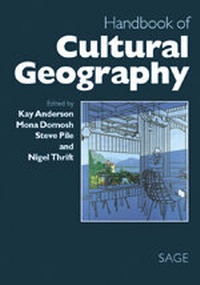
Handbook of Cultural Geography
1st Edition
Published on 20. November 2002
580 pages
978-1-84787-097-1 (ISBN)
Description

'Having just read this book, cover to cover, I can honestly say that I have not felt so excited about the discipline of geography since i was in my first year at college.... Overall, therefore, this is a truly wonderful book and the first comprehansive analysis of the cultural turn tha geography has taken, the pitfalls which lie ahead and the course which needs to be chartered. Innovative, invigorating, passionate and groundbreaking, it makes you feel great about being a cultural geographer, even if you never knew you were one'
-Space and Polity
`I never expected to call a handbook compulsive reading, but this wonderful volume changed all my preconceptions of what cultural geographers can do. Absorbing and thought-provoking, this is collaborative intellectual work at its imaginative best; it situates, explains and questions cultural geography as a "style of thought" and in the process imparts such vitality and joy from thinking in that style that this reader wants to join in. This Handbook can inform and inspire anyone concerned in any way with cultural research today' - Meaghan Morris, Chair Professor of Cultural Studies, Lingnan University, Hong Kong
`The Handbook of Cultural Geography lives up to its name. It is a book about where things are, how people live, what life means and why events happen. It should be carried at all times by anyone who is curious about the world. Crammed within its covers is a wealth of detail about the power to make history and shape geography. This is a catalogue of the disagreements and alliances that shape the world, and of the politics (and costs) of engaging with that world.The book is comprehensive yet has depth, accessible as well as experimental, and challenging without being too daunting. Each page contains something that seems highly familiar yet curiously strange. The message of course is that what we normally take for granted is so strange. The achievement is that after reading the Handbook, the world will never seem "normal" again' - Susan J Smith, Ogilvie Professor of Geography, The University of Edinburgh
`A richly plural and impassioned re-presentation of cultural geography that eschews everything in the way of boundary drawing and fixity. A re-visioning of the field as "a set of engagements with the world," it contains a vibrant atlas of ever shifting possibilities. Throbbing with commitment, and un-disciplined in the most positive sense of that term, it is exactly what a handbook ought to be' - Professor Allan Pred, Department of Geography, University of California at Berkeley
`A handbook with attitude and purpose, bristling with vitality, openness, and novelty. Dispelling with fixtures, canons, and retrofits, an imaginative cast in the hands of four of the most exciting contemporary cultural geographers opens up the cultural plural - culture as distribution of things, as a way of life, as meaning, as doing, as power - to a new spatial sensibility concerned with the fluid and mobile, the broadest ecology of spatial surfaces, the everyday lived, and the impetus of experimental forcings. A wonderful display of the confident maturity and originality that contemporary geography brings to cultural studies' - Professor Ash Amin, Department of Geography, University of Durham
The Handbook of Cultural Geography presents a state of the art assessment of the key questions informing cultural geography. Emphasizing the intellectual diversity of the discipline, the Handbook presents a comprehensive statement of the relationship between the cultural imagination and the geographical imagination while also looking at resonances between cultural geography and other disciplines.
The work is cross-referenced throughout and presents a completely integrated overview of cultural geography. This will be an essential reference for any inquiry into how culture is spatially constituted and, equally, how geography is culturally constructed.
-Space and Polity
`I never expected to call a handbook compulsive reading, but this wonderful volume changed all my preconceptions of what cultural geographers can do. Absorbing and thought-provoking, this is collaborative intellectual work at its imaginative best; it situates, explains and questions cultural geography as a "style of thought" and in the process imparts such vitality and joy from thinking in that style that this reader wants to join in. This Handbook can inform and inspire anyone concerned in any way with cultural research today' - Meaghan Morris, Chair Professor of Cultural Studies, Lingnan University, Hong Kong
`The Handbook of Cultural Geography lives up to its name. It is a book about where things are, how people live, what life means and why events happen. It should be carried at all times by anyone who is curious about the world. Crammed within its covers is a wealth of detail about the power to make history and shape geography. This is a catalogue of the disagreements and alliances that shape the world, and of the politics (and costs) of engaging with that world.The book is comprehensive yet has depth, accessible as well as experimental, and challenging without being too daunting. Each page contains something that seems highly familiar yet curiously strange. The message of course is that what we normally take for granted is so strange. The achievement is that after reading the Handbook, the world will never seem "normal" again' - Susan J Smith, Ogilvie Professor of Geography, The University of Edinburgh
`A richly plural and impassioned re-presentation of cultural geography that eschews everything in the way of boundary drawing and fixity. A re-visioning of the field as "a set of engagements with the world," it contains a vibrant atlas of ever shifting possibilities. Throbbing with commitment, and un-disciplined in the most positive sense of that term, it is exactly what a handbook ought to be' - Professor Allan Pred, Department of Geography, University of California at Berkeley
`A handbook with attitude and purpose, bristling with vitality, openness, and novelty. Dispelling with fixtures, canons, and retrofits, an imaginative cast in the hands of four of the most exciting contemporary cultural geographers opens up the cultural plural - culture as distribution of things, as a way of life, as meaning, as doing, as power - to a new spatial sensibility concerned with the fluid and mobile, the broadest ecology of spatial surfaces, the everyday lived, and the impetus of experimental forcings. A wonderful display of the confident maturity and originality that contemporary geography brings to cultural studies' - Professor Ash Amin, Department of Geography, University of Durham
The Handbook of Cultural Geography presents a state of the art assessment of the key questions informing cultural geography. Emphasizing the intellectual diversity of the discipline, the Handbook presents a comprehensive statement of the relationship between the cultural imagination and the geographical imagination while also looking at resonances between cultural geography and other disciplines.
The work is cross-referenced throughout and presents a completely integrated overview of cultural geography. This will be an essential reference for any inquiry into how culture is spatially constituted and, equally, how geography is culturally constructed.
Reviews / Votes
`I never expected to call a handbook compulsive reading, but this wonderful volume changed all my preconceptions of what cultural geographers can do. Absorbing and thought-provoking, this is collaborative intellectual work at its imaginative best; it situates, explains and questions cultural geography as a "style of thought" and in the process imparts such vitality and joy from thinking in that style that this reader wants to join in. This Handbook can inform and inspire anyone concerned in any way with cultural research today' - Meaghan Morris, Chair Professor of Cultural Studies, Lingnan University, Hong Kong`The Handbook of Cultural Geography lives up to its name. It is a book about where things are, how people live, what life means and why events happen. It should be carried at all times by anyone who is curious about the world. Crammed within its covers is a wealth of detail about the power to make history and shape geography.This is a catalogue of the disagreements and alliances that shape the world, and of the politics (and costs) of engaging with that world.The book is comprehensive yet has depth, accessible as well as experimental, and challenging without being too daunting. Each page contains something that seems highly familiar yet curiously strange. The message of course is that what we normally take for granted is so strange.The achievement is that after reading the Handbook, the world will never seem "normal" again' - Susan J. Smith, Ogilvie Professor of Geography, The University of Edinburgh
`A richly plural and impassioned representation of cultural geography that eschews everything in the way of boundary drawing and fixity. A revisioning of the field as "a set of engagements with the world," it contains a vibrant atlas of ever shifting possibilities.Throbbing with commitment, and undisciplined in the most positive sense of that term, it is exactly what a handbook ought to be' - Professor Allan Pred, Department of Geography, University of California at Berkeley
`A handbook with attitude and purpose, bristling with vitality, openness, and novelty. Dispelling with fixtures, canons, and retrofits, an imaginative cast in the hands of four of the most exciting contemporary cultural geographers opens up the cultural plural - culture as distribution of things, as a way of life, as meaning, as doing, as power - to a new spatial sensibility concerned with the fluid and mobile, the broadest ecology of spatial surfaces, the everyday lived, and the impetus of experimental forcings. A wonderful display of the confident maturity and originality that contemporary geography brings to cultural studies' - Professor Ash Amin, Department of Geography, University of Durham "The editors of this genuinely brilliant book seem to dare the reader to argue with them from the first page... I would encourage everyone interested in cultural geography, or in the cultural turn within a whole set of human geogrphies, to do likewise." -- Peter O.Muller * Annals of the Association of American Geographers *
All prices
More details
Language
English
Place of publication
London
United Kingdom
Target group
Professional and scholarly
ISBN-13
978-1-84787-097-1 (9781847870971)
Copyright in bibliographic data and cover images is held by Nielsen Book Services Limited or by the publishers or by their respective licensors: all rights reserved.
Schweitzer Classification
Other editions
Additional editions
Kay Anderson | Mona Domosh | Steve Pile
Handbook of Cultural Geography
Book
11/2002
1st Edition
SAGE Publications Inc
€201.00
Shipment within 15-20 days
Persons
Kay Anderson is a part-time Professorial Research Fellow at the Institute for Culture and Society. She is a leading, internationally recognised scholar in the fields of Cultural Geography and race historiography. Her sole-author book, Race and the Crisis of Humanism (Routledge 2007) won the 2008 NSW Premier's Literary Award for Critical Writing and her award-winningVancouver's Chinatown: Racial Discourse in Canada 1875-1980(McGill-Queens UP 1991) is in its 5th edition. She is co-editor ofEnvironment: Critical Essays in Human Geography (Ashgate 2008) and the Handbook of Cultural Geography (Sage 2002). She is an editorial board member of various journals includingCultural Geographies, Geographical Research, and City, and section editor on 'Cultural and Social Geography' for theEncyclopedia of Human Geography (Elsevier 2009). My research is primarily concerned with the relationship between place and the politics of identity. For example, I have undertaken a series of investigations into the relationship between the city, everyday life and the spatial constitution of power. This work has found outlets in projects such as City A-Z and also a sole authored book, Real Cities: modernity, space and the phantasmagorias of city life. This book makes a case for taking seriously the more imaginary, fantasmatic and emotional aspects of urbanism. Drawing inspiration from the work of Walter Benjamin, Sigmund Freud, Georg Simmel and various psychogeographers, Real Cities explores the dream-like and ghost-like experiences of city life.
A further strand of work has been to intervene in how Geography, as a Discipline, is conceived in terms of its practices, content and approaches. My main contribution has been to promote the legitimacy of a psychoanalytic approach to Geography, as first set out in The Body and the City. However, this project has also involved a more cultural take on Geography itself. This can be seen in both the Handbook of Cultural Geography and Patterned Ground.
The work I am conducting over the next few years, however, focuses on the body. This project is tentatively titled Fantastic Bodies. It is expected that the final outcome will be a sole authored book. Nigel Thrift is a Visiting Professor in Oxford and Tsinghua Universities. He was previously Executive Director of Schwarzman Scholars, Vice-Chancellor at the University of Warwick and Pro-Vice-Chancellor for Research at Oxford University.
A further strand of work has been to intervene in how Geography, as a Discipline, is conceived in terms of its practices, content and approaches. My main contribution has been to promote the legitimacy of a psychoanalytic approach to Geography, as first set out in The Body and the City. However, this project has also involved a more cultural take on Geography itself. This can be seen in both the Handbook of Cultural Geography and Patterned Ground.
The work I am conducting over the next few years, however, focuses on the body. This project is tentatively titled Fantastic Bodies. It is expected that the final outcome will be a sole authored book. Nigel Thrift is a Visiting Professor in Oxford and Tsinghua Universities. He was previously Executive Director of Schwarzman Scholars, Vice-Chancellor at the University of Warwick and Pro-Vice-Chancellor for Research at Oxford University.
Content
A Rough Guide - Kay Anderson et al
PART ONE: RETHINKING THE SOCIAL
Introduction - Peter Jackson
Reclaiming `the Social' in Social and Cultural Geography - Nicky Gregson
Embodying Social Geography - Pamela Moss and Isabel Dyck
Cultural Geographies of Transnationality - Katharyne Mitchell
PART TWO: THE CULTURE OF ECONOMY
Introduction - Trevor J Barnes
Cultures of Labour - Linda McDowell
Work, Employment, Identity and Economic Transformations
Cultures of Money - Adam Tickell
A Cultural Economic Geography of Production - Meric S Gertler
Cultures of Consumption - Don Slater
PART THREE: CULTURENATURES
Introduction - Sarah Whatmore
Geographies of Nature in the Making - Noel Castree
Reanimating Cultural Geography - Jennifer Wolch, Jody Emel and Chris Wilbert
`Inhabiting' - Steve Hinchliffe
Landscapes and Natures
PART FOUR: LANDSCAPE
Introduction - David Matless
Dead Labor and the Political Economy of Landscape - Don Mitchell
California Living, California Dying
Landscape and the European Sense of Sight - Denis Cosgrove
Eyeing Nature
Landscape and the Obliteration of Practice - Tim Cresswell
PART FIVE: PLACING SUBJECTIVITIES
Introduction - Robyn Longhurst
The Spatial Imperative of Subjectivity - Elspeth Probyn
Cultural Geographies of Racialization - Alastair Bonnett and Anoop Nayak
The Territory of Race
Queer Cultural Geographies - Michael Brown and Larry Knopp
We're Here! We're Queer! We're Over There, Too!
Troubling the Place of Gender - Liz Bondi and Joyce Davidson
PART SIX: AFTER EMPIRE
Introduction - Jane M Jacobs
Critical Imperial and Colonial Geographies - Daniel Clayton
Postcolonial Geographies of Place and Migration - Brenda S A Yeoh
Cultures and Spaces of Postcolonial Knowledges - Anthony D King
PART SEVEN: BEYOND THE WEST
Introduction - Jennifer Robinson
The West and Other Feminisms - Cheryl McEwan
Beyond Euro-Americanism - David Slater
Democracy and Post-colonialism
Alternative Modern - Michael Watts
Development as Cultural Geography
PART EIGHT: GEOPOLITICAL CULTURES
Introduction - Gerard Toal and John Agnew
Boundaries in a Globalizing World - Anssi Paasi
Gender in a Political and Patriarchal World - Joanne P Sharp
The Cultural Geography of Scale - Clare Newstead, Carolina K Reid and Matthew Sparke
Environmental Geopolitics - Simon Dalby
Nature, Culture, Urbanity
PART NINE: SPACES OF KNOWLEDGE
Introduction - John Paul Jones III
The Culture of Epistemology - Ulf Strohmayer
Knowledge and Geography's Technology - Francis Harvey
Politics, Ontologies, Representations in the Changing Ways we Know
The Construction of Geographical Knowledge - Audrey Kobayashi
Racialization, Spatialization
Contested Cultural Landscapes - Richard Howitt and Sandra Suchet-Pearson
PART ONE: RETHINKING THE SOCIAL
Introduction - Peter Jackson
Reclaiming `the Social' in Social and Cultural Geography - Nicky Gregson
Embodying Social Geography - Pamela Moss and Isabel Dyck
Cultural Geographies of Transnationality - Katharyne Mitchell
PART TWO: THE CULTURE OF ECONOMY
Introduction - Trevor J Barnes
Cultures of Labour - Linda McDowell
Work, Employment, Identity and Economic Transformations
Cultures of Money - Adam Tickell
A Cultural Economic Geography of Production - Meric S Gertler
Cultures of Consumption - Don Slater
PART THREE: CULTURENATURES
Introduction - Sarah Whatmore
Geographies of Nature in the Making - Noel Castree
Reanimating Cultural Geography - Jennifer Wolch, Jody Emel and Chris Wilbert
`Inhabiting' - Steve Hinchliffe
Landscapes and Natures
PART FOUR: LANDSCAPE
Introduction - David Matless
Dead Labor and the Political Economy of Landscape - Don Mitchell
California Living, California Dying
Landscape and the European Sense of Sight - Denis Cosgrove
Eyeing Nature
Landscape and the Obliteration of Practice - Tim Cresswell
PART FIVE: PLACING SUBJECTIVITIES
Introduction - Robyn Longhurst
The Spatial Imperative of Subjectivity - Elspeth Probyn
Cultural Geographies of Racialization - Alastair Bonnett and Anoop Nayak
The Territory of Race
Queer Cultural Geographies - Michael Brown and Larry Knopp
We're Here! We're Queer! We're Over There, Too!
Troubling the Place of Gender - Liz Bondi and Joyce Davidson
PART SIX: AFTER EMPIRE
Introduction - Jane M Jacobs
Critical Imperial and Colonial Geographies - Daniel Clayton
Postcolonial Geographies of Place and Migration - Brenda S A Yeoh
Cultures and Spaces of Postcolonial Knowledges - Anthony D King
PART SEVEN: BEYOND THE WEST
Introduction - Jennifer Robinson
The West and Other Feminisms - Cheryl McEwan
Beyond Euro-Americanism - David Slater
Democracy and Post-colonialism
Alternative Modern - Michael Watts
Development as Cultural Geography
PART EIGHT: GEOPOLITICAL CULTURES
Introduction - Gerard Toal and John Agnew
Boundaries in a Globalizing World - Anssi Paasi
Gender in a Political and Patriarchal World - Joanne P Sharp
The Cultural Geography of Scale - Clare Newstead, Carolina K Reid and Matthew Sparke
Environmental Geopolitics - Simon Dalby
Nature, Culture, Urbanity
PART NINE: SPACES OF KNOWLEDGE
Introduction - John Paul Jones III
The Culture of Epistemology - Ulf Strohmayer
Knowledge and Geography's Technology - Francis Harvey
Politics, Ontologies, Representations in the Changing Ways we Know
The Construction of Geographical Knowledge - Audrey Kobayashi
Racialization, Spatialization
Contested Cultural Landscapes - Richard Howitt and Sandra Suchet-Pearson
