
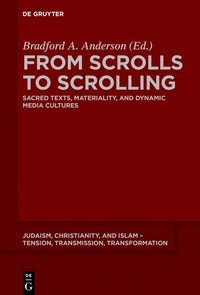
From Scrolls to Scrolling
Description
Alles über E-Books | Antworten auf Fragen rund um E-Books, Kopierschutz und Dateiformate finden Sie in unserem Info- & Hilfebereich.
Throughout history, the study of sacred texts has focused almost exclusively on the content and meaning of these writings. Such a focus obscures the fact that sacred texts are always embodied in particular material forms-from ancient scrolls to contemporary electronic devices. Using the digital turn as a starting point, this volume highlights material dimensions of the sacred texts of Judaism, Christianity, and Islam.
The essays in this collection investigate how material aspects have shaped the production and use of these texts within and between the traditions of Judaism, Christianity, and Islam, from antiquity to the present day. Contributors also reflect on the implications of transitions between varied material forms and media cultures.
Taken together, the essays suggests that materiality is significant for the academic study of sacred texts, as well as for reflection on developments within and between these religious traditions. This volume offers insightful analysis on key issues related to the materiality of sacred texts in the traditions of Judaism, Christianity, and Islam, while also highlighting the significance of transitions between various material forms, including the current shift to digital culture.
More details
Other editions
Additional editions

Person
System requirements
File format: PDF
Copy protection: Watermark-DRM (Digital Rights Management)
System requirements:
- Computer (Windows; MacOS X; Linux): Use the free software Adobe Reader, Adobe Digital Editions, or any other PDF viewer of your choice (see eBook Help).
- Tablet/Smartphone (Android; iOS): Install the free app Adobe Digital Editions or another reading app for eBooks, e.g., PocketBook (see eBook Help).
- E-reader: Bookeen, Kobo, Pocketbook, Sony, Tolino and many more (only limited: Kindle).
The file format PDF always displays a book page identically on any hardware. This makes PDF suitable for complex layouts such as those used in textbooks and reference books (images, tables, columns, footnotes). Unfortunately, on the small screens of e-readers or smartphones, PDFs are rather annoying, requiring too much scrolling.
This eBook uses Watermark-DRM, a „soft” copy protection. This means that there are no technical restrictions to prevent illegal distribution. However, there is a personalised watermark embedded in the eBook that can be used to identify the purchaser of the eBook in the event of misuse and to provide evidence for legal purposes.
For more information, see our eBook Help page.