

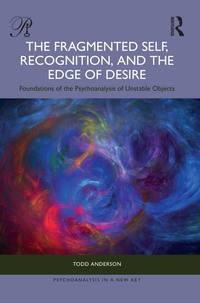
The Fragmented Self, Recognition, and the Edge of Desire
Foundations of the Psychoanalysis of Unstable Objects
Published on 1. April 2026
270 pages
978-1-040-80308-0 (ISBN)
Description

This book explores the most unstable facets of psychic life and how these can be understood and engaged in the psychoanalytic consulting room.
Psychic life is sustained by its very instabilities-by fragmentation, paradox, and the defenses that make survival possible. In dialogue with both psychoanalytic and philosophical traditions, Anderson shows how analysis becomes an aesthetic practice of presence, one that sustains the paradoxes necessary for psychic vitality. Reframing foundational psychoanalytic concepts such as the false self, regression, and symbolization, the book develops a clinical lens attuned to ambiguity, embodiment, and survival. Drawing from relational and post-structuralist traditions, it weaves vivid clinical vignettes with theoretical inquiry to explore how the psyche organizes itself around absence, symbolic rupture, and ethical refusal.
With a distinctive perspective on subjectivity, this book offers an aesthetic and ethical framework for psychoanalysis-one that sustains engagement with paradox, dissociation, and symbolic survival over premature resolution. It is essential reading for psychoanalysts, psychotherapists, and scholars of psychoanalytic thought.
Psychic life is sustained by its very instabilities-by fragmentation, paradox, and the defenses that make survival possible. In dialogue with both psychoanalytic and philosophical traditions, Anderson shows how analysis becomes an aesthetic practice of presence, one that sustains the paradoxes necessary for psychic vitality. Reframing foundational psychoanalytic concepts such as the false self, regression, and symbolization, the book develops a clinical lens attuned to ambiguity, embodiment, and survival. Drawing from relational and post-structuralist traditions, it weaves vivid clinical vignettes with theoretical inquiry to explore how the psyche organizes itself around absence, symbolic rupture, and ethical refusal.
With a distinctive perspective on subjectivity, this book offers an aesthetic and ethical framework for psychoanalysis-one that sustains engagement with paradox, dissociation, and symbolic survival over premature resolution. It is essential reading for psychoanalysts, psychotherapists, and scholars of psychoanalytic thought.
Reviews / Votes
'Brilliant, compelling, and thought-provoking'Christopher Bollas, PhD, author of The Shadow of the Object and Being a Character
'I find Unstable Objects to be a book that manages to describe the phenomena constituting the analytic experience in an unusually delicate and intelligent way. This is a rare event in the analytic world. It is a pleasure to read.'
Thomas Ogden, MD, author of What Alive Means and Coming to Life in the Consulting Room
'Taking the centrality of conflict, contradiction, and paradox in mental life as his subject of investigation, Todd Anderson offers us a discourse of astonishing range and depth. His approach integrates the perspectives of classical psychoanalysis, contemporary intersubjectivity, and modern Continental philosophy. The labyrinthine and near-mesmerizing syncretism that marks his voice yields proposals that are thoughtful, convincing, and humane. Paradox is thus revealed to be integral, inevitable, and, if held by unhurried attention, deeply instructive as well. This is a truly meaningful addition to our current psychoanalytic literature!'
Salman Akhtar, MD, DLFAPA, emeritus professor of Psychiatry, Jefferson Medical College; training and supervising analyst, Psychoanalytic Center of Philadelphia
'When you begin to read Todd Anderson's two-volume Unstable Objects, one of the more remarkable debut efforts to appear in our psychoanalytic literature, you will immediately feel, as I did when I first encountered this work, that you are in the hands of a master, someone who thinks with rare depth and grace, and whose writing is-what should I say?-simply marvelous. It's not just that Anderson writes beautifully and with great expressiveness. He does. But he also writes in a way that makes it virtually effortless to read him, even when he addresses complex matters. As lovely as it is, the writing is always transparent to the subject matter. Anderson's modesty, simplicity, and quiet confidence allow him to approach profound psychoanalytic questions with great thoughtfulness. In the process, he adds to our appreciation of the work of analytic writers, and others, who have preceded him. Over and over again, the writing demands quotation. You will find yourself trying to get people, especially people who know psychoanalysis, to listen to the many passages that say something in words that, once read, are irreplaceable. These books are special. They constitute a kind of manifesto, a statement of the nature of psychoanalysis from Anderson's relational point of view. Do yourself a favor: Read them.'
Donnel B. Stern, PhD, William Alanson White Institute; NYU Postdoctoral Program
'This book doesn't simply present ideas; it evokes states of mind. The writing form itself becomes part of the witnessing process - recursive, atmospheric, and affectively alive. Todd Anderson carries forward a lineage of symbolic containment that allows what is fragile, unformulated, and reverent to be held without being prematurely resolved. This is a work of psychoanalysis as living process.'
Michael Eigen, PhD, author of The Psychoanalytic Mystic and The Sensitive Self.
'Todd Anderson's new book makes me want to go back and rewrite everything I've ever published-not out of regret, but because of how deeply he integrates the loose ends of so many theorists we share and love. His work is a tour de force: richly lived in, deliberately untidy, and fiercely humane. Anderson writes not to our 'churches of reason,' but from within the clinical hour itself. He invites us to dwell in contradiction-not to interpret or resolve, but to inhabit. This is psychoanalysis at its most human: not aiming to fix, but to move, to dwell, to return home.'
Philip Ringstrom, PhD, author of A Relational Psychoanalytic Approach to Couples Psychotherapy
'Each practitioner must make psychoanalysis in their own idiom, personalizing theory to hold us as we reach for authenticity in clinical engagement. Todd Anderson offers original ways to understand the shapes and contours of the relationships we encounter as we try to make sense of the therapy that helps both us and our analysands.'
Susie Orbach, PhD, author of Fat Is a Feminist Issue and featured in Expanding Psychoanalysis: The Contributions of Susie Orbach (edited by Brett Kahr)
'A remarkable new voice has been added to the canon of contemporary psychoanalytic writing. With startling originality, Todd Anderson deconstructs the earliest expressions of subjectivity and the ways in which they can go awry. He finds ways to frame and elaborate theoretical material that is at once familiar yet his fresh and compelling insights encourage clinicians to look further. These volumes will become an essential addition to our professional libraries.'
Ghislaine Boulanger, PhD, author of Wounded by Reality: Understanding and Treating Adult Onset Trauma
More details
Series
Language
English
Place of publication
London
United Kingdom
Publishing group
Taylor & Francis Ltd
Target group
College/higher education
Professional and scholarly
File size
1,98 MB
ISBN-13
978-1-040-80308-0 (9781040803080)
Copyright in bibliographic data and cover images is held by Nielsen Book Services Limited or by the publishers or by their respective licensors: all rights reserved.
Schweitzer Classification
Other editions
Additional editions
Todd Anderson
The Fragmented Self, Recognition, and the Edge of Desire
Foundations of the Psychoanalysis of Unstable Objects
Book
approx. 04/2026
1st Edition
Routledge
€54.40
Not yet published
Todd Anderson
The Fragmented Self, Recognition, and the Edge of Desire
Foundations of the Psychoanalysis of Unstable Objects
Book
approx. 04/2026
1st Edition
Routledge
€211.60
Not yet published
Person
Todd Anderson, PhD, PsyD is a psychoanalyst practicing in New York City. His work explores how dissociation and desire shape psychic survival, bringing together insights from object relations, relational psychoanalysis, and contemporary philosophy.
Content
Foreword by Nancy McWilliams
Part 1: Hidden Structures and Symbolic Terrain 1. Secret Riverbeds: Secrecy and the Architecture of Subjectivity 2. Defenses Against Aliveness: Safety, Shame, and the Inhibition of Contact 3. Erotic Submission: Aesthetic Stylization, Dissociation, and the Ethics of Presence Part 2: Recursive Selves and Symbolic Reversal 4. The Original Paradox 5. The Madonna-Whore-Hologram: Erotic Dissociation, Affective Survival, and the Analyst's Double Position 6. The Dialectic of Coherence and Containment: Ferenczi's Legacy and the Ethics of Listening 7. The Wise Baby and the Unborn Self 8. Time-Bound Selves: Curation, Collapse, and the Temporality of the False Self 9. The False Self as Curator: Symbolic Life, Containment, and the Paradox of Authenticity Part 3: Recursive Integration and the Edge of Theory 10. The Original Paradox, Revisited 11. Pathological Accommodation and the Architecture of Invisibility
Part 1: Hidden Structures and Symbolic Terrain 1. Secret Riverbeds: Secrecy and the Architecture of Subjectivity 2. Defenses Against Aliveness: Safety, Shame, and the Inhibition of Contact 3. Erotic Submission: Aesthetic Stylization, Dissociation, and the Ethics of Presence Part 2: Recursive Selves and Symbolic Reversal 4. The Original Paradox 5. The Madonna-Whore-Hologram: Erotic Dissociation, Affective Survival, and the Analyst's Double Position 6. The Dialectic of Coherence and Containment: Ferenczi's Legacy and the Ethics of Listening 7. The Wise Baby and the Unborn Self 8. Time-Bound Selves: Curation, Collapse, and the Temporality of the False Self 9. The False Self as Curator: Symbolic Life, Containment, and the Paradox of Authenticity Part 3: Recursive Integration and the Edge of Theory 10. The Original Paradox, Revisited 11. Pathological Accommodation and the Architecture of Invisibility
