

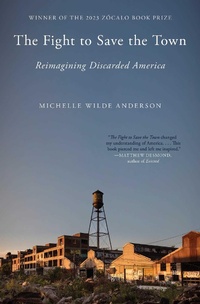
The Fight to Save the Town
Reimagining Discarded America
1st Edition
Published on 21. June 2022
368 pages
978-1-5011-9600-3 (ISBN)
Description

A sweeping and eye-opening study of wealth inequality and the dismantling of local government in four working-class US cities that passionately argues for reinvestment in people-centered leadership and offers "a welcome reminder of what government can accomplish if given the chance" (San Francisco Chronicle).
Decades of cuts to local government amidst rising concentrations of poverty have wreaked havoc on communities left behind by the modern economy. Some of these discarded places are rural. Others are big cities, small cities, or historic suburbs. Some vote blue, others red. Some are the most diverse communities in America, while others are nearly all white, all Latino, or all Black. All are routinely trashed by outsiders for their poverty and their politics. Mostly, their governments are just broke. Forty years after the anti-tax revolution began protecting wealthy taxpayers and their cities, our high-poverty cities and counties have run out of services to cut, properties to sell, bills to defer, and risky loans to take.
In this "astute and powerful vision for improving America" (Publishers Weekly), urban law expert and author Michelle Wilde Anderson offers unsparing, humanistic portraits of the hardships left behind in four such places. But this book is not a eulogy or a lament. Instead, Anderson travels to four blue-collar communities that are poor, broke, and progressing. Networks of leaders and residents in these places are facing down some of the hardest challenges in American poverty today. In Stockton, California, locals are finding ways, beyond the police department, to reduce gun violence and treat the trauma it leaves behind. In Josephine County, Oregon, community leaders have enacted new taxes to support basic services in a rural area with fiercely anti-government politics. In Lawrence, Massachusetts, leaders are figuring out how to improve job security and wages in an era of backbreaking poverty for the working class. And a social movement in Detroit, Michigan, is pioneering ways to stabilize low-income housing after a wave of foreclosures and housing loss.
Our smallest governments shape people's safety, comfort, and life chances. For decades, these governments have no longer just reflected inequality?they have helped drive it. But it doesn't have to be that way. Anderson shows that "if we learn to save our towns, we will also be learning to save ourselves" (The New York Times Book Review).
Decades of cuts to local government amidst rising concentrations of poverty have wreaked havoc on communities left behind by the modern economy. Some of these discarded places are rural. Others are big cities, small cities, or historic suburbs. Some vote blue, others red. Some are the most diverse communities in America, while others are nearly all white, all Latino, or all Black. All are routinely trashed by outsiders for their poverty and their politics. Mostly, their governments are just broke. Forty years after the anti-tax revolution began protecting wealthy taxpayers and their cities, our high-poverty cities and counties have run out of services to cut, properties to sell, bills to defer, and risky loans to take.
In this "astute and powerful vision for improving America" (Publishers Weekly), urban law expert and author Michelle Wilde Anderson offers unsparing, humanistic portraits of the hardships left behind in four such places. But this book is not a eulogy or a lament. Instead, Anderson travels to four blue-collar communities that are poor, broke, and progressing. Networks of leaders and residents in these places are facing down some of the hardest challenges in American poverty today. In Stockton, California, locals are finding ways, beyond the police department, to reduce gun violence and treat the trauma it leaves behind. In Josephine County, Oregon, community leaders have enacted new taxes to support basic services in a rural area with fiercely anti-government politics. In Lawrence, Massachusetts, leaders are figuring out how to improve job security and wages in an era of backbreaking poverty for the working class. And a social movement in Detroit, Michigan, is pioneering ways to stabilize low-income housing after a wave of foreclosures and housing loss.
Our smallest governments shape people's safety, comfort, and life chances. For decades, these governments have no longer just reflected inequality?they have helped drive it. But it doesn't have to be that way. Anderson shows that "if we learn to save our towns, we will also be learning to save ourselves" (The New York Times Book Review).
More details
Other editions
Additional editions
Book
07/2023
Avid Reader Press
€18.50
Shipment within 10-20 days
Book
08/2022
Avid Reader Press
€44.80
Article exhausted; check different version
Person
Michelle Wilde Anderson
