

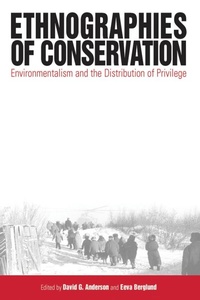
Ethnographies of Conservation
Description

Anthropologists know that conservation often disempowers already under-privileged groups, and that it also fails to protect environments. Through a series of ethnographic studies, this book argues that the real problem is not the disappearance of "pristine nature" or even the land-use practices of uneducated people. Rather, what we know about culturally determined patterns of consumption, production and unequal distribution, suggests that critical attention would be better turned on discourses of "primitiveness" and "pristine nature" so prevalent within conservation ideology, and on the historically formed power and exchange relationships that they help perpetuate.
More details
Other editions
Additional editions
Persons
David G. Anderson is Senior Lecturer in the Department of Anthropology at the University of Aberdeen.
Content
Introduction: Towards an Ethnography of Ecological Underprivilege
E. Berglund and D. Anderson
Chapter 1. Nature as Contested Terrai: Conflicts over Wilderness Protection and Local Livelihoods in Rio San Juan, Nicaragua
A. Nygren
Chapter 2. Pitfalls of Synchronicity: A Case Study of the Caiçaras in the Atlantic Rainforest of South-eastern Brazil
C. Adams
Chapter 3. The Environment at the Periphery: Conflicting Discourses on the Forest in Tanimbar, Eastern Indonesia
N. Frost and R. Wrangham
Chapter 4. Protest, Conflict and Litigation: Dissent or Libel in Resistance to a Conservancy in North-West Namibia
S. Sullivan
Chapter 5. Environmentalism in the Syrian Badia: The Assumptions of Degradation, Protection and Bedouin Misuse
D. Chatty
Chapter 6. "Ecocide and Genocide": Explorations of Environmental Justice in Lakota Sioux Country
B. Halder
Chapter 7. Promoting Consumption in the Rainforest: Global Conservation in Papua New Guinea
D. Ellis
Chapter 8. "We still are Soviet People": Youth Ecological Culture in the Republic of Tatarstan and the Legacy of the Soviet Union
L. Rolle
Chapter 9. The Ecology of Markets in Central Siberia
D. Anderson
Chapter 10. Contrasting Landscapes, Conflicting Ontologies: Assessing Environmental Conservation on Palawan Island, The Philippines
D. Novellino
Chapter 11. Ecologism as an Idiom in Amazonian Anthropology
S. Nugent
Notes on Contributors
Bibliography
Index
