

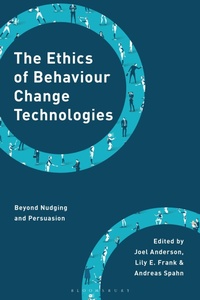
The Ethics of Behaviour Change Technologies
Beyond Nudging and Persuasion
1st Edition
Published on 2. October 2025
288 pages
978-1-78661-327-1 (ISBN)
Description

This book investigates behaviour change technologies (BCTs) from an ethical perspective, examining the broader societal and philosophical implications of these types of technologies. These technologies-ranging from fitness trackers and smart home systems to digital nudging and persuasive AI-are increasingly shaping our choices, habits, and lifestyles. This book moves beyond nudging and persuasion to explore a broader spectrum of ethical concerns, including autonomy, privacy, trust, responsibility, and social justice. Contributors from leading scholars do not merely critique BCTs but also offer constructive ethical frameworks and ethical analysis for their responsible design and implementation.
More details
Series
Edition
1. Auflage
Language
English
Place of publication
London
United Kingdom
Publishing group
Bloomsbury Publishing PLC
Target group
Professional and scholarly
Illustrations
3 bw illus
ISBN-13
978-1-78661-327-1 (9781786613271)
Copyright in bibliographic data and cover images is held by Nielsen Book Services Limited or by the publishers or by their respective licensors: all rights reserved.
Schweitzer Classification
Other editions
Additional editions
Joel Anderson | Lily E. Frank | Andreas Spahn
The Ethics of Behaviour Change Technologies
Beyond Nudging and Persuasion
Book
approx. 12/2025
Rowman & Littlefield International
€133.80
Not yet published
Persons
Joel Anderson is Professor of Moral Psychology and Social Philosophy at the Ethics Institute in the Department of Philosophy and Religious Studies of Utrecht University, the Netherlands. In his work, he develops a relational and intersubjectivist conception of autonomy, a recognitional account of critical social theory, an "extended" approach to self-regulation and disability studies, and a social ethics of technology. He is currently working on a book on "Autonomy Gaps" and editing a collection about how technology is "Disrupting the Human." He is also a principal investigator in the research consortium Ethics of Socially Disruptive Technologies (ESDiT.nl).
Lily E. Frank is Assistant Professor of Philosophy and Ethics at Eindhoven University of Technology, the Netherlands. Her research encompasses biomedical ethics, biotechnology, moral psychology, and ethics of technology. Currently, she investigates topics such as moral expertise, the moralization of health conditions, and the interplay between technology and moral progress. She also explores reproductive ethics, including issues like abortion and the development of artificial uteruses. Frank serves as a Senior Researcher at the 4TU Center for Ethics and Technology and is a board member of the TU/e Center for Humans and Technology.
Andreas Spahn is Associate Professor in the Philosophy and Ethics research group at the Eindhoven University of Technology, the Netherlands. He has worked and published on ethics of behaviour change technologies and persuasive technologies, ethics of energy systems, and environmental ethics, as well as on the role of ethics in engineering education. Spahn is a member of the management team and senior researchers in the 4TU Center for Ethics and Technology, as well as in the ESDiT research program on Ethics of Socially Disruptive Technologies.
Lily E. Frank is Assistant Professor of Philosophy and Ethics at Eindhoven University of Technology, the Netherlands. Her research encompasses biomedical ethics, biotechnology, moral psychology, and ethics of technology. Currently, she investigates topics such as moral expertise, the moralization of health conditions, and the interplay between technology and moral progress. She also explores reproductive ethics, including issues like abortion and the development of artificial uteruses. Frank serves as a Senior Researcher at the 4TU Center for Ethics and Technology and is a board member of the TU/e Center for Humans and Technology.
Andreas Spahn is Associate Professor in the Philosophy and Ethics research group at the Eindhoven University of Technology, the Netherlands. He has worked and published on ethics of behaviour change technologies and persuasive technologies, ethics of energy systems, and environmental ethics, as well as on the role of ethics in engineering education. Spahn is a member of the management team and senior researchers in the 4TU Center for Ethics and Technology, as well as in the ESDiT research program on Ethics of Socially Disruptive Technologies.
Content
Introduction: The Ethical Landscape of Behaviour Change Technology
Joel Anderson (Utrecht University, the Netherlands), Lily E. Frank (Eindhoven University of Technology, the Netherlands), Andreas Spahn (Eindhoven University of Technology, the Netherlands) and Arianna Sica (Eindhoven University of Technology, the Netherlands)
Part I. Foundations
1. Psychology of Behaviour Change
Wokje Abrahamse (Victoria University of Wellington, New Zealand) and Nadja Contzen (Eawag: Swiss Federal Institute of Aquatic Science and Technology, Switzerland, and University of Groningen, the Netherlands)
Chapter 2. Technologies of Behaviour Change
Harri Oinas-Kukkonen (University of Oulu, Finland) and Eunice E.Y.F. Agyei (University of Oulu, Finland)
Chapter 3. Guiding Hands or Invisible Chains? On the Ethics and Philosophy of Behaviour Change Technologies
Andreas Spahn (Eindhoven University of Technology, the Netherlands) and Lily E. Frank (Eindhoven University of Technology, the Netherlands)
Part II. Values and Principles
Chapter 4. Control, Personal Autonomy, and Behaviour Change Technologies
Sven Nyholm (Ludwig Maximilian University of Munich, Germany)
Chapter 5. Transparency and Trust in Behaviour Change Technologies
Philip J. Nickel (Eindhoven University of Technology, the Netherlands)
Chapter 6. Privacy, Consent, and Behaviour Change Technologies
Titus Stahl (University of Groningen, the Netherlands)
Chapter 7. Social Justice, Autonomous Agency, and Interpersonal Recognition
Joel Anderson (Utrecht University, the Netherlands)
Part III. Cases and Applications
Chapter 8. Limiting Driver Autonomy for Safety and Sustainability
Jilles Smids (Erasmus University Rotterdam, the Netherlands)
Chapter 9. 'Good Patients Manage Their Health': A Critical Conceptual Analysis of the Patient as Health Manager Using Smart Technology
Tania Moerenhout (University of Otago, New Zealand) and Katleen Gabriels (Maastricht University, the Netherlands)
Chapter 10. The Ethics of Using Boosts to Change Behaviour
Till Grüne-Yanoff (Royal Institute of Technology, Sweden)
Chapter 11. The Cumulative Impact of Behaviour Change Interventions
Will Tiemeijer (Erasmus University Rotterdam, the Netherlands)
Chapter 12. Pandemic Behaviour Change Technology, Autonomy, and Confucian Philosophy: The Case of Jiankangma (China's Digital Health Code)
Tom Xiaowei Wang (Renmin University of China, China) and Pak-Hang Wong (Hong Kong Baptist University, Hong Kong)
Chapter 13. Behaviour Change, Technology, and the Regulation of the Poor: A Case Study of the 'Water Wars' in South Africa
Brendon R. Barnes (University of Johannesburg, South Africa)
Index
About the Contributors
Joel Anderson (Utrecht University, the Netherlands), Lily E. Frank (Eindhoven University of Technology, the Netherlands), Andreas Spahn (Eindhoven University of Technology, the Netherlands) and Arianna Sica (Eindhoven University of Technology, the Netherlands)
Part I. Foundations
1. Psychology of Behaviour Change
Wokje Abrahamse (Victoria University of Wellington, New Zealand) and Nadja Contzen (Eawag: Swiss Federal Institute of Aquatic Science and Technology, Switzerland, and University of Groningen, the Netherlands)
Chapter 2. Technologies of Behaviour Change
Harri Oinas-Kukkonen (University of Oulu, Finland) and Eunice E.Y.F. Agyei (University of Oulu, Finland)
Chapter 3. Guiding Hands or Invisible Chains? On the Ethics and Philosophy of Behaviour Change Technologies
Andreas Spahn (Eindhoven University of Technology, the Netherlands) and Lily E. Frank (Eindhoven University of Technology, the Netherlands)
Part II. Values and Principles
Chapter 4. Control, Personal Autonomy, and Behaviour Change Technologies
Sven Nyholm (Ludwig Maximilian University of Munich, Germany)
Chapter 5. Transparency and Trust in Behaviour Change Technologies
Philip J. Nickel (Eindhoven University of Technology, the Netherlands)
Chapter 6. Privacy, Consent, and Behaviour Change Technologies
Titus Stahl (University of Groningen, the Netherlands)
Chapter 7. Social Justice, Autonomous Agency, and Interpersonal Recognition
Joel Anderson (Utrecht University, the Netherlands)
Part III. Cases and Applications
Chapter 8. Limiting Driver Autonomy for Safety and Sustainability
Jilles Smids (Erasmus University Rotterdam, the Netherlands)
Chapter 9. 'Good Patients Manage Their Health': A Critical Conceptual Analysis of the Patient as Health Manager Using Smart Technology
Tania Moerenhout (University of Otago, New Zealand) and Katleen Gabriels (Maastricht University, the Netherlands)
Chapter 10. The Ethics of Using Boosts to Change Behaviour
Till Grüne-Yanoff (Royal Institute of Technology, Sweden)
Chapter 11. The Cumulative Impact of Behaviour Change Interventions
Will Tiemeijer (Erasmus University Rotterdam, the Netherlands)
Chapter 12. Pandemic Behaviour Change Technology, Autonomy, and Confucian Philosophy: The Case of Jiankangma (China's Digital Health Code)
Tom Xiaowei Wang (Renmin University of China, China) and Pak-Hang Wong (Hong Kong Baptist University, Hong Kong)
Chapter 13. Behaviour Change, Technology, and the Regulation of the Poor: A Case Study of the 'Water Wars' in South Africa
Brendon R. Barnes (University of Johannesburg, South Africa)
Index
About the Contributors
