

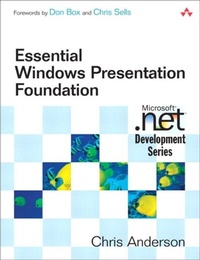
Essential Windows Presentation Foundation (WPF)
1st Edition
Published on 11. April 2007
512 pages
978-0-13-270161-7 (ISBN)
Description

Windows Presentation Foundation (WPF) replaces Microsoft's diverse presentation technologies with a unified, state-of-the-art platform for building rich applications. WPF combines the best of Windows and the Web; fully integrates user interfaces, documents, and media; and leverages the full power of XML-based declarative programming.
In Essential Windows Presentation Foundation, former WPF architect Chris Anderson systematically introduces this breakthrough platform, focusing on the concepts and techniques working developers need in order to build robust applications for real users. Drawing on his unique experience as an architect on the team, Anderson thoroughly illuminates the crucial new concepts underlying WPF and reveals how its APIs work together to offer developers unprecedented value.
Through working sample code, you'll discover how WPF draws on the Web's simple models for markup and deployment, common frame for applications, and rich server connectivity, and on Windows' rich client model, simple programming model, strong control over look-and-feel, and rich networking. Topics explored in depth include
WPF components and architecture
Key WPF design decisions-and why they matter
XAML markup language
Controls
Layouts
Visuals and media, including 2D, 3D, video, and animation
Data integration
Actions
Styles
WPF Base Services
In Essential Windows Presentation Foundation, former WPF architect Chris Anderson systematically introduces this breakthrough platform, focusing on the concepts and techniques working developers need in order to build robust applications for real users. Drawing on his unique experience as an architect on the team, Anderson thoroughly illuminates the crucial new concepts underlying WPF and reveals how its APIs work together to offer developers unprecedented value.
Through working sample code, you'll discover how WPF draws on the Web's simple models for markup and deployment, common frame for applications, and rich server connectivity, and on Windows' rich client model, simple programming model, strong control over look-and-feel, and rich networking. Topics explored in depth include
WPF components and architecture
Key WPF design decisions-and why they matter
XAML markup language
Controls
Layouts
Visuals and media, including 2D, 3D, video, and animation
Data integration
Actions
Styles
WPF Base Services
More details
Language
English
Place of publication
Boston
United States
Publishing group
Pearson Education (US)
Target group
College/higher education
ISBN-13
978-0-13-270161-7 (9780132701617)
Copyright in bibliographic data and cover images is held by Nielsen Book Services Limited or by the publishers or by their respective licensors: all rights reserved.
Schweitzer Classification
Other editions
Additional editions
Chris Anderson
Essential Windows Presentation Foundation (WPF)
Book
04/2007
Addison Wesley
€50.12
Article exhausted; check different version
Person
Chris Anderson, architect in Microsoft's Connected Systems Division, specializes in designing and architecting .NET technologies for the next generation of applications and services. In ten years at Microsoft, he has worked on technologies ranging from Visual Basic 6.0 and Visual J++ 6.0 to .NET Framework 1.0 and 1.1. In 2002, he joined the Windows Client team as an architect for Windows Presentation Foundation. Anderson has spoken at numerous conferences, including PDC, TechEd, WinDev, and DevCon.
Content
Figures xv Foreword by Don Box xxv Foreword by Chris Sells xxvii Preface xxix About the Author xxxix Chapter 1: Introduction 1 WPF as the New GUI 1
A Brief Look at the XAML Programming Model 11
A Tour of WPF 17
Tools for Building Applications 39
Where Are We? 41
Chapter 2: Applications 43 Application Principles 43
Application 52
Resources and Configuration 60
Windows 71
User Controls 80
Navigation and Pages 83
Hosting Applications in a Browser 103
Where Are We? 111
Chapter 3: Controls 113 Control Principles 113
Control Library 128
Building Blocks 161
Where Are We? 171
Chapter 4: Layout 173 Layout Principles 173
Layout Library 186
Grid 196
Writing a Custom Layout 207
Where Are We? 215
Chapter 5: Visuals 217 2D Graphics 218
3D Graphics 254
Documents and Text 267
Animation 283
Media 300
Where Are We? 305
Chapter 6: Data 307 Data Principles 307
Resources 310
Binding Basics 316
Binding to CLR Objects 322
Binding to XML 331
Data Templates 338
Advanced Binding 342
Data-Driven Display 357
Where Are We? 363
Chapter 7: Actions 365 Action Principles 365
Events 369
Commands 373
Triggers 383
Where Are We? 389
Chapter 8: Styles 391 Style Principles 391
Beginning Styles 397
Using Styles for Good, Not Evil 415
Where Are We? 419
Appendix: Base Services 421 Threading and Dispatchers 421
Properties 427
Keyboards, Mice, and Styluses 437
Where Are We? 442
Index 443
A Brief Look at the XAML Programming Model 11
A Tour of WPF 17
Tools for Building Applications 39
Where Are We? 41
Chapter 2: Applications 43 Application Principles 43
Application 52
Resources and Configuration 60
Windows 71
User Controls 80
Navigation and Pages 83
Hosting Applications in a Browser 103
Where Are We? 111
Chapter 3: Controls 113 Control Principles 113
Control Library 128
Building Blocks 161
Where Are We? 171
Chapter 4: Layout 173 Layout Principles 173
Layout Library 186
Grid 196
Writing a Custom Layout 207
Where Are We? 215
Chapter 5: Visuals 217 2D Graphics 218
3D Graphics 254
Documents and Text 267
Animation 283
Media 300
Where Are We? 305
Chapter 6: Data 307 Data Principles 307
Resources 310
Binding Basics 316
Binding to CLR Objects 322
Binding to XML 331
Data Templates 338
Advanced Binding 342
Data-Driven Display 357
Where Are We? 363
Chapter 7: Actions 365 Action Principles 365
Events 369
Commands 373
Triggers 383
Where Are We? 389
Chapter 8: Styles 391 Style Principles 391
Beginning Styles 397
Using Styles for Good, Not Evil 415
Where Are We? 419
Appendix: Base Services 421 Threading and Dispatchers 421
Properties 427
Keyboards, Mice, and Styluses 437
Where Are We? 442
Index 443
