

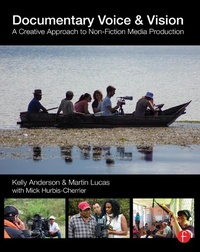
Documentary Voice & Vision
A Creative Approach to Non-Fiction Media Production
Published on 31. March 2016
484 pages
978-1-317-63613-7 (ISBN)
Description

Learn the creative and technical essentials of documentary filmmaking with Documentary Voice & Vision. This comprehensive work combines clear, up-to-date technical information, production techniques and gear descriptions with an understanding of how technical choices can create meaning and serve a director's creative vision. Drawing on the authors' years of experience as documentary filmmakers, and on interviews with a range of working professionals in the field, the book offers concrete and thoughtful guidance through all stages of production, from finding and researching ideas to production, editing and distribution. Documentary Voice & Vision will help students and aspiring filmmakers think though research and story structure, ethics, legal issues and aesthetics, as well as techniques from camera handling to lighting, sound recording and editing. The book explores a full range of production styles, from expository to impressionistic to observational, and provides an overview of contemporary distribution options.
Documentary Voice & Vision is a companion text to Mick Hurbis-Cherrier's Voice & Vision: A Creative Approach to Narrative Film and DV Production, and employs a similar style and approach to that classic text. This text is written from the perspective of documentary filmmakers, and includes myriad examples from the world of non-fiction filmmaking. A robust companion website featuring additional resources and interactive figures accompanies the book.
Documentary Voice & Vision is a companion text to Mick Hurbis-Cherrier's Voice & Vision: A Creative Approach to Narrative Film and DV Production, and employs a similar style and approach to that classic text. This text is written from the perspective of documentary filmmakers, and includes myriad examples from the world of non-fiction filmmaking. A robust companion website featuring additional resources and interactive figures accompanies the book.
Reviews / Votes
"Documentary Voice and Vision offers an expansive soup-to-nuts approach to advanced nonfiction filmmaking and is remarkably comprehensive in scope. The book guides the filmmaker through the myriad hurdles of documentary production, deftly interweaving detailed practical information and relevant case studies." -Jan Krawitz, Professor, Department of Art & Art History, Stanford University"No more need to cobble together different materials on storytelling, styles, history, theory, production techniques and the latest technical aspects of documentary filmmaking-it's all here! Whether for undergraduate or graduate students, or experienced professionals looking for an updated understanding of the field, this book is an essential tool." -Johnny Symons, Assistant Professor and Documentary Program Coordinator, School of Cinema, San Francisco State University
"Anderson, Lucas, and Hurbis-Cherrier have done an extraordinary job providing an in-depth understanding of how documentaries are made from both an aesthetic and technical perspective. Superb book." -Sam Pollard, Producer/Editor, 4 Little Girls, Eyes on the Prize, Sinatra: All or Nothing at All, When the Levees Broke: A Requiem in Four Acts
"An impressive book! The authors have expertly drawn upon their filmmaking skills and integrated it with decades of teaching experience to incorporate theory with practice. Documentary Voice & Vision is both an essential reference for students and an informed update for skilled professionals." -Arthur Dong, Distinguished Professor in Film, Loyola Marymount University, Director, Coming Out Under Fire, Licensed to Kill, Hollywood Chinese, The Killing Fields of Dr. Haing S. Ngor
This is a very comprehensive guide to contemporary documentary filmmaking. Embedded in the history of the form but also using a wealth of current examples, it is rich in aesthetic, practical and technical knowledge." -Tony Dowmunt, Professor, Department of Media and Communications, Goldsmith's College, University of London
"Documentary Voice & Vision is a comprehensive resource for documentary film production, balancing practical, technical information and historical insight into documentary practice and methods. This textbook provides a valuable line of inquiry into the ethical, storytelling, and aesthetic issues documentary production students face. The text features real world examples from contemporary documentary filmmakers and serves as a wonderful tool for any documentary production class."-Jamie Meltzer, Associate Professor, Documentary Film and Video, Stanford University
More details
Language
English
Place of publication
London
United Kingdom
Publishing group
Taylor & Francis Ltd
Target group
College/higher education
File size
28,25 MB
ISBN-13
978-1-317-63613-7 (9781317636137)
Copyright in bibliographic data and cover images is held by Nielsen Book Services Limited or by the publishers or by their respective licensors: all rights reserved.
Schweitzer Classification
Other editions
Additional editions
Kelly Anderson | Martin Lucas
Documentary Voice & Vision
A Creative Approach to Non-Fiction Media Production
Book
04/2016
1st Edition
Routledge
€207.50
Shipment within 10-20 days
Kelly Anderson | Martin Lucas
Documentary Voice & Vision
A Creative Approach to Non-Fiction Media Production
Book
04/2016
1st Edition
Routledge
€103.07
Shipment within 10-20 days
Persons
Kelly Anderson's documentaries include My Brooklyn (2012) and Every Mother's Son (2004, with Tami Gold). Her work has been screened on the PBS series POV and on HBO, and she was nominated for a national Emmy Award. She is a Professor in the Department of Film and Media Studies at Hunter College, City University of New York.
Martin Lucas is a documentary filmmaker and educator with over 30 years of experience making and speaking about documentary worldwide. His most recent film, Hiroshima Bound (2015), is a personal exploration of coming to terms with the Atomic Bomb. He teaches in the Department of Film and Media Studies at Hunter College, City University of New York.
Mick Hurbis-Cherrier teaches film production and screenwriting at Hunter College, City University of New York. Professionally, he has worked as a screenwriter, director, cinematographer, and editor. He is the author of Voice & Vision: A Creative Approach to Narrative Film and DV Production 2nd ed. (Focal Press) and the coauthor of Directing: Film Techniques and Aesthetics, 5th ed. (Focal Press) (with Michael Rabiger).
Martin Lucas is a documentary filmmaker and educator with over 30 years of experience making and speaking about documentary worldwide. His most recent film, Hiroshima Bound (2015), is a personal exploration of coming to terms with the Atomic Bomb. He teaches in the Department of Film and Media Studies at Hunter College, City University of New York.
Mick Hurbis-Cherrier teaches film production and screenwriting at Hunter College, City University of New York. Professionally, he has worked as a screenwriter, director, cinematographer, and editor. He is the author of Voice & Vision: A Creative Approach to Narrative Film and DV Production 2nd ed. (Focal Press) and the coauthor of Directing: Film Techniques and Aesthetics, 5th ed. (Focal Press) (with Michael Rabiger).
Content
Introduction
Part 1: Developing Your Documentary
Ch. 1. Finding and Developing Ideas
Ch. 2. Documentary Styles
Ch. 3: Structuring the Documentary
Ch. 4: The Documentary Proposal
Ch. 5 Documentary Ethics and Legal Issues
Part 2: Production
Ch. 6 Planning the Shoot
Ch. 7 Organizing Cinematic Time and Space
Ch. 8 The Digital Video System
Ch. 9 The Lens
Ch. 10 Camera Support
Ch. 11 Basic Lighting for Documentary
Ch. 12: Lighting and Exposure - Beyond the Basics
Ch. 13 Sound Basics and Equipment
Ch. 14 Location Sound Techniques
Ch. 15 Interviewing and Working With Subjects
Ch. 16 Production Procedures, Etiquette and Safety
Part 3: Postproduction
Ch. 17: Postproduction Workflow and the Process of Digital Editing
Ch. 18: Writing and Structuring the Documentary
Ch. 19: The Art of Editing
Ch. 20: Archival Storytelling
Ch. 21: Sound Design and Finishing
Ch. 22: Finishing Picture and Mastering
Ch. 23: Distributing Your Documentary
Part 1: Developing Your Documentary
Ch. 1. Finding and Developing Ideas
Ch. 2. Documentary Styles
Ch. 3: Structuring the Documentary
Ch. 4: The Documentary Proposal
Ch. 5 Documentary Ethics and Legal Issues
Part 2: Production
Ch. 6 Planning the Shoot
Ch. 7 Organizing Cinematic Time and Space
Ch. 8 The Digital Video System
Ch. 9 The Lens
Ch. 10 Camera Support
Ch. 11 Basic Lighting for Documentary
Ch. 12: Lighting and Exposure - Beyond the Basics
Ch. 13 Sound Basics and Equipment
Ch. 14 Location Sound Techniques
Ch. 15 Interviewing and Working With Subjects
Ch. 16 Production Procedures, Etiquette and Safety
Part 3: Postproduction
Ch. 17: Postproduction Workflow and the Process of Digital Editing
Ch. 18: Writing and Structuring the Documentary
Ch. 19: The Art of Editing
Ch. 20: Archival Storytelling
Ch. 21: Sound Design and Finishing
Ch. 22: Finishing Picture and Mastering
Ch. 23: Distributing Your Documentary
