

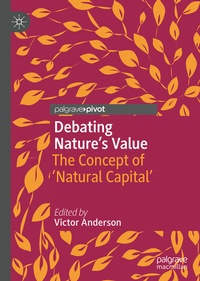
Debating Nature's Value
Description

The concept of 'Natural Capital' has come to play a central role in current debates about biodiversity and nature conservation. It implies an approach to the natural world based on the valuation of places and species in terms of money. This is, in a variety of ways, both attractive and problematic.
This edited collection comprehensively discusses the issues raised by the concept of 'Natural Capital', with contributors presenting not only arguments for and against the widespread adoption of the idea, but also viewpoints arguing for nuanced, pragmatic and middle-ground positions.
Reviews / Votes
"In this edited collection, Anderson (Anglia Ruskin Univ., UK) explains the controversial nature of natural capital and shows how different contributors approach the issues raised by the use and implications of this concept. . Summing Up: Recommended. Advanced undergraduates through faculty and professionals; general readers." (R. M. Ramazani, Choice, Vol. 56 (12), August 2019)More details
Other editions
Additional editions
Person
Content
Chapter 1: Introduction.- Chapter 2: The International Debate.- Chapter 3: A Micro Case Study: Critiquing the TEEB.- Chapter 4: The Natural Capital Protocol.- Chapter 5: The Role of Monetary Valuation.- Chapter 6: Is the Concept of Natural Capital Useful?.- Chapter 7: How Should we Value Nature?.- Chapter 8: Natural Capital: The Risks of Losing Sight of Nature.- Chapter 9: Some Problems about Measuring Natural Capital.- Chapter 10: Who Should Value Nature?.- Chapter 11: 'Natural Capital': Ontology or Transitional Analogy?.- Chapter 12: Natural Capital and Tragedy.- Chapter 13: The Role of 'Natural Capital' in the Debate about Biodiversity.
