

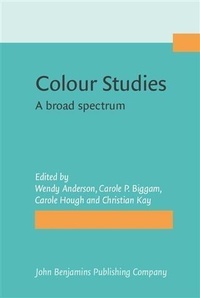
Colour Studies
A broad spectrum
1st Edition
Published on 26. November 2014
XIV, 417 pages
978-90-272-6919-5 (ISBN)
Description

This volume presents some of the latest research in colour studies by specialists across a wide range of academic disciplines. Many are represented here, including anthropology, archaeology, the fine arts, linguistics, onomastics, philosophy, psychology and vision science. The chapters have been developed from papers and posters presented at the Progress in Colour Studies (PICS12) conference held at the University of Glasgow. Papers from the earlier PICS04 and PICS08 conferences were published by John Benjamins as Progress in Colour Studies, 2 volumes, 2006 and New Directions in Colour Studies, 2011, respectively. The opening chapter of this new volume stems from the conference keynote talk on prehistoric colour semantics by Carole P. Biggam. The remaining chapters are grouped into three sections: colour and linguistics; colour categorization, naming and preference; and colour and the world. Each section is preceded by a short preface drawing together the themes of the chapters within it. There are thirty-one colour illustrations.
More details
Other editions
Additional editions
Book
11/2014
John Benjamins Publishing Co
€111.30
Shipment within 10-15 days
Persons
Content
- Colour Studies
- Title page
- LCC data
- Table of contents
- Preface
- Acknowledgements
- Abbreviations
- Section I. Prehistoric colour semantics
- Prehistoric colour semantics: A contradiction in terms
- 1. Introduction
- 2. Lexical form
- 3. Semantic content
- 4. Core concepts and core vocabulary
- 5. The evolutionary sequence
- 6. Cognates
- 7. The situation so far
- 8. Prototypes
- 9. Archaeology and colour prototypes
- 10. Anthropology and colour concepts
- 11. Art and colour terms
- 12. The earliest recorded Indo-European colour terms
- 13. Conclusion
- References
- Section II. Colour and linguistics
- Preface to Section II
- Towards a historical and cultural atlas of colour terms in the Near East
- 1. Introduction
- 2. Brightness versus hue
- 3. The data
- 4. The grue (green+blue) category in contemporary Aramaic
- 5. Conclusion
- References
- The evolution of GRUE: Evidence for a new colour term in the language of the Himba
- 1. Introduction
- 2. Experiment 1: colour list task
- 2.1 Introduction
- 2.2 Method
- 2.3 Results
- 2.4 Discussion
- 3. Experiment 2: colour naming task
- 3.1 Introduction
- 3.2 Method
- 3.3 Results
- 3.4 Discussion
- 4. General discussion
- Acknowledgements
- References
- Linguistic categorization of blue in Standard Italian
- 1. Background and objectives
- 2. Methodology
- 3. A description of the subjects
- 4. Results and discussion
- 4.1 The list and colour-naming tasks
- 4.2 Free-sorting and best-example tasks
- 4.3 Collocation-association task and reference to objects
- 5. Discussion
- Acknowledgements
- References
- From blood to worms: The semantic evolution of a Portuguese colour term
- 1. Introduction
- 2. Portuguese roxo and vermelho
- 3. Evidence and timeline of semantic change
- 4. Processes of change
- 4.1 The internal process
- 4.2 The external processes (Iberian dyeing trade)
- 5. Conclusion
- References
- The motivational analysis of some Finnic colour terms
- 1. Introduction
- 2. Ruskea
- 3. Raudjas
- 4. Lepp
- 5. Leet
- 6. Paat
- 7. Conclusion
- References
- Her blue eyes are red: An idealized cognitive model of conceptual color metonymy in English
- 1. Introduction
- 1.1 Activating metonymy for color conceptualization
- 1.2 Definition and discernment of conceptual metonymy
- 1.3 Phrasing and definition
- 1.4 Discernment of conceptual metonymy
- 1.5 Conceptual metonymy and image schemas
- 2. Past research on conceptual metonymy
- 3. Corpus-based analysis
- 3.1 Methodology
- 3.2 Results
- 4. Discussion of conceptual color metonymy
- 5. Conclusion
- Acknowledgements
- References
- The spread of red in the Historical Thesaurus of English
- 1. Introduction
- 2. The problem of pink
- 3. The rise of red
- 3.1 The effect of pink on red
- 4. red and BCC sub-category size variance
- 5. The salience of red
- 5.1 Back to BCCs
- 6. Conclusion
- References
- A metaphorical spectrum: Surveying colour terms in English
- 1. The ubiquity of colour terms
- 2. Mapping Metaphor with the Historical Thesaurus
- 3. English colour terms: a case-study
- 3.1 Black
- 3.2 White
- 3.3 Blue
- 3.4 Yellow
- 3.5 Green
- 4. Conclusion
- References
- Exploring the metaphorical use of colour with the Historical Thesaurus of English
- 1. Introduction
- 2. Mapping metaphor with the Historical Thesaurus
- 3. Methodology
- 4. Purple
- 5. Lavender
- 6. Conclusions
- References
- Section III. Colour categorization, naming and preference
- Preface to Section III
- The case for infant colour categories
- 1. Introduction
- 2. The evidence for infant colour categories
- 3. The evidence against infant colour categories
- 4. Alternative explanations for infant colour categories
- 5. Theoretical challenges
- 6. Conclusions
- Acknowledgements
- References
- Bornstein's paradox (redux)
- 1. The logic of "Bornstein's paradox"
- 2. Is there a perceptual cognitive organization of colour experience
- 3. Undermining Bornstein's paradox: colour as a core cognitive domain
- 4. Explicit colour categories
- References
- Category effects on colour discrimination
- 1. Introduction
- 2. Categorical sensitivity
- 3. Categorical facilitation
- 4. Lateralized category effect
- 5. Categorical appearance
- 6. Conclusion
- Acknowledgements
- References
- Colour category effects: Evidence from asymmetries in task performance
- 1. Introduction
- 1.1 Colour category effects
- 1.2 Role of on-line stimulus categorization in colour category effects
- 2. Within-pair asymmetries in performance of colour 2-AFC and visual search tasks
- 2.1 Asymmetries in 2-AFC tasks
- 2.2 Asymmetries in visual search tasks
- 3. Summary
- References
- Gender differences in colour naming
- 1. Introduction: gender differences in colour vocabulary, colour naming and colour perception
- 2. Method
- 2.1 Interface of the web-based colour-naming experiment
- 2.2 Colour stimuli
- 2.3 Data analysis
- 3. Results
- 3.1 Validation of the online experimental methodology
- 3.2 Number of words in colour descriptors: females vs males
- 3.3 Occurrence of most frequent colour names: females vs males
- 3.4 Occurrence of BCTs: females vs males
- 3.5 Consistency of colour descriptors: Females vs males
- 3.6 Response times for BCTs and frequent non-BCTs: females vs males
- 3.7 Synthetic image: colour naming segmentation by females vs males
- 4. Discussion
- References
- Personality and gender-schemata contributions to colour preferences
- 1. Introduction
- 2. Method
- 2.1 Subjects
- 2.2 Stimuli
- 2.3 Procedure
- 3. Results
- 3.1 BSRI
- 3.2 IPIP
- 3.3 Preference rankings
- 3.4 Consensus analysis
- 3.5 Mean preference curves
- 3.6 Principal component analysis
- 3.7 Correlations of preferences with IPIP and BSRI scores
- 4. Conclusions
- References
- Axiological aspects of Polish colour vocabulary: A study of associations
- 1. Introduction
- 2. Polish colour vocabulary
- 3. Axiology and colours
- 4. The questionnaire and respondents
- 5. Results of the questionnaire
- 5.1 A quantitative analysis
- 5.2 A qualitative / quantitative analysis
- 5.3 Associations and fixed phrases
- 6. Conclusions
- References
- The metaphysical significance of colour categorization: Mind, world, and their complicated relations
- 1. Introduction: Are colours real?
- 2. Defining colour categorizationloosely
- 3. Anti-realism
- 4. Realism
- 5. Relationism
- 5.1 Categorization and colour constancy
- 5.2 Closing remarks
- 6. Summary
- References
- Section IV. Colour and the world
- Preface to Section IV
- Color seeing and speaking: Effects of biology, environment and language
- 1. Introduction
- 2. Computational approaches to the color terms problem
- 3. Vision and language integration in the cortex
- 4. Environments and languages
- 5. Conclusion
- References
- Colour terms in the names of coastal and inland features
- 1. Introduction
- 2. Base names and derived names
- 3. Colour terms and their referents
- 4. Interpreting names
- 5. Coastal and inland names
- 6. Conclusions
- References
- Referential meaning in basic and non-basic color terms
- 1. Introduction
- 2. Data
- 3. The referential range of basic and non-basic color terms
- 4. Types of color terms
- 5. Conclusion
- Acknowledgements
- References
- Unfolding colour in mind and language: Strategies for colour denotation in Spanish wine-tasting
- 1. Introduction
- 2. Colour naming in wine notes
- 2.1 The red wine categorization system in Spanish
- 2.2 The white wine categorization system in Spanish
- 2.3 Other strategies in colour description and naming
- 2.4 Shifting strategies and perspectives
- 3. Individual perception versus social communication
- 3.1 Dynamical systems theory and complex adaptive systems
- 3.2 Natural language applications of complex adaptive systems thinking
- 3.3 Perception of colour
- 3.4 Language as a social activity
- 4. Conclusion and future plans
- References
- Synaesthetic associations: Exploring the colours of voices
- 1. Introduction
- 2. Experimental design
- 2.1 Participants
- 2.2 Voice stimuli
- 2.3 Colour stimuli
- 2.4 Procedure
- 2.5 Analysis
- 3. Results and discussion
- 3.1 Voice description
- 3.2 Semantic differentials
- 3.3 Colour display
- 3.4 Consistency
- 4. Conclusion
- References
- Bach to the blues: Color, music and emotion across cultures
- 1. Introduction
- 2. Methods
- 2.1 Participants
- 2.2 Materials and equipment
- 2.3 Procedure
- 3. Results
- 3.1 Music-to-color cross-modal matching
- 3.2 Color-emotion ratings
- 3.3 Music-emotion ratings
- 3.4 Correlations between emotion ratings of colors and music
- 4. Discussion
- Acknowledgments
- References
- "Miss Gartside's immediate eye": An examination of Mary Gartside's publications on colour
- 1. Gartside in context: publications on colour in the eighteenth and early nineteenth century
- 1.1 Enlightened Romantics: who published on colour, and why?
- 1.2 The influence of Newton
- 1.3 Moses Harris's colour circles
- 2. Mary Gartside's illustrated publications on colour
- 2.1 Gartside's life, career and context
- 2.2 An Essay on Light and Shade, 1805
- 2.3 An Essay on a New Theory of Colours, 1808
- 2.4 Ornamental Groups, 1808
- 3. Illustrated books on colour after 1810
- 3.1 Towards chromo-lithography
- 3.2 The case of George Field
- 4. Conclusion
- References
- Lighting up Shakespeare: The metamerism of Jacobean stage lighting using LED technology
- 1. Introduction
- 1.1 A brief history of the Jacobean stage
- 2. Aims of the investigation
- 2.1 The metamerism of candlelight using LED technology
- 2.2 Recreating the Jacobean stage
- 2.3 The ambience and flicker of a flame
- 3. Experiments
- 3.1 Quantitative experiments
- 3.2 Qualitative experiments
- 3.3 Colour mixing experiments
- 4. Results and discussion
- 4.1 Quantitative results
- 4.2 Qualitative results
- 4.3 Colour mixing results
- 5. Practical interpretation
- 5.1 Prop lighting - lanterns and cressets
- 5.2 Stage lighting
- 5.3 Ambience and flicker
- 6. Practical evaluation
- Acknowledgements
- References
- Index
