

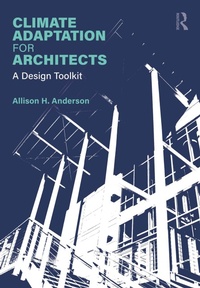
Climate Adaptation for Architects
A Design Toolkit
1st Edition
Published on 16. September 2025
394 pages
978-1-040-38957-7 (ISBN)
Description

Architecture must adapt to protect people from the threat of climate change. About half of the world's population lives in contexts that are highly vulnerable to climate change as hazards continue to intensify, with global disasters projected to reach 560 events per year by 2030, or 1.5 events every day. The accelerating frequency and intensity of disasters underscores the urgency to prepare for severe events to protect people, communities, and essential systems but also to protect the environment which provides shelter, livelihoods, cultural heritage, and public functions. This book provides a comprehensive reference of climate adaptation design tactics and a toolkit for adaptation to shocks and stresses, outlining the process for architects and designers to:
Understand the risks posed by climate change to the built environment.
Reduce the risks to people and the built environment from natural hazards.
Reduce human vulnerability to shocks and stresses by strengthening resilience and adaptive capacity.
Design the built environment to adapt to changes over its lifetime.
Design buildings and cities to reduce dependence on fossil fuels.
Preserve biodiversity and support natural resources.
Climate Adaptation for Architects presents 45 adaptation tactics responding to the most consequential effects of climate change: heat, water, wind, and resource scarcity. Each chapter includes images, a definition, background information, key design considerations, potential impacts, and resources for further information. This is a valuable resource for every architect, landscape architect, urban planner, developer, and policymaker.
Understand the risks posed by climate change to the built environment.
Reduce the risks to people and the built environment from natural hazards.
Reduce human vulnerability to shocks and stresses by strengthening resilience and adaptive capacity.
Design the built environment to adapt to changes over its lifetime.
Design buildings and cities to reduce dependence on fossil fuels.
Preserve biodiversity and support natural resources.
Climate Adaptation for Architects presents 45 adaptation tactics responding to the most consequential effects of climate change: heat, water, wind, and resource scarcity. Each chapter includes images, a definition, background information, key design considerations, potential impacts, and resources for further information. This is a valuable resource for every architect, landscape architect, urban planner, developer, and policymaker.
Reviews / Votes
'Resilience for architects is a matter of understanding how climate hazards threaten to damage and destroy a building and making hundreds of well-informed design decisions. Allison Anderson's book, Climate Adaptation for Architects, is written with the obvious insight of a practicing architect who has made those hundred of decisions many times and lives up to the responsibility to make buildings that will stand the tests of increasing risks'. David Perkes, AIA, Professor, Mississippi State University'The rising number of climate-related disasters worldwide make investing in adaptation increasingly critical. This is an essential resource for designers working at multiple scales to ensure that planning, infrastructure, and buildings are prepared for disasters'. Amy Chester, Director, Rebuild by Design
'Resilient design is essential if we choose to protect people and property from a warmer, more chaotic climate. Luckily, the path forward is clear thanks to Climate Adaptation for Architects: A Design Toolkit. With design strategies that cover the full breadth of challenges we face, every architect now has the tools necessary to design for the future we know is coming'. Corey Squire, author of People, Planet, Design: A Practical Guide to Realizing Architecture's Potential
'Climate Adaptation for Architects provides essential knowledge to drive the crucial need to integrate resilience and adaptation into the built environment. The book is a comprehensive guide to adaptive design solutions at all scales - from materials to community scale, from theory to application. The clear organization by risk category, with great illustrations, makes the book easily accessible as a go-to guide. It should be an indispensable resource for all architects, from students to seasoned professionals'. Mary Ann Lazarus, FAIA LEED Fellow, Architect and Consultant, Cameron MacAllister Group, Adjunct Faculty, Washington University in St. Louis
More details
Edition
1. Auflage
Language
English
Place of publication
London
United Kingdom
Publishing group
Taylor & Francis Ltd
Target group
College/higher education
Professional and scholarly
Illustrations
97 Line drawings, color; 97 Halftones, color; 194 Illustrations, color
File size
148,30 MB
ISBN-13
978-1-040-38957-7 (9781040389577)
Copyright in bibliographic data and cover images is held by Nielsen Book Services Limited or by the publishers or by their respective licensors: all rights reserved.
Schweitzer Classification
Other editions
Additional editions
Book
09/2025
1st Edition
Routledge
€215.74
Shipment within 10-20 days
Book
09/2025
1st Edition
Routledge
€47.50
Shipment within 10-20 days
Person
Allison H. Anderson, FAIA, is the founding principal of unabridged Architecture, a firm recognized for incorporating sustainability, climate change adaptation, and resilience across a wide variety of project scales. Allison was the first LEED-Accredited Professional in Mississippi, focused on sustainability. After Hurricane Katrina devastated her community, unabridged Architecture began exploring resilience and climate adaptation. Her research is included in the Oxford Research Encyclopedia of Natural Hazard Science, the AIA Resilient Project Process Guide, AIA Climate Action Playbook, and the AIA Framework for Design Excellence. Allison has taught architecture at the University of Texas, Tulane University, and Louisiana State University. She is a Fellow of the American Institute of Architects.
Content
INTRODUCTION Part 1. HEAT 1. HEAT RESPONSE NETWORKS 2. POLICY OF SHADE 3. URBAN COOLING WITH WATER 4. COOL CORRIDORS 5. REFLECTIVE + ABSORPTIVE SITES 6. WILDFIRE PROTECTION 7. AIR QUALITY 8. PASSIVE DESIGN, PASSIVE SURVIVABILITY 9. SOLAR CONTROL 10. COOL ENVELOPE 11. BUILDING ELECTRIFICATION 12. UNINTERRUPTIBLE POWER Part 2. WATER 13. TOPOGRAPHY + RISK 14. RETREAT + REALIGNMENT 15. NEARSHORE BREAKWATERS 16. MODULAR REVETMENTS 17. SEAWALLS, FLOODWALLS, LEVEES + BERMS 18. INFILTRATION ZONES, RIPARIAN BUFFERS + LIVING SHORELINES 19. ELEVATED ROADWAYS 20. RECONNECTING WATER 21. THE ELEVATED COMMONS 22. FLOOD BARRIERS + GATES 23. CORNICHE 24. ELEVATION 25. WET + DRY FLOODPROOFING 26. FLOATING STRUCTURES Part 3. WIND 27. WIND ANALYSIS 28. SPATIAL TEXTURE 29. TEMPORARY HOUSING 30. DEFENSIBLE LANDSCAPE 31. CONTINUOUS LOAD PATH 32. ENVELOPE + BREACH 33. COLLATERAL DAMAGE 34. SAFE ROOMS 35. EARTH SHELTER 36. EMERGENCY CACHE Part 4. SCARCITY 37. BIODIVERSITY + ADAPTATION 38. EDIBLE CITIES 39. BOUNDARIES TO GROWTH 40. COMMUNITY PARTICIPATION AFTER DISASTER 41. SOCIAL CAPITAL + SOCIAL INFRASTRUCTURE 42. NET-ZERO WATER 43. CIRCULARITY 44. ADAPTABLE + ADAPTIVE 45. ANTIFRAGILE
