

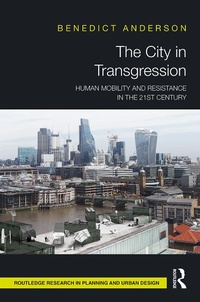
The City in Transgression
Human Mobility and Resistance in the 21st Century
1st Edition
Published on 27. July 2020
242 pages
978-1-000-09345-2 (ISBN)
Description

The City in Transgression explores the unacknowledged, neglected, and ill-defined spaces of the built environment and their transition into places of resistance and residence by refugees, asylum seekers, migrants, the homeless, and the disadvantaged.
The book draws on urban and spatial theory, socio-economic factors, public space, and architecture to offer an intimate look at how urban sites and infrastructure are transformed into spaces for occupation. Anderson proposes that the varied innovations and adaptations of urban spaces enacted by such marginalized figures - for whom there are no other options - herald a radical new spatial programming of cities. The book explores cities and sites such as Mexico City and London, the Mexican/US border, the Calais Jungle, and Palestinian camps in Beirut and utilizes concepts associated with 'mobility' - such as anarchy, vagrancy, and transgression - alongside photography, 3D modelling, and 2D imagery. From this constellation of materials and analysis, a radical spatial picture of the city in transgression emerges.
By focusing on the 'underside of urbanism', The City in Transgression reveals the potential for new spatial networks that can cultivate the potential for self-organization so as to counter the existing dominant urban models of capital and property and to confront some of the major issues facing cities amid an age of global human mobility.
This book is valuable reading for those interested in architectural theory, modern history, human geography and mobility, climate change, urban design, and transformation.
The book draws on urban and spatial theory, socio-economic factors, public space, and architecture to offer an intimate look at how urban sites and infrastructure are transformed into spaces for occupation. Anderson proposes that the varied innovations and adaptations of urban spaces enacted by such marginalized figures - for whom there are no other options - herald a radical new spatial programming of cities. The book explores cities and sites such as Mexico City and London, the Mexican/US border, the Calais Jungle, and Palestinian camps in Beirut and utilizes concepts associated with 'mobility' - such as anarchy, vagrancy, and transgression - alongside photography, 3D modelling, and 2D imagery. From this constellation of materials and analysis, a radical spatial picture of the city in transgression emerges.
By focusing on the 'underside of urbanism', The City in Transgression reveals the potential for new spatial networks that can cultivate the potential for self-organization so as to counter the existing dominant urban models of capital and property and to confront some of the major issues facing cities amid an age of global human mobility.
This book is valuable reading for those interested in architectural theory, modern history, human geography and mobility, climate change, urban design, and transformation.
Reviews / Votes
"Although Dr. Anderson sets out to write 'a succinct account of human mobility and resistance in the 21st century' (p.1), he has ended up doing much more. Not only has he unveiled a new way of studying cities and mobility, he has also offered much-needed answers on how cities might be reconfigured to better support migrants, their families, and friends. The City in Transgression is a breakthrough in how to study the city and make urban policy for people; not for profit. Here is a welcome transgression against orthodoxy."-Franklin Obeng-Odoom, Ph.D. Development Studies and Helsinki Institute of Sustainability Science, University of Helsinki, Finland "Although Dr. Anderson sets out to write 'a succinct account of human mobility and resistance in the 21st century' (p.1), he has ended up doing much more. Not only has he unveiled a new way of studying cities and mobility, he has also offered much-needed answers on how cities might be reconfigured to better support migrants, their families, and friends. The City in Transgression is a breakthrough in how to study the city and make urban policy for people; not for profit. Here is a welcome transgression against orthodoxy."
-Franklin Obeng-Odoom, Ph.D. Development Studies and Helsinki Institute of Sustainability Science, University of Helsinki, Finland
More details
Series
Edition
1. Auflage
Language
English
Place of publication
London
United Kingdom
Publishing group
Taylor & Francis Ltd
Target group
College/higher education
Illustrations
4 Line drawings, black and white; 39 Halftones, black and white; 43 Illustrations, black and white
ISBN-13
978-1-000-09345-2 (9781000093452)
Copyright in bibliographic data and cover images is held by Nielsen Book Services Limited or by the publishers or by their respective licensors: all rights reserved.
Schweitzer Classification
Other editions
Additional editions
Book
01/2023
1st Edition
Routledge
€63.10
Shipment within 15-20 days
Book
08/2020
Routledge
Unfortunately, price unknown
Available (delivery time upon request)
Book
07/2020
1st Edition
Routledge
€206.40
Shipment within 15-20 days
Person
Benedict Anderson is an independent scholar and practices in design, architecture, and public art. He has worked in many different universities, lectured extensively as an invited speaker, and exhibited in major exhibitions around the world. His previous books for Routledge are Buried City, Unearthing Teufelsberg: Berlin and its Geography of Forgetting (2017) and The City in Geography: Renaturing the Built Environment (2019).
Content
Preface
Introduction
Chapter 1 Movement
Interview
Civil and Civic
Migratory Fields
Chapter 2 Urban Mobility
Movement to Mobility
Surface Wearing
Indifferent Non-selves
Chapter 3 Indeterminant Occupation
Determinacy of Experience
Opportunities in Space
Discontent with Place
Chapter 4 Ousted Vagrancy
Roaming Where
Loitering How
Unhomely As
Chapter 5 Collective Anarchy
Off the Wall
Rogue Sites
Out of Space
Chapter 6 City in Transgression
Instability of Order
The Radical TurnInfrastructure Edges
Chapter 7 Unbounded Mobility
Dwelling in MobilityFluid UrbanityFabricating Mobility
Bibliography
Introduction
Chapter 1 Movement
Interview
Civil and Civic
Migratory Fields
Chapter 2 Urban Mobility
Movement to Mobility
Surface Wearing
Indifferent Non-selves
Chapter 3 Indeterminant Occupation
Determinacy of Experience
Opportunities in Space
Discontent with Place
Chapter 4 Ousted Vagrancy
Roaming Where
Loitering How
Unhomely As
Chapter 5 Collective Anarchy
Off the Wall
Rogue Sites
Out of Space
Chapter 6 City in Transgression
Instability of Order
The Radical TurnInfrastructure Edges
Chapter 7 Unbounded Mobility
Dwelling in MobilityFluid UrbanityFabricating Mobility
Bibliography
