

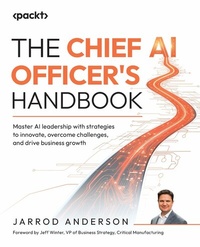
The Chief AI Officer's Handbook
Master AI leadership with strategies to innovate, overcome challenges, and drive business growth
1st Edition
Published on 28. January 2025
336 pages
978-1-83620-084-0 (ISBN)
Description

Empower your leadership with this detailed guide for CAIOs and business leaders to drive innovation, address complex challenges, and implement ethical AI strategiesKey Features - Explore practical frameworks for effective AI team building and team management
- Implement and Optimize AI Agents and Agentic Systems through design and implementation of AI agents.
- Gain actionable advice for leveraging AI to drive innovation and strategic growth
- Purchase of the print or Kindle book includes a free PDF eBook
Book DescriptionChief Artificial Intelligence Officers (CAIOs) are now imperative for businesses, enabling organizations to achieve strategic goals and unlock transformative opportunities through the power of AI. By building intelligent systems, training models to drive impactful decisions, and creating innovative applications, they empower organizations to thrive in an AI-driven world. Written by Jarrod Anderson, Chief AI Officer at SYRV.AI, this book bridges the gap between visionary leadership and practical execution. This handbook reimagines AI leadership for today's fast-paced environment, leveraging predictive, deterministic, generative, and agentic AI to address complex challenges and foster innovation. It provides CAIOs with the strategies to develop transformative AI initiatives, build and lead elite teams, and adopt AI responsibly while maintaining compliance. From shaping impactful solutions to achieving measurable business outcomes, this guide offers a roadmap for making AI your organization's competitive edge. By the end of this book, you'll have the knowledge and tools to excel as a Chief AI Officer, driving innovation, strategic growth, and lasting success for your organization.What you will learn - Develop and execute AI strategy as a CAIO, ensuring ethical compliance
- Master agile AI project management from ideation to deployment
- Apply deterministic and probabilistic AI concepts through case studies
- Design and implement AI agents for autonomous system optimization
- Create human-centered AI systems using proven design principles
- Enhance AI security through data privacy and model protection measures
Who this book is forThis book is for chief AI officers, business leaders, AI and data science professionals, IT managers, entrepreneurs, consultants, academic leaders, policymakers, and general business professionals. This diverse audience seeks to understand not only the technical intricacies of AI, but also how to leverage AI to solve real-world business problems, drive innovation, and achieve strategic goals.
- Implement and Optimize AI Agents and Agentic Systems through design and implementation of AI agents.
- Gain actionable advice for leveraging AI to drive innovation and strategic growth
- Purchase of the print or Kindle book includes a free PDF eBook
Book DescriptionChief Artificial Intelligence Officers (CAIOs) are now imperative for businesses, enabling organizations to achieve strategic goals and unlock transformative opportunities through the power of AI. By building intelligent systems, training models to drive impactful decisions, and creating innovative applications, they empower organizations to thrive in an AI-driven world. Written by Jarrod Anderson, Chief AI Officer at SYRV.AI, this book bridges the gap between visionary leadership and practical execution. This handbook reimagines AI leadership for today's fast-paced environment, leveraging predictive, deterministic, generative, and agentic AI to address complex challenges and foster innovation. It provides CAIOs with the strategies to develop transformative AI initiatives, build and lead elite teams, and adopt AI responsibly while maintaining compliance. From shaping impactful solutions to achieving measurable business outcomes, this guide offers a roadmap for making AI your organization's competitive edge. By the end of this book, you'll have the knowledge and tools to excel as a Chief AI Officer, driving innovation, strategic growth, and lasting success for your organization.What you will learn - Develop and execute AI strategy as a CAIO, ensuring ethical compliance
- Master agile AI project management from ideation to deployment
- Apply deterministic and probabilistic AI concepts through case studies
- Design and implement AI agents for autonomous system optimization
- Create human-centered AI systems using proven design principles
- Enhance AI security through data privacy and model protection measures
Who this book is forThis book is for chief AI officers, business leaders, AI and data science professionals, IT managers, entrepreneurs, consultants, academic leaders, policymakers, and general business professionals. This diverse audience seeks to understand not only the technical intricacies of AI, but also how to leverage AI to solve real-world business problems, drive innovation, and achieve strategic goals.
All prices
More details
Other editions
Additional editions
Jarrod Anderson
The Chief AI Officer's Handbook
Master AI leadership with strategies to innovate, overcome challenges, and drive business growth
Book
01/2025
Packt Publishing
€55.90
Shipment within 3-4 weeks
Persons
Anderson Jarrod :
Jarrod Anderson is the Chief Artificial Intelligence Officer at SYRV. He is a visionary and transformative leader in AI. With over three decades of experience, he has led AI teams at multiple Fortune 50 companies. Now dedicated to cutting-edge AI agents and agentic systems, he pushes AI's boundaries to drive innovation, efficiency, and growth. At SYRV, he leads his team to achieve groundbreaking advancements across industries, envisioning a future where AI is integral to business strategy and operational excellence. His expertise spans agriculture, finance, energy, and manufacturing, where he has integrated AI solutions to solve complex challenges and create new opportunities, delivering exceptional value to clients and partners worldwide.
Jarrod Anderson is the Chief Artificial Intelligence Officer at SYRV. He is a visionary and transformative leader in AI. With over three decades of experience, he has led AI teams at multiple Fortune 50 companies. Now dedicated to cutting-edge AI agents and agentic systems, he pushes AI's boundaries to drive innovation, efficiency, and growth. At SYRV, he leads his team to achieve groundbreaking advancements across industries, envisioning a future where AI is integral to business strategy and operational excellence. His expertise spans agriculture, finance, energy, and manufacturing, where he has integrated AI solutions to solve complex challenges and create new opportunities, delivering exceptional value to clients and partners worldwide.
Content
Table of Contents - Why Every Company Needs a Chief AI Officer
- Key Responsibilities of a Chief AI Officer
- Crafting a Winning AI Strategy
- Building High-Performing AI Teams
- Data - the Lifeblood of AI
- AI Project Management
- Understanding Deterministic, Probabilistic, and Generative AI
- AI Agents and Agentic Systems
- Designing AI Systems
- Training AI Models
- Deploying AI Solutions
- AI Governance and Ethics
- Security in AI Systems
- Privacy in the Age of AI
- AI Compliance
- Conclusion
- Appendix
- Key Responsibilities of a Chief AI Officer
- Crafting a Winning AI Strategy
- Building High-Performing AI Teams
- Data - the Lifeblood of AI
- AI Project Management
- Understanding Deterministic, Probabilistic, and Generative AI
- AI Agents and Agentic Systems
- Designing AI Systems
- Training AI Models
- Deploying AI Solutions
- AI Governance and Ethics
- Security in AI Systems
- Privacy in the Age of AI
- AI Compliance
- Conclusion
- Appendix
