

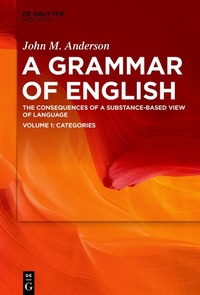
Categories
Description

This grammar of English embraces major lexical, phonological, syntactic structures and interfaces. It is based on the substantive assumption: that the categories and structures at all levels represent mental substance, conceptual and/or perceptual. The adequacy of this assumption in expressing linguistic generalizations is tested. The lexicon is seen as central to the grammar; it contains signs with conceptual, or content, poles, minimally words, and perceptual, and expression, poles, segments. Both words and segments are differentiated by substance-based features. They determine the erection of syntactic and phonological structures at the interfaces from lexicon. The valencies of words, the identification of their semantically determined complements and modifiers, control the erection of syntactic structures in the form of dependency relations. However, the features of different segment types determines their placement in the syllable, or as prosodies. Despite this discrepancy, dependency and linearization are two of the analogical properties displayed by lexical, syntactic and phonological structure. Analogies among parts of the grammar are another consequence of substantiveness, as is the presence of figurativeness and iconicity.
More details
Other editions
Additional editions
Person
Content
- Intro
- Contents
- Preface
- Part I: Parts of Speech
- Chapter 1 Representation
- Chapter 2 Categorization
- Chapter 3 Categorial Asymmetries and Functional Categories
- Chapter 4 The Content of Functors
- Chapter 5 Dependency and Linearity - Syntax
- Chapter 6 Dependency and Linearization - Phonology
- Chapter 7 Complex Categories, and Complex Parts of Speech
- Chapter 8 Determiners and Attributives
- Chapter 9 Names and Pronouns
- Chapter 10 Substance and Modularity - Syntax
- Chapter 11 Substance and Modularity - Phonology
- Chapter 12 Contrast and the Segment
- Chapter 13 Restrictions on Phonological Structure
- Chapter 14 Demands on Syntactic Structure
- Chapter 15 Finiteness, Truth, and Mood
- Chapter 16 Subordinating Conjunctions
- Chapter 17 Coordinating Conjunctions
- Conclusion to Part I
- Part II: Modes of Signifying
- Prelude to Part II
- Chapter 18 Modes of Signifying and of Troping
- Chapter 19 Deverbal Nominalizations and the Genitive
- Chapter 20 Non-deverbal Derived Nouns
- Chapter 21 Adjectives, Nouns, and Valency
- Chapter 22 Derived Adjectives
- Chapter 23 Determinerization, Attributivization, and Adverbialization
- Chapter 24 Adverbs, Attributives, and Nominal Compounds
- Chapter 25 Verbs and Non-deverbal Verbalization
- Chapter 26 Deverbal Verbs
- Conclusion to Part II
- Subplot: Commentary on the Text
