

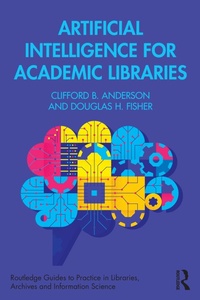
Artificial Intelligence for Academic Libraries
1st Edition
Published on 8. July 2025
236 pages
978-1-040-38071-0 (ISBN)
Description

Artificial Intelligence for Academic Libraries provides a clear and dependable guide to the history, theory, and application of artificial intelligence (AI) and machine learning (ML) in academic libraries, addressing the needs of librarians, staff, administrators, and other stakeholders.
Emerging from a long-running conversation between an academic librarian and a professor of computer science, this book provides readers with a critical perspective on the history, present, and future of AI in libraries and information services. Synthesizing the literature on AI, ML, and librarianship, the authors provide the requisite background to evaluate the impact of these technologies on the information ecosystem. The first half of the volume covers the fundamentals of AI, notably the divergences between the two major AI paradigms as well as philosophical, legal, and ethical issues that arise from the use of AI. The second half addresses specialized topics, including hybrid AIs that bridge the dominant AI paradigms, the responsible use of AI in research and learning, and suggestions for professional development.
Artificial Intelligence for Academic Libraries will benefit academic librarians seeking to develop a solid understanding of AI and ML and their likely impact on library operations and services, including student and faculty outreach. The volume also serves as a pedagogical resource for library and information science students entering this rapidly changing field.
Emerging from a long-running conversation between an academic librarian and a professor of computer science, this book provides readers with a critical perspective on the history, present, and future of AI in libraries and information services. Synthesizing the literature on AI, ML, and librarianship, the authors provide the requisite background to evaluate the impact of these technologies on the information ecosystem. The first half of the volume covers the fundamentals of AI, notably the divergences between the two major AI paradigms as well as philosophical, legal, and ethical issues that arise from the use of AI. The second half addresses specialized topics, including hybrid AIs that bridge the dominant AI paradigms, the responsible use of AI in research and learning, and suggestions for professional development.
Artificial Intelligence for Academic Libraries will benefit academic librarians seeking to develop a solid understanding of AI and ML and their likely impact on library operations and services, including student and faculty outreach. The volume also serves as a pedagogical resource for library and information science students entering this rapidly changing field.
More details
Series
Edition
1. Auflage
Language
English
Place of publication
London
United Kingdom
Publishing group
Taylor & Francis Ltd
Target group
College/higher education
Professional and scholarly
File size
1,32 MB
ISBN-13
978-1-040-38071-0 (9781040380710)
Copyright in bibliographic data and cover images is held by Nielsen Book Services Limited or by the publishers or by their respective licensors: all rights reserved.
Schweitzer Classification
Other editions
Additional editions
Clifford B. Anderson | Douglas H. Fisher
Artificial Intelligence for Academic Libraries
Book
07/2025
1st Edition
Routledge
€206.40
Shipment within 10-20 days
Clifford B. Anderson | Douglas H. Fisher
Artificial Intelligence for Academic Libraries
Book
07/2025
1st Edition
Routledge
€57.20
Shipment within 10-20 days

Clifford B. Anderson
Artificial Intelligence for Academic Libraries
Book
05/2025
Routledge
Unfortunately, price unknown
Article exhausted; check different version
Persons
Clifford B. Anderson is the Director of the Divinity Library at Yale University. Previously, he was Chief Digital Strategist at the Vanderbilt University Library. He holds an M.Div. from Harvard Divinity School, an M.S.L.I.S. from the Pratt Institute, and a Ph.D. from Princeton Theological Seminary. His research interests include computational theology, digital humanities, and block-based programming languages. Among other publications, he is co-author of XQuery for Humanists (2020) and editor of Digital Humanities and Libraries and Archives in Religious Studies (2022).
Douglas H. Fisher is Associate Professor Emeritus and Professor of the Practice in Computer Science at Vanderbilt University, having long taught and researched artificial intelligence, notably machine learning, cognitive modeling, computing for environmental sustainability, computational creativity, database, and other topics. His most recent research and publications, with colleagues, are on the nature of large language model cognition. He served for three years at the National Science Foundation, vetting and administering proposals and grants in all areas of artificial intelligence, as well as interdisciplinary programs. He received the Director's Award for his work on NSF programs for computing and environment, and his innovations on virtual proposal review.
Douglas H. Fisher is Associate Professor Emeritus and Professor of the Practice in Computer Science at Vanderbilt University, having long taught and researched artificial intelligence, notably machine learning, cognitive modeling, computing for environmental sustainability, computational creativity, database, and other topics. His most recent research and publications, with colleagues, are on the nature of large language model cognition. He served for three years at the National Science Foundation, vetting and administering proposals and grants in all areas of artificial intelligence, as well as interdisciplinary programs. He received the Director's Award for his work on NSF programs for computing and environment, and his innovations on virtual proposal review.
Content
Preface; 1 Introduction; 2 Milestones in Deliberative AI Development; 3 The Rise of Connectionist AI; 4 Philosophies of Artificial Intelligence; 5 Ethical and Societal Considerations; 6 Intellectual Property Rights and Obligations; 7 Hybrid AIs; 8 Robust Conversational AI; 9 Professional Development; 10 Looking Forward; Bibliography; Index.
