

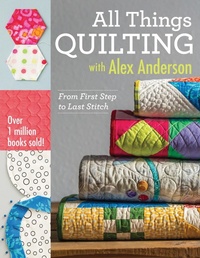
All Things Quilting with Alex Anderson
From First Step to Last Stitch
Published on 30. July 2021
176 pages
978-1-60705-857-1 (ISBN)
Description

This comprehensive guide by the host of
The Quilt Show covers everything you need to know to become a master quilter.
Alex Anderson has taught and inspired countless quilters around the world through her television programs, fabric lines, and numerous books. In All Things Quilting with Alex Anderson, she packs her most indispensable knowledge and advice into a single volume.
Encyclopedic in its scope, it covers quilting techniques, essential tools, binding basics, piecing and appliqué, and much more. It is both a master class for novices and an essential reference for experienced quilters.
Alex Anderson has taught and inspired countless quilters around the world through her television programs, fabric lines, and numerous books. In All Things Quilting with Alex Anderson, she packs her most indispensable knowledge and advice into a single volume.
Encyclopedic in its scope, it covers quilting techniques, essential tools, binding basics, piecing and appliqué, and much more. It is both a master class for novices and an essential reference for experienced quilters.
More details
Other editions
Additional editions
Book
06/2015
C & T Publishing
€28.50
Shipment within 3-4 weeks
Person
Alex Anderson Bio: Alex Anderson seeks to educate, inspire, entertain, and grow today's quilting community. A longtime host of the TV show Simply Quilts, she is also executive producer and co-host of the web TV's The Quilt Show with Ricky Tims. Alex lives in Northern California. alexandersonquilts.com and thequiltshow.com
Content
- Intro
- Copyright
- Dedication
- Acknowledgments
- Introduction: A Few Words from Alex
- Anatomy of a Quilt
- In the Sewing Room
- Sewing Machine
- ■ Shopping for a New Machine
- ■ Caring for Your Machine
- Your Physical Setup
- Tools and Notions
- Fabric and Color: Choose It and Use It!
- Fabric Grain
- A Few Words about Quality
- Three Keys to Successful Fabric Selection
- ■ Color
- ■ Value
- ■ Character of Print
- Alternative Strategies for Choosing Fabrics
- ■ Fabulous Focus Fabric (or Favorite Designer)
- ■ Capture a Style or an Era
- Caring for Your Fabric
- ■ To Prewash . or Not?
- Where and How to Store It
- Drafting: Have It Your Way
- Drafting Blocks Based on Grids
- Drafting Non-Grid-Based Blocks
- ■ Drafting an Eight-Pointed Star
- Drafting a Hexagon (Hexie)
- ■ When Hexie Size Doesn't Matter
- ■ When Hexie Size Does Matter
- ■ Subdividing the Hexie
- Rev Up Your Rotary Cutter
- Safety First
- Basic Rotary-Cutting Technique
- Squaring Up the Fabric
- Cutting Strips
- Magic Numbers
- Cutting Squares
- Cutting Rectangles
- Cutting Half- and Quarter-Square Triangles
- ■ Half-Square Triangles
- ■ Quarter-Square Triangles
- Cutting 45° Trapezoids
- Cutting an Isosceles Triangle in a Square
- ■ Background Triangles (A)
- ■ Isosceles Triangles (B)
- Cutting Equilateral Triangles
- Cutting 45° Diamonds
- Cutting Bias Strips
- The Ins and Outs of Piecing
- When You Need Templates
- ■ Adding a Seam Allowance to Drafted Patterns
- Machine Piecing
- ■ Pinning
- ■ Stitching
- ■ Pressing Matters
- ■ "Unsewing" (a.k.a. Seam Ripping)
- Machine-Piecing Techniques You'll Want to Know
- ■ Strip Piecing
- ■ Sew-and-Flip Method
- ■ Secret Star-Point Method
- ■ Y-Seams
- ■ Sewing Curves
- Paper-Foundation Piecing
- ■ Sizing Fabric Pieces
- ■ Creating Patterns
- ■ Sewing
- ■ Sewing Units into Blocks
- Hand Piecing: English Paper Piecing
- ■ Cutting the Shapes
- ■ Piecing the Shapes
- All About Appliqué
- Preparing for Appliqué
- ■ Preparing Individual Appliqués (Hand or Machine)
- ■ Preparing Individual Appliqués (Hand Only)
- ■ Preparing the Background for Appliqué (Hand or Machine)
- Hand-Appliqué Techniques
- ■ Basic Appliqué Stitch
- ■ Needle-Turn Appliqué
- ■ Buttonhole-Stitch (Blanket-Stitch) Appliqué
- ■ Reverse Appliqué
- Machine-Appliqué Techniques
- ■ Invisible-Stitch Appliqué
- ■ Customizing Stitches
- ■ Raw-Edge Appliqué with Buttonhole (or Blanket) Stitch
- Putting it Together: Settings and Borders
- Settings
- ■ Gallery of Settings
- Borders
- ■ Design Considerations and Proportions
- ■ Intended Use
- ■ Squaring Up the Quilt
- ■ Measuring for Borders
- ■ Cutting and Grainline
- ■ Stitching Borders
- Border Options
- ■ Butted Borders
- ■ Mitered Borders
- ■ Partial-Seam Borders
- ■ Borders with Corner Squares
- ■ Pieced Borders
- ■ Self-Bordering Quilts
- ■ Scalloped Borders
- ■ Appliqué and Quilted Borders
- Choosing and Marking Your Quilting Design
- Basics of Good Quilting Design
- Basic Quilting Strategies
- Other Sources for Quilting Designs
- Ideas for Creating Your Own Motifs
- ■ Eight-Section Designs
- ■ Twelve-Section Designs
- ■ Soft, Curved Lines
- Transferring the Design
- Straight-Line Quilting
- Stipple Quilting
- Preparing to Quilt
- Housekeeping
- Choosing and Preparing a Batting
- Choosing and Preparing the Backing
- ■ Piecing the Backing
- Basting
- ■ Basting for Hand Quilting in a Hoop
- ■ Basting for Machine Quilting
- Ready, Set, . Quilt!
- Hand Quilting
- ■ Placing the Quilt in a Hoop
- ■ Selecting a Thimble
- ■ The Quilting (Rocking) Stitch
- ■ Preparing to Stitch
- ■ The Quilter's Knot
- ■ Thimble on Middle Finger
- ■ Thimble on Pointer Finger
- ■ Thimble on Thumb
- ■ Finishing and Burying the Knot
- Machine Quilting
- ■ Adjusting the Tension
- ■ Handling Bulk
- ■ Starting and Stopping
- ■ Anchoring
- ■ Machine-Quilting Technique
- ■ Straight-Line and Simple-Curve Quilting
- ■ Free-Motion Quilting
- ■ Stipple Quilting
- Practice, Practice, Practice
- Tying Your Quilt
- Finishing Touches
- Binding
- ■ Straight-Grain vs. Bias Binding
- ■ Figuring Binding Length
- ■ Double-Fold Binding
- ■ Preparing the Quilt for Binding
- ■ Binding with Squared Corners
- ■ Binding with Mitered Corners
- ■ Binding a Zigzag Edge
- ■ Binding a Scalloped Edge
- Faced Edge with Hanging Sleeve
- Folded (Flat) Piping
- Prairie Points
- Adding a Hanging Sleeve
- Making a Label
- Caring for Your Quilts
- Resources
- About the Author
- Personal Legal
- eProduct Marketing
