

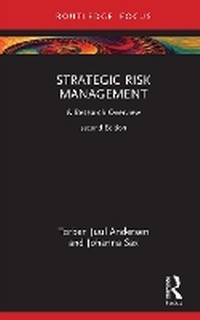
Strategic Risk Management
A Research Overview
2nd Edition
Will be published approx. on 18. August 2026
156 pages
E-Book
978-1-040-76102-1 (ISBN)
Description

Strategic Risk Management represents an organisational capacity to adapt business activities to match the evolving competitive environment.
This updated edition reflects the increasingly disruptive global competitive landscape. Incorporating the latest scholarly developments, the authors advance the risk leadership model to introduce a strategic drift warning system that accounts for behavioural trends across organizational hierarchies. Across five concise chapters, the book traces the evolution from enterprise risk management (ERM) toward a dynamic multidisciplinary approach to strategic risk management (SRM) with more sophisticated perspectives on strategy-making. It demonstrates how conventional models, grounded in probabilistic forecasts, compliance routines, and auditable processes, fail to capture and address emergent threats and systemic shocks. Drawing on decades of research in behavioural science, organizational theory, and dynamic capabilities, it reveals the hidden cognitive biases, social pressures, and structural frictions that distort judgment and undermine even well-designed strategies. The book contends that risk is not merely a technical challenge but a fundamentally human endeavour. Strategy execution falters not from lack of intent or motivation, but because real-world conditions, such as time pressure, cognitive overload, misaligned incentives, and flawed routines, to shape behaviour in predictable yet overlooked ways. To bridge the gap between strategic intent and frontline action, organizations must cultivate new forms of sensing, learning, and cross-functional collaboration. Central to the book is the emergence of strategic risk leadership (SRL), a forward-looking leadership orientation blending analytical rigor with moral purpose, psychological safety, and adaptive decision-making. SRL reframes risk governance as a sociotechnical practice enabling organisations to navigate sudden environmental shifts, systemic poly-crisis conditions, and AI-driven ambiguity.
A concise yet comprehensive guide to the field, this book distils research that has stood the test of time with emerging trends to present a resource which is valuable reading for research, advanced study and reflective business practice.
This updated edition reflects the increasingly disruptive global competitive landscape. Incorporating the latest scholarly developments, the authors advance the risk leadership model to introduce a strategic drift warning system that accounts for behavioural trends across organizational hierarchies. Across five concise chapters, the book traces the evolution from enterprise risk management (ERM) toward a dynamic multidisciplinary approach to strategic risk management (SRM) with more sophisticated perspectives on strategy-making. It demonstrates how conventional models, grounded in probabilistic forecasts, compliance routines, and auditable processes, fail to capture and address emergent threats and systemic shocks. Drawing on decades of research in behavioural science, organizational theory, and dynamic capabilities, it reveals the hidden cognitive biases, social pressures, and structural frictions that distort judgment and undermine even well-designed strategies. The book contends that risk is not merely a technical challenge but a fundamentally human endeavour. Strategy execution falters not from lack of intent or motivation, but because real-world conditions, such as time pressure, cognitive overload, misaligned incentives, and flawed routines, to shape behaviour in predictable yet overlooked ways. To bridge the gap between strategic intent and frontline action, organizations must cultivate new forms of sensing, learning, and cross-functional collaboration. Central to the book is the emergence of strategic risk leadership (SRL), a forward-looking leadership orientation blending analytical rigor with moral purpose, psychological safety, and adaptive decision-making. SRL reframes risk governance as a sociotechnical practice enabling organisations to navigate sudden environmental shifts, systemic poly-crisis conditions, and AI-driven ambiguity.
A concise yet comprehensive guide to the field, this book distils research that has stood the test of time with emerging trends to present a resource which is valuable reading for research, advanced study and reflective business practice.
More details
Series
Edition
2nd edition
Language
English
Place of publication
London
United Kingdom
Publishing group
Taylor & Francis Ltd
Target group
College/higher education
Product notice
Reflowable
Illustrations
3 Tables, black and white; 2 Line drawings, black and white; 2 Illustrations, black and white
ISBN-13
978-1-040-76102-1 (9781040761021)
Copyright in bibliographic data and cover images is held by Nielsen Book Services Limited or by the publishers or by their respective licensors: all rights reserved.
Schweitzer Classification
Other editions
Additional editions
Book
approx. 08/2026
2nd Edition
Routledge
€69.50
Not yet published
Persons
Torben Juul Andersen is Professor of Strategy and International Management at the Copenhagen Business School with the Department of International Economics, Government and Business. Torben holds a PhD in Strategy and Financial Management from the University of North Carolina at Chapel Hill, an MBA in Finance and International Business from McGill University, and an MSc Economics (cand. polit.) from University of Copenhagen. He previously worked at George Mason University and Johns Hopkins University and in senior positions with Citibank/Citicorp, Unibank, and Hagler-Bailly. His research has focused on global strategic responsiveness, multinational corporate strategy, strategic risk governance, and risk leadership issues.
Johanna Sax holds a PhD in Strategic Risk Management and an MSc in Finance and Strategic Management from Copenhagen Business School where she is currently engaged as external lecturer and Research Associate with the Department of International Economics, Government and Business. She is First Vice President at Danske Bank in Copenhagen, Head of Implementation, Personal Customers and was previously Head of Standards & Transformation, Business Risk & Controls. She also worked at National Australia Bank, Melbourne as Senior Analyst and has extensive risk management experience.
Johanna Sax holds a PhD in Strategic Risk Management and an MSc in Finance and Strategic Management from Copenhagen Business School where she is currently engaged as external lecturer and Research Associate with the Department of International Economics, Government and Business. She is First Vice President at Danske Bank in Copenhagen, Head of Implementation, Personal Customers and was previously Head of Standards & Transformation, Business Risk & Controls. She also worked at National Australia Bank, Melbourne as Senior Analyst and has extensive risk management experience.
Content
1. Status and challenges 2. Insights from never empirical studies 3. Strategic execution risks - from intent to action 4. Strategic risk management as dynamic adaptation 5. Synthesis and emerging risk leadership themes
