

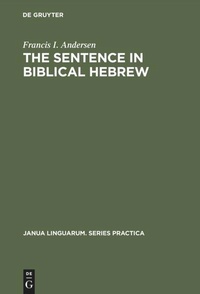
The Sentence in Biblical Hebrew
Sentence in Biblical Hebrew
1st Edition
Published on 6. February 2015
209 pages
978-3-11-135680-8 (ISBN)
Description

No detailed description available for "The Sentence in Biblical Hebrew".
More details
Other editions
Additional editions
Francis I. Andersen
The Sentence in Biblical Hebrew
Book
02/2015
1st Edition
De Gruyter Mouton
€169.95
Withdrawn from sale
Francis I. Andersen
The Sentence in Biblical Hebrew
Book
04/1974
1st Edition
De Gruyter Mouton
€119.95
Shipment within 7-9 days
Content
- Intro
- PREFACE
- SYMBOLS AND ABBREVIATIONS
- THE TRANSLITERATION OF HEBREW
- 1. INTRODUCTION
- 1.0. Traditional Grammar
- 1.1. Discourse Grammar
- Notes
- 2. THE SENTENCE IN HEBREW
- 2.0. Definition of Sentence
- 2.1. The Clause as a Sentence Element
- 2.2. Sentence Types
- 2.3. Complex Sentences
- 2.4. Compound Sentences
- 2.5. Relationships Between Sentence Types
- 2.6. Surface Grammar and Deep Grammar
- 2.6.0. The English Relative Clause
- 2.6.1. Head is a Proper Noun
- 2.6.2. Head is a Pronoun
- 2.6.3. Head is a Definite Noun
- 2.6.4. Head is an Indefinite Noun
- 2.6.5. Coordination as Alternative Realization
- 2.6.6. An Exception
- 2.6.7. Naming Two Persons
- 2.6.8. The Use of the Nominalizer
- 2.6.9. Conclusions
- Notes
- 3. APPOSITION SENTENCES
- 3.0. Deep Grammar of Apposition
- 3.1. Surface Grammar of Apposition
- 3.2. Verbal Repetition in Apposition
- 3.3. Synonymous Apposition
- 3.4. Epic Repetition in Apposition
- 3.4.0. Introduction
- 3.4.1. Verb Patterns in Epic Apposition
- 3.4.2. Discourse Function of Epic Apposition
- 3.4.3. Alternative Realization in Sequential Clauses
- 3.5. Apposition for Emphasis
- 3.5.0. Formal Features
- 3.5.1. Antithesis in Apposition
- 3.5.2. Apposition in Another Perspective
- 3.5.3. Climactic Repetition in Apposition
- 3.5.4. Coordination of Emphatic Repetition
- 3.6. Resumption and Distribution in Apposition
- 3.6.0. Resumption
- 3.6.1. Distribution
- 3.7. Explanation in Apposition
- 3.7.0. The Semantics of Apposition
- 3.7.1. Specifying Apposition
- 3.7.2. Exposition in Apposition
- 3.7.3. An Example of Explication
- 3.7.4. A Summary in Apposition
- 3.7.5. Titles and Colophons
- 3.8. Curses and Blessings
- 3.9. Multiple Apposition
- 3.10. Apposition Instead of Other Constructions
- 3.10.0. Alternative Deep Relationships
- 3.10.1. Coordinate Commands in Apposition
- 3.10.2. Coordinated Declarative Clauses in Apposition
- 3.10.3. Coordinate Questions in Apposition
- 3.10.4. Antithetical Clause in Apposition
- 3.10.5. Apposition Instead of Subordination
- 3.10.6. Apposition Instead of a Relative Clause
- 3.10.7. Apposition Instead of Sequence
- Notes
- 4. COORDINATION
- 4.0. Kinds of Coordination
- 4.1. Upper-level Coordination
- 4.1.0. Heterogeneous Speeches
- 4.1.1. Coordination of Units of Narrative
- 4.1.2. Stories in Juxtaposition
- 4.1.3. Coordinated Stories
- 4.1.4. Story-level Episodes
- 4.1.5. Episode-level Paragraphs
- 4.2. Paragraph-level Coordination
- 4.2.0. Introduction
- 4.2.1. Sequential Coordination
- 4.2.2. Paragraph-level Circumstantial Clause
- 4.2.3. Paragraph-level Adjunctive Clause
- 4.2.4. Paragraph-level Surprise Clause
- 4.3. Sentence-level Coordination
- 4.3.0. Sentence or Paragraph?
- 4.3.1. Conjunctive Coordination
- 4.3.2. Chiastic Coordination
- 4.3.3. Alternative (Disjunctive) Sentence
- 4.3.4. Contrastive Coordination
- 4.3.5. Antithetical Coordination
- 4.4. Inclusive and Exclusive Coordination
- 4.4.0. Deep Grammar
- 4.4.1. Inclusive Coordination
- 4.4.2. Exclusive Coordination
- 4.5. Inter-clausal Relationships in Precative and Predictive Discourse
- 4.6. Summary
- 4.7. Back-looping (Rank-shifting)
- 4.8. Alternative Surface Realizations
- 4.9. Empirical Testing
- Notes
- 5. CIRCUMSTANTIAL CLAUSES
- 5.0. Introduction
- 5.1. Episode-marginal Circumstantial Clauses
- 5.1.0. Nucleus and Margin
- 5.1.1. Episode-initial Circumstantial Clauses
- 5.1.2. Episode-final Circumstantial Clauses
- 5.1.3. Circumstantial Clause Beside an Episode
- 5.2. Sentence-level Circumstantial Clauses
- 5.2.0. Sentence versus Paragraph
- 5.2.1. Clauses Circumstantial to Time Margin
- 5.2.2. Circumstance of a Circumstance
- 5.3. Pseudocircumstantial Sequential Clauses
- 5.4. Pseudosequential Circumstantial Clauses
- 5.5. Circumstantial Clauses as Alternatives to Noncircumstantial Constructions
- 5.5.0. Introduction
- 5.5.1. Circumstantial Form for Deep Subordination
- 5.5.2. Circumstantial Form for a Relative Clause.
- 6. ADJUNCTIVE CLAUSES
- 6.0. Structure
- 6.1. Function
- 6.2. Adjunctive Clauses Used Circumstantially
- 6.3. Other Forms
- Notes
- 7. SURPRISE CLAUSES
- 7.0. Form
- 7.1. Participant Perspective
- 7.2. Dream Reports
- 7.3. Other Uses
- 7.4. Other Forms
- 8. CONJUNCTIVE SENTENCES
- 8.0. The Form of a Conjunctive Sentence
- 8.0.0. Optimum Realization
- 8.0.1. Double-duty Items
- 8.0.2. Multiple Coordination
- 8.1. Declarative Conjunctive Sentences
- 8.1.0. Introduction
- 8.1.1. Reports of Accomplished Fact Using 'Perfect 1 Verbs
- 8.1.2. Conjoined Predictive Clauses
- 8.1.3. Conjoined Verbless Clauses
- 8.1.4. Reports of Present Facts Using Quasiverbal Clauses
- 8.1.5. Circumstantial Conjunctive Sentences
- 8.1.6. Conjoined Clauses in Poetry
- 8.1.7. Dissimilar Clauses Conjoined
- 8.1.8. Successive Events in Conjoined Clauses
- 8.2. Distributive Coordination
- 8.3. Conjoined Precative Clauses
- 8.3.0. The Variety of Combinations
- 8.3.1. Conjoined Verbless Precative Clauses
- 8.3.2. Conjoined Imperative Clauses
- 8.3.5. Mixed Linkages of Precative Clauses
- 8.4. Negation in Conjunctive Sentences
- 8.5. Conjoined Prohibitions
- 8.6. Coordination of Questions
- 8.7. Conjoining of Surprise Clauses
- 8.8. Coordination of Subordinate Clauses
- 8.9. Coordination of Relative Clauses
- 8.10. Conjunctive Sentences Instead of Other Constructions
- 8.10.0. Introduction
- 8.10.1. Hendiadys in Conjunctive Sentences,
- 8.10.2. Coordination Instead of Apposition
- 8.10.3. Coordination Instead of Subordination
- 9. CHIASTIC SENTENCES
- 9.0. The Form of Inter-clause Chiasmus
- 9.1. The Surface Grammar of Chiastic Sentences
- 9.2. The Deep Grammar of Chiasmus
- 9.3. Chiasmus in Narrative Prose
- 9.3.0. An Illustration
- 9.3.1. Chiasmus in Poetic Discourse
- 9.3.2. Chiasmus in Epic Narrative
- 9.3.3. Three-clause Chiasmus
- 9.4.Grammatical Aspects of Chiasmus
- 9.4.0. Introduction
- 9.4.1. Verbless Predicators
- 9.4.2. Perfect Verbs
- 9.4.3. Subjects in Chiasmus
- 9.4.4. Objects in Chiasmus
- 9.4.5. Indirect Objects in Chiasmus
- 9.4.6. Other Clause-level Elements
- 9.4.7. Other Verbal Patterns
- 9.4.8. Chiasmus with Negation
- 9.4.9. Chiasmus not Involving the Verbs
- 9.5. Chiasmus in Predictive Discourse
- 9.5.0. Verb Patterns
- 9.5.1. Subjects in Chiasmus
- 9.5.2. Objects in Chiasmus
- 9.5.3. Mixed Constructions
- 9.5.4. Indirect Objects in Chiasmus
- 9.5.5. Other Clause-level Tagmemes in Chiasmus
- 9.5.6. Other Verb Forms in Chiasmus
- 9.6. Chiasmus in Precative Discourse
- 9.7. Chiasmus in Prohibition
- 9.8. Incompletely Formed Chiasmus
- 9.9. Discontinuous Chiastic Sentences
- 9.10. Chiasmus as a High-level Node
- 9.11. Chiastic Sentence as Nucleus
- 9.12. Chiasmus a Distortion
- 9.13. Sequential Clauses in Chiasmus
- Notes
- 10. DISJUNCTIVE SENTENCES
- 10.0. Disjunctive Coordination
- 10.1. Phrase-level Disjunction
- 10.1.0. Introduction
- 10.1.1. A or B
- 10.1.2. Either A or B
- 10.1.3. Either A and B
- 10.1.4. Whether A or B
- 10.2. Disjunctive Coordination above Phrase Level
- 10.2.0. Transformations up and down the Hierarchy
- 10.2.1. Disjunctive Sentences
- 10.2.2. Paragraph-level Disjunction
- 10.2.3. Disjunction of Paragraphs
- 10.3. Disjunctive Questions
- 10.3.0. Fully Formed Disjunction
- 10.3.1. Interrogated Disjunctive Sentence
- 10.3.2. The Normal Construction
- 10.3.3. Phrase-level Disjunction of Questions
- 10.3.4. Redundant Antithetical Tag Question
- 10.4. Disjunctive Realization of Conjunctive Relationships
- 10.5. Conjunctive Realization of Disjunctive Relationships
- Notes
- 11. CONTRASTIVE SENTENCES
- 11.0. The Degree of Contrast
- 11.1. Contrastive Sentences and Other Constructions
- 11.2. Contrast with Pronoun Subjects
- 11.3. Contrast with Nouns as Subjects
- 11.4. Contrast with Objects
- 11.5. Other Items in Contrast
- 11.6. Exceptions
- 11.7. Contrast Sentence with Asyndeton
- 12. INCLUSIVE SENTENCES
- 12.0. Inclusion and Addition
- 12.1. Phrase-level Coordination Using GAM
- 12.1.0. Introduction
- 12.1.1. Inclusive Phrases
- 12.1.2. Compound Conjunction
- 12.1.3. Duals
- 12.2. Trans-sentence Inclusive Phrases
- 12.3. Double Coordination
- 12.4. Inclusive Coordination and Sentence Types
- 12.4.0. Introduction
- 12.4.1. Inclusive Chiastic Sentences
- 12.4.2. Inclusive Conjunctive Sentences
- 12.4.3. Inclusive 'Contrast' Sentences
- 12.4.4. Circumstantial Clauses
- 12.4.5. Surprise Clauses
- 12.4.6. Paragraph-level Inclusive Linkage
- 12.4.7. Predictive Discourse
- 12.4.8. Other Constructions
- 12.4.9. Inclusive Complex Sentences
- 12.4.10. AP Equivalent to GAM
- 12.5. Inclusive Coordination and Negation
- 12.6. The Implication of Inclusive Coordination
- 12.7. Noninclusive Uses of GAM
- 12.7.0. Introduction
- 12.7.1. Coordination
- 12.7.2. Compound Inter-clause Conjunction
- 12.8. GAM not a Conjunction
- 12.8.0. Introduction
- 12.8.1. Appositive GAM
- 12.8.2. Emphasizing GAM
- 12.8.3. Focussing GAM
- 12.9. The Hierarchical Significance of GAM
- Notes
- 13. EXCLUSIVE SENTENCES
- 13.0. Signals of Exclusive Relationships
- 13.1. The Form of the Exclusive Relationship
- 13.2. Phrase-level Exclusion
- 13.3.Trans-sentence Exclusive Phrases
- 13.4. Exclusive Sentences
- 13.5. Exclusive Forms used for Antithetical Relationships
- 13.6. Exclusive Forms Used for Coordination or Apposition
- 13.7.Exclusive Relationships Realized by Antithetical Forms
- 13.8. Phrase 'Adverb' and Clause 'Adverb'
- 13.9. Limitative 'Adverbs'
- 13.10. Limitative Clause-modifier
- 13.11. Summary
- Notes
- 14. ANTITHETICAL SENTENCES
- 14.0. Antithesis between Clauses
- 14.1. The Form of Antithetical Sentences
- 14.2. Antithesis with Implicit Negation
- 14.3. Antithesis by Means of Antonyms
- 14.4. Antithesis by Negation
- 14.5. Antithesis After Negation
- 14.5.0. Introduction
- 14.5.1. Antithetical WÈ
- 14.5.2. Antithetical Sequential WAW
- 14.5.3. Antithetical KI
- 14.5.4. Antithetical KI IM
- 14.5.5. Antithetical IM LO
- 14.5.6. Antithetical IM
- 14.5.7. Antithesis Using Exclusive Forms
- 14.6. Antithetical Questions
- 14.7. Antithesis in Apposition
- Notes
- 15. SURFACE REALIZATIONS AND DEEP RELATIONSHIPS
- 15.0. Introduction
- 15.1. Alternative Surface Realizations
- 15.2. Limitations in Alternative Realizations
- 15.3. Juxtaposition and Concatenation
- 15.4. Coordination and Subordination
- INDEX OF BIBLICAL REFERENCES
