

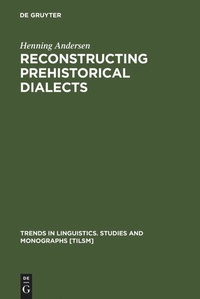
Reconstructing Prehistorical Dialects
Initial Vowels in Slavic and Baltic
1st Edition
Published on 21. July 2011
X, 238 pages
978-3-11-081971-7 (ISBN)
Description

No detailed description available for "Reconstructing Prehistorical Dialects".
More details
Other editions
Additional editions
Book
07/2011
1st Edition
De Gruyter Mouton
€239.00
Withdrawn from sale
Book
09/1996
1st Edition
De Gruyter Mouton
€169.95
Shipment within 7-9 days
Content
- Intro
- Acknowledgements
- List of tables
- List of figures
- Abbreviations
- Graphic and reference conventions
- Introduction
- 0.1. Common Slavic and the Slavic Migrations
- 0.2. LCS *jezero || *ozero, La. ezars, Li. ?zeras || ãzeras, OPr. Assaran 'lake'
- Chapter 1 Proto-Slavic E- and A-
- 1.1. PS eE- - LCS *je-|| *o-
- 1.2. The Common Slavic prothesis
- 1.3. Discussion
- Chapter 2 A typological parallel
- 2.1. The Lithuanian e- & je- change
- 2.2. The Lithuanian e- & a- change
- 2.3. Discussion
- Chapter 3 The Late Common Slavic *je- || *o- isoglosses
- 3.1. Other Late Common Slavic isoglosses
- 3.2. Implicational relations
- 3.3. The *je- || *o- diversity in time
- 3.4. Scenario A
- 3.5. Scenario A´
- 3.6. Scenario B
- 3.7. The East Slavic gradations
- 3.8. Invariant *je-
- 3.9. Summary
- Chapter 4 The Baltic change of *e- & *a-
- 4.1. The Baltic data
- 4.2. The geographical distribution
- 4.3. Baltic and Slavic
- 4.4. The larger perspective
- Chapter 5 Layers of innovation: Slavic, Slavic and Baltic, and Indo-European
- 5.1. Prothesis in Slavic
- 5.2. PS E- in liquid diphthongs
- 5.3. Proto-Slavic and Proto-Baltic by-forms
- 5.4. Summary and results
- Chapter 6 PIE *e-, *a-, *o- in Slavic and Baltic
- 6.1. Rozwadowski's change: When and where?
- 6.2. Balto-Slavic *a- & *e-?
- 6.3. Non-Indo-European contacts?
- 6.4. Contact with other Indo-European dialects
- 6.5. Slavic-Baltic *a- & *e- as a contact change
- 6.6. Slavic, Baltic, and other Indo-European dialects
- Chapter 7 The material
- 7.1.-44. The lexical material
- Chapter 8 Alternative approaches
- 8.1. The geographical dimension
- 8.2. Categorizing the lexical data
- 8.3. The phonological change
- 8.4. The Baltic change
- 8.5. Conclusion
- Chapter 9 Perspectives
- 9.1. Proto-Slavic and Common Slavic
- 9.2. Proto-Baltic and Common Baltic
- 9.3. Balto-Slavic versus Slavic-Baltic
- 9.4. Extinct languages in Eastern Europe
- 9.5. Prehistoric phonemics and phonetics
- 9.6. Dialect geography and migration
- 9.7. Reconstructing ante-Migration dialects by projection
- 9.8. Patterns of geographical distribution
- Chapter 10 Conclusion
- 10.1. Proto-Slavic E- and A-
- 10.2. A typological parallel
- 10.3. The Late Common Slavic *je-|| *o- isoglosses
- 10.4. The Baltic change of *e- & *a-
- 10.5. Layers of innovation: Slavic, Slavic-Baltic, and Indo-European
- 10.6. PIE *e-, *a-, *o- in Slavic and Baltic
- 10.7. The material
- 10.8. Alternative approaches
- 10.9. Perspectives
- 10.10. Conclusion
- References
- Index
