

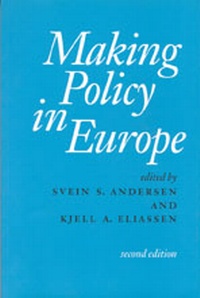
Making Policy in Europe
2nd Edition
Published on 26. January 2001
304 pages
978-1-84787-611-9 (ISBN)
Description

This Second Edition of Making Policy in Europe is fully revised and expanded to provide the most up-to-date introduction to the study of policymaking in the European Union (EU).
The first part of the book introduces the different perspectives to study of the EU as a political system, and provides a framework for the study of the main actors and institutions in the decision-making process from transnational lobbying within Brussels to the implementation of EU law in national member states.
Part two introduces each of the main sectoral policy areas. The common "market" is introduced and reviewed before students are provided with detailed studies of policies and policy-making in telecommunications, the environment, energy, education, immigration, and policing. In each case the complex interaction between different interests and actors at different levels in the EU apparatus is richly illustrated and the future prospects for further integration fully examined.
The final part of the book looks at the future economic and political structure of the EU and the direction of contemporary studies of the EU and European integration. A completely new chapter reviews European monetary union, another looks at the important enlargement question, and, finally, the editors review the wider implications for Europe and the EU political system.
This book will be essential reading for another generation of students of the EU, European pubic policy and European integration.
In each case the complex interaction between interests and actors at different levels in the EU apparatus is richly illustrated and the future prospects for further integration are examined.
The first part of the book introduces the different perspectives to study of the EU as a political system, and provides a framework for the study of the main actors and institutions in the decision-making process from transnational lobbying within Brussels to the implementation of EU law in national member states.
Part two introduces each of the main sectoral policy areas. The common "market" is introduced and reviewed before students are provided with detailed studies of policies and policy-making in telecommunications, the environment, energy, education, immigration, and policing. In each case the complex interaction between different interests and actors at different levels in the EU apparatus is richly illustrated and the future prospects for further integration fully examined.
The final part of the book looks at the future economic and political structure of the EU and the direction of contemporary studies of the EU and European integration. A completely new chapter reviews European monetary union, another looks at the important enlargement question, and, finally, the editors review the wider implications for Europe and the EU political system.
This book will be essential reading for another generation of students of the EU, European pubic policy and European integration.
In each case the complex interaction between interests and actors at different levels in the EU apparatus is richly illustrated and the future prospects for further integration are examined.
All prices
More details
Edition
Second Edition
Language
English
Place of publication
London
United Kingdom
Target group
College/higher education
ISBN-13
978-1-84787-611-9 (9781847876119)
Copyright in bibliographic data and cover images is held by Nielsen Book Services Limited or by the publishers or by their respective licensors: all rights reserved.
Schweitzer Classification
Other editions
Additional editions
Svein S. Andersen | Kjell A. Eliassen
Making Policy in Europe
Book
02/2001
2nd Edition
SAGE Publications Inc
€113.30
Shipment within 15-20 days
Svein S. Andersen | Kjell A. Eliassen
Making Policy in Europe
Book
01/2001
2nd Edition
SAGE Publications Inc
€270.37
Shipment within 15-20 days
Persons
Svein Andersen is a professor at the Norwegian School of Management and has held various academic positions over the last 25 years, including as a visiting professor at Berkeley and adjunct professor at the University of Oslo. He is also an adjunct professor at the Norwegian School of Sport Sciences. His teaching experience includes executive leadership and sports management. He holds two PhDs, one from the University of Oslo and one from Stanford University. Kjell A Eliassen is Professor and Director of European and Asian Studies (CEAS) at the Norwegian School of Management.
CONTRIBUTORS
Esther Barbe Universitat Autonoma Barcelona
Yves Boyer CREST Paris
Michael Clark King's College University of London
Catriona Gourlay Universite Libre Bruxelles
Esben Oust Heiberg Norwegian School of Management
Eric Remacle Universite Libre Bruxelles
Marit Sjovaag Norwegian School of Management
Reimund Seidelmann Universitat Giessen and Universite Libre Bruxelles
Arnhild Spence NATO and EC Bruxelles
David Spence NATO and EC Bruxelles
G Pinar Tank Norwegian School of Management
Pierre de Vestel Universite Libre Bruxelles
CONTRIBUTORS
Esther Barbe Universitat Autonoma Barcelona
Yves Boyer CREST Paris
Michael Clark King's College University of London
Catriona Gourlay Universite Libre Bruxelles
Esben Oust Heiberg Norwegian School of Management
Eric Remacle Universite Libre Bruxelles
Marit Sjovaag Norwegian School of Management
Reimund Seidelmann Universitat Giessen and Universite Libre Bruxelles
Arnhild Spence NATO and EC Bruxelles
David Spence NATO and EC Bruxelles
G Pinar Tank Norwegian School of Management
Pierre de Vestel Universite Libre Bruxelles
Content
PART ONE: POLICYMAKING IN THE EUROPEAN UNION
Introduction - Svein S Andersen and Kjell A Eliassen
The EU as a new political system
Formal Processes - Svein S Andersen, Kjell A Eliassen and Nick Sitter
EU Institutions and Actors
Informal Processes - Svein S Andersen and Kjell A Eliassen
Lobbying, Actor Strategies, Coalitions and Dependencies
PART TWO: EUROPEAN POLICY STUDIES
Rail and Transport Policy - Frank Dobbin
National Paradigms and Supranational Structure
Telecommunications Policy - Kjell A Eliassen and Marit S Marino
Interest Convergence and Globalization
Energy Policy - Svein S Andersen
Interest Interaction and Supranational Authority
Educational Policy - Erik Beukel
Institutionalization and Multilevel Governance
Policing Policy and Justice and Home Affairs - Ellen Ahnfelt and Johan From
From High to Low Politics
PART THREE: THE FUTURE OF THE EU AND EUROPEAN INTEGRATION
European Monetary Union - Miriam L Campanella
Economic Versus Political Intregation and the Limits of Supranationalism
The Common Foreign and Security Policy - Helene Sjursen
Limits of Intergovernmentalism and the Search for a Global Role
EU Enlargement - Finn Laursen
Interests, Issues and the Need for Insitutional Reform
Conclusion - Svein S Andersen and Kjell A Eliassen
Making Policy in the New Europe
Introduction - Svein S Andersen and Kjell A Eliassen
The EU as a new political system
Formal Processes - Svein S Andersen, Kjell A Eliassen and Nick Sitter
EU Institutions and Actors
Informal Processes - Svein S Andersen and Kjell A Eliassen
Lobbying, Actor Strategies, Coalitions and Dependencies
PART TWO: EUROPEAN POLICY STUDIES
Rail and Transport Policy - Frank Dobbin
National Paradigms and Supranational Structure
Telecommunications Policy - Kjell A Eliassen and Marit S Marino
Interest Convergence and Globalization
Energy Policy - Svein S Andersen
Interest Interaction and Supranational Authority
Educational Policy - Erik Beukel
Institutionalization and Multilevel Governance
Policing Policy and Justice and Home Affairs - Ellen Ahnfelt and Johan From
From High to Low Politics
PART THREE: THE FUTURE OF THE EU AND EUROPEAN INTEGRATION
European Monetary Union - Miriam L Campanella
Economic Versus Political Intregation and the Limits of Supranationalism
The Common Foreign and Security Policy - Helene Sjursen
Limits of Intergovernmentalism and the Search for a Global Role
EU Enlargement - Finn Laursen
Interests, Issues and the Need for Insitutional Reform
Conclusion - Svein S Andersen and Kjell A Eliassen
Making Policy in the New Europe
