

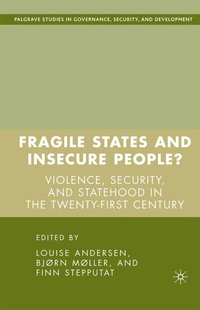
Fragile States and Insecure People?
Description

Reviews / Votes
'This important book explores security needs in areas where the formal state has little or no presence and hence where our normative ontology of the sovereign, territorial state does not apply. It doing so, it challenges conventional notions of peace-building, state-building and the assumptions that underpin most of our approaches to development and security. This is an overdue debate that is set to have a profound impact upon security sector reform and post-conflict reconstruction in general.'
- Jakkie Cilliers, Executive Director, Institute for Security Studies"This book should drive those who are involved in the conceptualization, design and implementation of security sector reform in post-conflict situations to rethink the current approach which is wholly state-centric and frequently offers up a one-size-fits-all model that can only be sustained with external resources and control. Though focused on security sector governance, the essays in this book provide an insightful departure from current post-conflict governance orthodoxy and constitute an articulate call for a more appropriate paradigm for constructing systems of self-governance in post-conflict countries."
- Amos Sawyer, Co-Director, Workshop in Political Theory & Policy Analysis, Indiana University and Chairman, Governance Reform Commission, Liberia
More details
Other editions
Additional editions
Persons
BJØRN MØLLER a Senior Researcher at the Danish Institute for International
Studies and leader of its research group on Post-Conflict Peacebuilding. He holds an MA in History and a PhD in Political Science from the University of Copenhagen, Denmark, and teaches conflict theory, international relations and development studies at the universities of Copenhagen and Aalborg. He is the author of three books and editor or co-editor of seven anthologies.
FINN STEPPUTAT is a Senior Researcher at the Danish Institute for International Studies. He holds a M.Sc. in Economic Geography and a Ph.D. in Cultural Sociology from Copenhagen University, Denmark, and has published extensively on issues of violent conflict, forced migration, and post-conflict reconstruction, mainly in Latin America. He has also worked on more theoretical and methodological issues of state formation and sovereignty, and has co-edited the books States of Imagination: Ethnographic Explorations of the Post-colonial State (2001), and Sovereign Bodies: Citizens,Migrants and States in the Post-colonial World (2005).
