

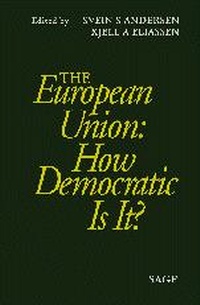
The European Union: How Democratic Is It?
1st Edition
Published on 5. December 1995
304 pages
978-1-84920-712-6 (ISBN)
Description

Taking as its starting point the major issues of democracy which are the ongoing concerns of every liberal Western political system, this volume offers a wide-ranging review of democracy in the European Union. It treats the EU as a new type of political system within the tradition of parliamentary democracies, a system which is neither federal nor intergovernmental, and which consequently has unique problems of how to handle democratic requirements.
Part One deals with the two major challenges of interest articulation in the EU, political parties and lobbying. The second part discusses how democracy becomes the key element in the linkage between the EU and its member states, focusing on France, Italy and Belgium where the relation to the EU constitutes an important part of the national democratic debate. The third part focuses on democratic aspects of key EU institutions - the European Council, the European Commission and the European Parliament. The final part looks at democracy in relation to possible EU development generally, and in the context of societal change which may tend to undermine the role of parliamentary institutions.
Part One deals with the two major challenges of interest articulation in the EU, political parties and lobbying. The second part discusses how democracy becomes the key element in the linkage between the EU and its member states, focusing on France, Italy and Belgium where the relation to the EU constitutes an important part of the national democratic debate. The third part focuses on democratic aspects of key EU institutions - the European Council, the European Commission and the European Parliament. The final part looks at democracy in relation to possible EU development generally, and in the context of societal change which may tend to undermine the role of parliamentary institutions.
Reviews / Votes
`This collection of essays.... includes several useful chapters: Andersen and Burns' thoughtful essay on `post-parliamentary governance', Pedersen's treatment of Euro-cooperation between parties, Wessel's portrayal of the EU as `a new kind of polity', and excellent analyses by Laursen and Hayes-Renshaw of the Commission and Council (respectively). Lane et al. offer a particularly interesting examination of the obsolescence of majority voting in a future, much-enlarged EU' - Political Studies`This is a timely title. The well-worn clich[ac]e - a sort of twisted verison of a Groucho Marx witticism- has it that, were the EU to apply to join itself, it would not get in. The implicit assumption, one with which most Europeans would presumably agree, is that the EU should be democratic.... the book is a welcome and thought-provoking addition to a growing literature' - Journal of Legislative Studies
All prices
More details
Language
English
Place of publication
London
United Kingdom
Target group
College/higher education
ISBN-13
978-1-84920-712-6 (9781849207126)
Copyright in bibliographic data and cover images is held by Nielsen Book Services Limited or by the publishers or by their respective licensors: all rights reserved.
Schweitzer Classification
Other editions
Additional editions
Svein S. Andersen | Kjell A. Eliassen
The European Union: How Democratic Is It?
How Democratic Is It?
Book
12/1995
1st Edition
SAGE Publications Inc
€118.80
Shipment within 15-20 days
Persons
Svein Andersen is a professor at the Norwegian School of Management and has held various academic positions over the last 25 years, including as a visiting professor at Berkeley and adjunct professor at the University of Oslo. He is also an adjunct professor at the Norwegian School of Sport Sciences. His teaching experience includes executive leadership and sports management. He holds two PhDs, one from the University of Oslo and one from Stanford University. Kjell A Eliassen is Professor and Director of European and Asian Studies (CEAS) at the Norwegian School of Management.
CONTRIBUTORS
Esther Barbe Universitat Autonoma Barcelona
Yves Boyer CREST Paris
Michael Clark King's College University of London
Catriona Gourlay Universite Libre Bruxelles
Esben Oust Heiberg Norwegian School of Management
Eric Remacle Universite Libre Bruxelles
Marit Sjovaag Norwegian School of Management
Reimund Seidelmann Universitat Giessen and Universite Libre Bruxelles
Arnhild Spence NATO and EC Bruxelles
David Spence NATO and EC Bruxelles
G Pinar Tank Norwegian School of Management
Pierre de Vestel Universite Libre Bruxelles
CONTRIBUTORS
Esther Barbe Universitat Autonoma Barcelona
Yves Boyer CREST Paris
Michael Clark King's College University of London
Catriona Gourlay Universite Libre Bruxelles
Esben Oust Heiberg Norwegian School of Management
Eric Remacle Universite Libre Bruxelles
Marit Sjovaag Norwegian School of Management
Reimund Seidelmann Universitat Giessen and Universite Libre Bruxelles
Arnhild Spence NATO and EC Bruxelles
David Spence NATO and EC Bruxelles
G Pinar Tank Norwegian School of Management
Pierre de Vestel Universite Libre Bruxelles
Content
Introduction - Svein S Andersen and Kjell A Eliassen
Dilemmas, Contradictions and the Future of European Democracy
PART ONE: NUMERICAL DEMOCRACY, CORPORATIVE PLURALISM AND LOBBYING IN EUROPEAN POLITICS
Euro-Parties and European Parties - Mogens N Pedersen
New Arenas, New Challenges and New Strategies
EU-Lobbying - Svein S Andersen and Kjell A Eliassen
Between Representativity and Effectiveness
The Modern West European State and the European Union - Wolgang Wessels
Democratic Erosion or a New Kind of Polity?
PART TWO: EU POLICY-MAKING AND NATIONAL INSTITUTIONS
The French EU Decision-Making - Christian Lequesne
Between Destablization and Adaptation
European Policy-Making and National Institutions - The Case of Belgium - Cecilia Andersen
Italy - Federiga Maria Bindi
In Need of More EU Democracy
PART THREE: EUROPEAN INSTITUTIONS: LEGITIMACY AND DEMOCRACY
The Role of the Commission - Finn Laursen
The Role of the Council - Fiona Hayes-Renshaw
Voting Power under the EU Constitution - Jan E Lane, Reinert Moeland and Sven Berg
The European Parliament - Juliet Lodge
PART FOUR: THE FUTURE OF EU DEMOCRACY
The European Union - Rolf Gustavsson
1996 and beyond a Personal View from the Side-Line
The European Union and the Erosion of Parliamentary Democracy - Svein S Andersen and Tom Burns
A Study of Post-Parliamentary Governance
Democracy - Svein S Andersen and Kjell A Eliassen
Traditional Concerns in New Institutional Settings
Dilemmas, Contradictions and the Future of European Democracy
PART ONE: NUMERICAL DEMOCRACY, CORPORATIVE PLURALISM AND LOBBYING IN EUROPEAN POLITICS
Euro-Parties and European Parties - Mogens N Pedersen
New Arenas, New Challenges and New Strategies
EU-Lobbying - Svein S Andersen and Kjell A Eliassen
Between Representativity and Effectiveness
The Modern West European State and the European Union - Wolgang Wessels
Democratic Erosion or a New Kind of Polity?
PART TWO: EU POLICY-MAKING AND NATIONAL INSTITUTIONS
The French EU Decision-Making - Christian Lequesne
Between Destablization and Adaptation
European Policy-Making and National Institutions - The Case of Belgium - Cecilia Andersen
Italy - Federiga Maria Bindi
In Need of More EU Democracy
PART THREE: EUROPEAN INSTITUTIONS: LEGITIMACY AND DEMOCRACY
The Role of the Commission - Finn Laursen
The Role of the Council - Fiona Hayes-Renshaw
Voting Power under the EU Constitution - Jan E Lane, Reinert Moeland and Sven Berg
The European Parliament - Juliet Lodge
PART FOUR: THE FUTURE OF EU DEMOCRACY
The European Union - Rolf Gustavsson
1996 and beyond a Personal View from the Side-Line
The European Union and the Erosion of Parliamentary Democracy - Svein S Andersen and Tom Burns
A Study of Post-Parliamentary Governance
Democracy - Svein S Andersen and Kjell A Eliassen
Traditional Concerns in New Institutional Settings
