

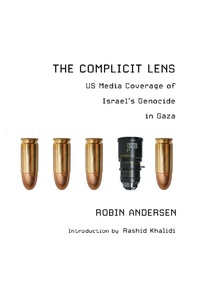
The Complicit Lens
Description

A media scholar examines how US establishment outlets echo Israeli narratives on Gaza, miminimizing atrocities like the Flour Massacre as ?aid-related deaths? to whitewash genocide and excuse war crimes amid global outrage.
This vitally necessary and carefully researched book examines the way US establishment media ran interference for Israel's ongoing genocide in Gaza, aligning its coverage with Israeli military narratives whilst downplaying, and even condoning, the wholesale massacre of Palestinians.
Commencing with the October 7, 2023, attack, The Complicit Lens scrutinizes mainstream journalism, contrasting it with social media reports and international news coverage. It reveals how legacy media presented Israeli violence as defensive and justified, casting doubt on IDF bombings, employing passive language to deflect blame for atrocities, and repeating Israeli talking points, often word-for-word. Massacres of those seeking food became ?aid-related deaths,? whilst missile attacks on tented refugees were ?tragic mistakes.? Meanwhile, well-worn tropes of war propaganda, including claims of the beheading of babies and mass rapes, subsequently revealed to be without foundation, were used to justify Israeli actions and obscure culpability.
Andersen documents the targeting of journalists and aid workers in what has become the deadliest conflict for each on record. She spotlights the editorial censorship that prohibited the use of terms such as ?genocide? and ?massacre? in the reporting of Palestinian deaths. And, as global protests against the Gaza genocide gathered strength, she examines the hostile media portrayal of these uprisings, particularly those led by young people and Jewish organizations.
More details
Person
Robin Andersen is professor emerita of media studies at Fordham University and an award-winning author of a dozen single- and co-authored books. Her work examines film, television, and media coverage of war, the environment, politics, and elections. She edits the Routledge Focus Book Series on Media and Humanitarian Action, serves as a Project Censored Judge, and contributes to the annual State of the Free Press. Andersen is on the Board of Directors of Fairness and Accuracy in Reporting (FAIR), where she also writes regularly, and is an Izzy Award Judge for the Park Center for Independent Media. Her writing has appeared in CounterPunch, LA Progressive, The Progressive, Salon, Common Dreams, and ScheerPost, among others.
