

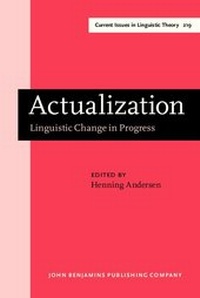
Actualization
Linguistic Change in Progress. Papers from a workshop held at the 14th International Conference on Historical Linguistics, Vancouver, B.C., 14 August 1999
1st Edition
Published on 19. November 2001
VII, 250 pages
978-90-272-8440-2 (ISBN)
Description

This collection of papers consolidates the observation that linguistic change typically is actualized step by step: any structural innovation being introduced, accepted, and generalized, over time, in one grammatical environment after another, in a progression that can be understood by reference to the markedness values and the ranking of the conditioning features. The Introduction to the volume and a chapter by Henning Andersen clarify the theoretical bases for this observation, which is exemplified and discussed in separate chapters by Kristin Bakken, Alexander Bergs and Dieter Stein, Vit Bubenik, Ulrich Busse, Marianne Mithun, Lene Schøsler, and John Charles Smith in the light of data from the histories of Norwegian, English, Hindi, Northern Iroquoian, and Romance. A final chapter by Michael Shapiro adds a philosophical perspective. The papers were first presented in a workshop on "Actualization Patterns in Linguistic Change" at the XIV International Conference on Historical Linguistics, Vancouver, B.C. in 1999.
More details
Other editions
Additional editions
Henning Andersen
Actualization
Linguistic Change in Progress. Papers from a workshop held at the 14th International Conference on Historical Linguistics, Vancouver, B.C., 14 August 1999
Book
11/2001
John Benjamins Publishing Co
€116.60
Shipment within 10-15 days
Person
Content
- ACTUALIZATION
- Editorial page
- Title page
- Copyright page
- PREFACE
- Table of contents
- INTRODUCTION
- 0. Preamble
- 1. The papers
- 2. Discussion
- 3. Conclusion
- REFERENCES
- MARKEDNESS AND THE THEORY OF LINGUISTIC CHANGE
- 0. Introduction
- 1. Markedness in synchrony
- 2. Markedness in diachrony
- 3. An analytic account of markedness
- 4. Conclusion
- REFERENCES
- PATTERNS OF RESTITUTION OF SOUND CHANGE
- 1. Introduction
- 2. Data
- 3. Results
- 4. Discussion
- REFERENCES
- THE ROLE OF MARKEDNESS IN THE ACTUATION AND ACTUALIZATION OF LINGUISTIC CHANGE
- 0. Introduction
- 1. Markedness agreement: agreement in what?
- 2. The problem
- 3. A short history of English relative particles
- 4. Periphrastic do
- Addendum: Heavenly language.
- REFERENCES
- ON THE ACTUALIZATION OF THE PASSIVE-TO-ERGATIVE SHIFT IN PRE-ISLAMIC INDIA
- 0. Introduction
- 1. Functionalism and markedness
- 2. Reconstructing sociolinguistic variation in Pre-Islamic India
- 3. Multiple analyses in the actualization of the passive-to-ergative shift
- 4. Noniconic relationships between morphology and semantics
- 5. Syntactic ambiguity in late Middle Indo-Aryan absolute constructions
- 6. Conclusions
- REFERENCES
- THE USE OF ADDRESS PRONOUNS IN SHAKESPEARE'S PLAYS AND SONNETS
- 0. The development of address pronouns in Early Modern English
- 1. On the use of address pronouns in the Shakespeare Corpus
- 2. Corpus study
- 3. Summary and conclusion
- REFERENCES
- ACTUALIZATION PATTERNS IN GRAMMATICALIZATION: FROM CLAUSE TO LOCATIVE MORPHOLOGY IN NORTHERN IROQUOIAN
- 1. Stimulus to reanalysis: structural ambiguity
- 2. Actualization
- 3. Motivating f orces
- REFERENCES
- FROM LATIN TO MODERN FRENCH: ACTUALIZATION AND MARKEDNESS
- 0. Introduction
- 1. Morphosyntax
- 2. Syntax
- 3. Conclusion
- REFERENCES
- MARKEDNESS, CAUSATION, AND LINGUISTIC CHANGE: A SEMIOTIC PERSPECTIVE
- 1. Instead of prolegomena: a philosopher's-eye view of language
- 2. Nominalism and realism in linguistics
- 3. Semiosis and linguistic change: efficient and final causation
- 4. Markedness in a theory of change
- REFERENCES
- MARKEDNESS, FUNCTIONALITY, AND PERSEVERATION IN THE ACTUALIZATION OF A MORPHOSYNTACTIC CHANGE
- 0. Introduction
- 1. Markedness and morphosyntactic change
- 2. Functionality and morphosyntactic change
- 3. Markedness, functionality, and object-participle agreement
- 4. Conclusion
- REFERENCES
- ACTUALIZATION AND THE (UNI)DIRECTIONALITY OF CHANGE
- 0. Introduction
- 1. Actualization: observable innovations in usage
- 2. On the (uni)directionality of chang
- 3. Conclusion
- REFERENCES
- GENERAL INDEX
