

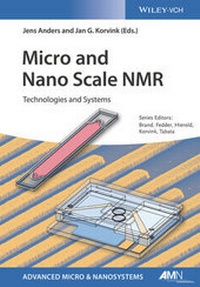
Micro and Nano Scale NMR
Technologies and Systems
1st Edition
Published on 8. May 2018
XVI, 429 pages
978-3-527-69734-2 (ISBN)
Description

This must-have book is the first self-contained summary of recent developments in the field of microscale nuclear magnetic resonance hardware, covering the entire technology from miniaturized detectors, the signal processing chain, and detection sequences. Chapters cover the latest advances in interventional NMR and implantable NMR sensors, as well as in using CMOS technology to manufacture miniaturized, highly scalable NMR detectors for NMR microscopy and high-throughput arrays of NMR spectroscopy detectors.
More details
Other editions
Additional editions
Book
06/2018
1st Edition
Wiley-VCH
from
€169.00
Article exhausted; check different version
Jens Anders | Jan G. Korvink
Micro and Nano Scale NMR - Technologies and Systems
Software
05/2018
Wiley-VCH
€231.61
No shipping information available
Persons
Jens Anders obtained his PhD from the Ecole Polytechnique Federale de Lausanne (EPFL), Switzerland, in 2011. He then joined the Institute of Microelectronics at the University of Ulm, Germany, first as a group leader and since 2013 as assistant professor. Prof. Anders is the recipient of several awards including the E.ON Future Award 2007, the VDE ITG ISS Study Award 2008 and the VDE Outstanding Publication award 2012. His main research interests include electronics for biomedical and materials science applications, mixed-signal circuit design, and the modeling of nonlinear circuits and systems in the absence as well as in the presence of noise.
Professor Anders has authored more than 90 scientific publications.
Jan Korvink obtained his PhD from the ETH in Zürich, Switzerland, in 1993. In 1997 he moved to the Albert Ludwig University in Freiburg, Germany, where for 18 years he was professor for microsystems engineering. From 2007 to 2013 he was a director of the Freiburg Institute for Advanced Studies. Since April 2015 he is Professor and director of the Institute of Microstructure Technology at the Karlsruhe Institute of Technology. His research interests cover the development of ultra low cost micromanufacturing methods, microsystem applications in the area of magnetic resonance imaging and spectroscopy, and the design and simulation of micro- and nano-systems. He is a recipient of the European Research Council's Advanced Grant for the development of an NMR metabolomic analyser for the nematode C. elegans. He has also been awarded a Red Dot Design Concept Prize in the area of NMR hardware.
Professor Korvink has authored more than 300 scientific publications, and was a founding editor of this book series.
Professor Anders has authored more than 90 scientific publications.
Jan Korvink obtained his PhD from the ETH in Zürich, Switzerland, in 1993. In 1997 he moved to the Albert Ludwig University in Freiburg, Germany, where for 18 years he was professor for microsystems engineering. From 2007 to 2013 he was a director of the Freiburg Institute for Advanced Studies. Since April 2015 he is Professor and director of the Institute of Microstructure Technology at the Karlsruhe Institute of Technology. His research interests cover the development of ultra low cost micromanufacturing methods, microsystem applications in the area of magnetic resonance imaging and spectroscopy, and the design and simulation of micro- and nano-systems. He is a recipient of the European Research Council's Advanced Grant for the development of an NMR metabolomic analyser for the nematode C. elegans. He has also been awarded a Red Dot Design Concept Prize in the area of NMR hardware.
Professor Korvink has authored more than 300 scientific publications, and was a founding editor of this book series.
Content
MAGNETS FOR SMALL-SCALE AND PORTABLE NMR
NMR Magnets for Portable NMR
Concept of Inside-out or Single-sided NMR
Applications Scenarios: Medicine Material Science
WIREBONDED NMR MICROCOILS
Wirebond Coils for NMR Spectroscopy and NMR Microscopy
Phased Array Microcoils
Magic Angle Spinning Inserts
Helmholtz coils for Nanoliter NMR Spectroscopy with High Frequency Resolution
ALTERNATIVE MICRO-TECHNOLOGIES FOR NMR MICROCOILS
Inkjet Printing Technology
Coil Decoupling
Amplifier Integration
WAVEGUIDES FOR MICRO NMR
Theory, RF-modeling and Fabrication Techniques
Waveguides with Microfluidics
Waveguide Probes for Metabolomics Studies
CMOS-BASED AND CMOS-ASSISTED MICRO-NMR
Electronics for Inductive NMR Detection
Single-chip NMR Transceiver with On-chip Coil Arrays for NMR Microscopy
Single-chip NMR Transceivers for Large-scale Arrays of External Coils
MICROGRADIENT SYSTEMS FOR NMR MICROSCOPY
Introduction to Planar Gradient Systems
Methods to Compute the Current Distribution
Fabrication Techniques
EFFICIENT PULSE SEQUENCES FOR NMR MICROSCOPY
SNR in NMR Microscopy
Problems Related to Diffusion in Fourier Encoded MRI vs. DESIRE
Diffusion Tensor Microscopy
IMPLANTABLE MR COILS
Applications of Implantable MR Coils
Fabrication Techniques
Biocompatible Encapsulation
MR CATHETER TIP COILS
Active Tracking of Catheters and Surgical Instruments
Overview of the Different Technologies Used to Manufacture Catheter Tip Coils
Patient Safety Considerations
Imaging Using Catheter Tip Coils
BROADBAND MICROCOILS FOR BROADBAND MULTINUCLEI DETECTION
Advantages of Direct Multinuclei Detection
Hardware Challenges Associated with Multinuclei Probe Heads
Decoupling Schemes
1D- And 2D Heteronuclear Experiments
MICRO-SCALE DYNAMIC NUCLEAR POLARIZATION
Brief Review of the DNP Effect
Micro Probes for DNP Enhanced NMR Spectroscopy
Challenges Associated With Microwave DNP Sources
FORCE DETECTED NMR (MRFM)
Brief Review of the Detection Principle and the Hardware
Nano-MRI Using MRFM
Challenges towards Single Nuclear Spin Sensitivity
OPTICALLY DETECTED NMR (ODMR)
Brief Review of the Detection Principle and the Required Hardware
Alkali Vapor Magnetometers for Portable NMR
Remote Detection of Nuclear Spins Using Ensembles of Nitrogen-Vacancy Centers for High Resolution Microfluidics Applications
NITROGEN VACANCY (NV) CENTERS IN DIAMONDS
Brief Review of the Spin Physics of NV Centers
Atomic Size Magnetometers Using NV Centers
Single Nuclear Spin Detection Using NV Centers in Diamond Chips
NV Centers as Nanoscale Sensors for Biological Applications
NMR Magnets for Portable NMR
Concept of Inside-out or Single-sided NMR
Applications Scenarios: Medicine Material Science
WIREBONDED NMR MICROCOILS
Wirebond Coils for NMR Spectroscopy and NMR Microscopy
Phased Array Microcoils
Magic Angle Spinning Inserts
Helmholtz coils for Nanoliter NMR Spectroscopy with High Frequency Resolution
ALTERNATIVE MICRO-TECHNOLOGIES FOR NMR MICROCOILS
Inkjet Printing Technology
Coil Decoupling
Amplifier Integration
WAVEGUIDES FOR MICRO NMR
Theory, RF-modeling and Fabrication Techniques
Waveguides with Microfluidics
Waveguide Probes for Metabolomics Studies
CMOS-BASED AND CMOS-ASSISTED MICRO-NMR
Electronics for Inductive NMR Detection
Single-chip NMR Transceiver with On-chip Coil Arrays for NMR Microscopy
Single-chip NMR Transceivers for Large-scale Arrays of External Coils
MICROGRADIENT SYSTEMS FOR NMR MICROSCOPY
Introduction to Planar Gradient Systems
Methods to Compute the Current Distribution
Fabrication Techniques
EFFICIENT PULSE SEQUENCES FOR NMR MICROSCOPY
SNR in NMR Microscopy
Problems Related to Diffusion in Fourier Encoded MRI vs. DESIRE
Diffusion Tensor Microscopy
IMPLANTABLE MR COILS
Applications of Implantable MR Coils
Fabrication Techniques
Biocompatible Encapsulation
MR CATHETER TIP COILS
Active Tracking of Catheters and Surgical Instruments
Overview of the Different Technologies Used to Manufacture Catheter Tip Coils
Patient Safety Considerations
Imaging Using Catheter Tip Coils
BROADBAND MICROCOILS FOR BROADBAND MULTINUCLEI DETECTION
Advantages of Direct Multinuclei Detection
Hardware Challenges Associated with Multinuclei Probe Heads
Decoupling Schemes
1D- And 2D Heteronuclear Experiments
MICRO-SCALE DYNAMIC NUCLEAR POLARIZATION
Brief Review of the DNP Effect
Micro Probes for DNP Enhanced NMR Spectroscopy
Challenges Associated With Microwave DNP Sources
FORCE DETECTED NMR (MRFM)
Brief Review of the Detection Principle and the Hardware
Nano-MRI Using MRFM
Challenges towards Single Nuclear Spin Sensitivity
OPTICALLY DETECTED NMR (ODMR)
Brief Review of the Detection Principle and the Required Hardware
Alkali Vapor Magnetometers for Portable NMR
Remote Detection of Nuclear Spins Using Ensembles of Nitrogen-Vacancy Centers for High Resolution Microfluidics Applications
NITROGEN VACANCY (NV) CENTERS IN DIAMONDS
Brief Review of the Spin Physics of NV Centers
Atomic Size Magnetometers Using NV Centers
Single Nuclear Spin Detection Using NV Centers in Diamond Chips
NV Centers as Nanoscale Sensors for Biological Applications
