

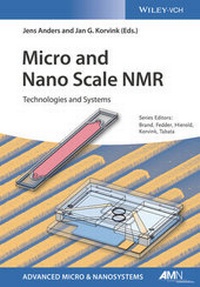
Micro and Nano Scale NMR
Description

More details
Other editions
Additional editions
Persons
Professor Anders has authored more than 90 scientific publications.
Jan Korvink obtained his PhD from the ETH in Zürich, Switzerland, in 1993. In 1997 he moved to the Albert Ludwig University in Freiburg, Germany, where for 18 years he was professor for microsystems engineering. From 2007 to 2013 he was a director of the Freiburg Institute for Advanced Studies. Since April 2015 he is Professor and director of the Institute of Microstructure Technology at the Karlsruhe Institute of Technology. His research interests cover the development of ultra low cost micromanufacturing methods, microsystem applications in the area of magnetic resonance imaging and spectroscopy, and the design and simulation of micro- and nano-systems. He is a recipient of the European Research Council's Advanced Grant for the development of an NMR metabolomic analyser for the nematode C. elegans. He has also been awarded a Red Dot Design Concept Prize in the area of NMR hardware.
Professor Korvink has authored more than 300 scientific publications, and was a founding editor of this book series.
Content
NMR Magnets for Portable NMR
Concept of Inside-out or Single-sided NMR
Applications Scenarios: Medicine Material Science
WIREBONDED NMR MICROCOILS
Wirebond Coils for NMR Spectroscopy and NMR Microscopy
Phased Array Microcoils
Magic Angle Spinning Inserts
Helmholtz coils for Nanoliter NMR Spectroscopy with High Frequency Resolution
ALTERNATIVE MICRO-TECHNOLOGIES FOR NMR MICROCOILS
Inkjet Printing Technology
Coil Decoupling
Amplifier Integration
WAVEGUIDES FOR MICRO NMR
Theory, RF-modeling and Fabrication Techniques
Waveguides with Microfluidics
Waveguide Probes for Metabolomics Studies
CMOS-BASED AND CMOS-ASSISTED MICRO-NMR
Electronics for Inductive NMR Detection
Single-chip NMR Transceiver with On-chip Coil Arrays for NMR Microscopy
Single-chip NMR Transceivers for Large-scale Arrays of External Coils
MICROGRADIENT SYSTEMS FOR NMR MICROSCOPY
Introduction to Planar Gradient Systems
Methods to Compute the Current Distribution
Fabrication Techniques
EFFICIENT PULSE SEQUENCES FOR NMR MICROSCOPY
SNR in NMR Microscopy
Problems Related to Diffusion in Fourier Encoded MRI vs. DESIRE
Diffusion Tensor Microscopy
IMPLANTABLE MR COILS
Applications of Implantable MR Coils
Fabrication Techniques
Biocompatible Encapsulation
MR CATHETER TIP COILS
Active Tracking of Catheters and Surgical Instruments
Overview of the Different Technologies Used to Manufacture Catheter Tip Coils
Patient Safety Considerations
Imaging Using Catheter Tip Coils
BROADBAND MICROCOILS FOR BROADBAND MULTINUCLEI DETECTION
Advantages of Direct Multinuclei Detection
Hardware Challenges Associated with Multinuclei Probe Heads
Decoupling Schemes
1D- And 2D Heteronuclear Experiments
MICRO-SCALE DYNAMIC NUCLEAR POLARIZATION
Brief Review of the DNP Effect
Micro Probes for DNP Enhanced NMR Spectroscopy
Challenges Associated With Microwave DNP Sources
FORCE DETECTED NMR (MRFM)
Brief Review of the Detection Principle and the Hardware
Nano-MRI Using MRFM
Challenges towards Single Nuclear Spin Sensitivity
OPTICALLY DETECTED NMR (ODMR)
Brief Review of the Detection Principle and the Required Hardware
Alkali Vapor Magnetometers for Portable NMR
Remote Detection of Nuclear Spins Using Ensembles of Nitrogen-Vacancy Centers for High Resolution Microfluidics Applications
NITROGEN VACANCY (NV) CENTERS IN DIAMONDS
Brief Review of the Spin Physics of NV Centers
Atomic Size Magnetometers Using NV Centers
Single Nuclear Spin Detection Using NV Centers in Diamond Chips
NV Centers as Nanoscale Sensors for Biological Applications
1
Magnets for Small-Scale and Portable NMR
Bernhard Blümich1, Christian Rehorn1 and Wasif Zia2
1RWTH Aachen University, Institut für Technische und Makromolekulare Chemie, Worringerweg 2, 52074 Aachen, Germany
2Sir Peter Mansfield Imaging Center, University of Nottingham, United Kingdom
1.1 Introduction
Nuclear magnetic resonance (NMR) exploits the resonance of the precessing motion of nuclear magnetization in magnetic fields [1, 2]. From the measurement methodology, three groups of common techniques of probing resonance can be assigned: those employing forced oscillations, free oscillations, and interferometric principles [3]. In either case, the sensitivity depends on the strength of the nuclear magnetic polarization, which, in thermodynamic equilibrium at temperatures higher than few degrees above absolute zero, is in good approximation proportional to the strength of the magnetic field. In recognition of this fact, one guideline in the development of NMR magnets has always been to reach high field strength. The highest field strength of temporally stable magnetic fields today is achieved with superconducting electromagnets. This is why most standard NMR instruments used for NMR spectroscopy in chemical analysis and magnetic resonance imaging (MRI) in medical diagnostics employ superconducting magnets cooled to the low temperature of boiling helium with cryogenic technology.
Another force driving the development of high-field magnets is that the frequency range of the chemical shift is also proportional to the field strength. The wider the frequency range, the more complicated are the molecules that can be analyzed by NMR spectroscopy. High magnetic fields are most crucial in structural biology [4]. In chemistry and biology, molecules are mostly studied in liquid solutions. The NMR spectra of such molecules can show hundreds of narrow resonance lines, which can be better separated at high field, provided the magnetic field is sufficiently homogeneous. Else, the resonance lines from different volume elements of the sample shift and the sum spectrum measured from all volume elements show small and broad peaks instead of narrow and tall peaks (Figure 1.1c vs e). In either case, the peak area is determined by the number of nuclei resonating in the given frequency range, and the resonance frequency ? is determined by the strength B of the magnetic field, which is experienced by the nuclei (Figure 1.1),
(1.1)where ? is the gyromagnetic ratio of the nucleus under observation.
Figure 1.1 NMR in inhomogeneous and in homogeneous fields. (a) Magnetic field strength B linearly varying with pixel position x. (b) Three pixels containing different numbers of NMR-active nuclei at different positions x. (c) NMR spectrum observed in an inhomogeneous field (gray). For the case that the magnetic field B is homogeneous across each pixel (broken lines in a), the peak integral is proportional to the total magnetization at each pixel (black). (d) Spatially homogeneous magnetic field. (e) In a homogeneous field, the resonance signals from each pixel sum up at the same frequency.
In NMR spectroscopy, the frequency range of the signal-bearing nuclei depends on the nuclide. Small-scale instruments use permanent magnets with low field strengths so that their sensitivity is low, unless the nuclear polarization is enhanced by hyperpolarization methods [3, 5]. The most sensitive, stable NMR nuclei are 1H and 19F. 1H is the most abundant element in the universe and is found in water and organic matter. It has a frequency range of , where ppm denotes . 19F, on the other hand, is similarly sensitive but with a much wider frequency range of . It is frequently encountered in pharmaceutical compounds and can be detected against a 1H signal background due to its resonance frequency being 40 MHz at versus 42 MHz for 1H. Thus, both types of nuclei are of great interest also for miniature NMR devices.
To resolve individual resonance lines within these frequency ranges, the magnetic field needs to be homogeneous with an accuracy of 0.1-0.01 ppm across the sample extension for 1H and with a factor of about 10 less for 19F (Fig. 1.1d). This magnetic field homogeneity defines a design goal for spectroscopy-grade permanent NMR magnets. In terms of the magnetic field varying linearly along the space direction x across a 5 mm diameter sample, the field gradient should consequently be smaller than for for 1H (Figure 1.1a). Note that this is two orders of magnitude less than the minimum gradient required to resolve structures in NMR imaging of soft matter at the 1 mm scale at 1 T where one deliberately applies linear magnetic field profiles across the object to measure projections of the magnetization density in terms of NMR spectra.
If the field inhomogeneity is higher, NMR spectra cannot be resolved, but NMR relaxation can still be measured by echo techniques [1, 2, 6]. In fact, NMR relaxometry experiments can be executed in arbitrarily inhomogeneous magnetic fields, where the NMR signal is spread over wide frequency ranges (Fig. 1.1c). The signal amplitude is then limited by the excitation bandwidth, which in turn is determined by the duration tp of the excitation pulse and the resonance characteristics of the transmit/receive electronics. For example, to excite all spins across the diameter of a 5 mm sample tube with a 10 µs excitation pulse, the average field gradient for 1H relaxometry should be less than 0.5 T/m. Although NMR spectroscopy experiments are in demand for chemical identification, NMR relaxometry experiments are employed for characterizing physical properties of condensed liquids and solids such as crude oil, foodstuff, plants, and polymers [6, 7] as well as for identifying relaxation agents with chemical functionality, which bind to markers of disease in biological extracts [8-12]. Depending on their use, NMR magnets are consequently categorized into magnets with high field homogeneity for both NMR spectroscopy and relaxometry at the same time and magnets with lesser homogeneity, which are suitable for NMR imaging and relaxometry or NMR relaxometry only.
1.2 Compact Permanent Magnets
1.2.1 Types of Permanent Magnets
A big advantage of using permanent magnets over superconducting devices is their portability and lower weight. On the downside, they usually provide less homogeneity and lower field [13]. Although NMR relaxation can be measured in inhomogeneous fields, sample size, inhomogeneity, and radio frequency (RF) pulse width commonly define two limiting cases. In the first case, the magnetization in each voxel of the sample can be exited with an RF pulse. In the second case, only a subset of all voxels can be excited. In this case, the RF pulse is said to be selective because the spread in resonance frequencies from all voxels in the object caused by the field inhomogeneity is larger than the excitation bandwidth. Typically, this situation is encountered in unilateral stray-field NMR, where a small NMR sensor is placed near a large object (Figure 1.2a), and the stray magnetic field decays with distance into the object along with the NMR resonance frequency. A popular example of such a sensor is the NMR-MOUSE [14], which typically operates at a magnetic field strength in the vicinity of 0.5 T with a gradient of 10-20 T/m depending on the size of the device. Stray-field sensors are employed for nondestructive testing because the object can be arbitrarily large [15].
Figure 1.2 Types of compact NMR magnets. (a) A stray-field magnet is placed close to the object, here a car tire, for analysis of material properties. (b) A center-field magnet accommodates the sample inside, here one of the 5 mm diameter sample tubes (foreground) containing the sample solution. The magnet is the most voluminous component of the NMR spectrometer (red). The sample tube is inserted into the magnet from the top.
The average gradient of the NMR-MOUSE is more than one order of magnitude larger than the gradient tolerable for NMR relaxometry with nonselective excitation of typical 5 mm diameter samples. Magnets with low gradients suitable for nonselective relaxometry, imaging, and spectroscopy are easier to construct when they surround the object. This, however, limits the object diameter because the object needs to be inserted into an opening of the magnet body (Figure 1.2b). In contrast to stray-field magnets, such magnets are referred to as center-field magnets in the following. If the object size exceeds the dimensions of the magnet bore, samples need to be drawn from the object, a procedure common in chemical analysis of molecules in solution by NMR spectroscopy.
The arguments specifying the tolerable average field gradient across the sample also relate to the quality factor of the resonance circuit, which detects the nuclear induction signal. It is defined as the ratio of the resonance frequency ? over the detection bandwidth as , where ?? is of the order of the inverse excitation pulse width tp, . A high-quality factor is desirable for high sensitivity of signal detection, especially at very low field [16]. On the other hand, it limits the detection bandwidth (Figure...
