

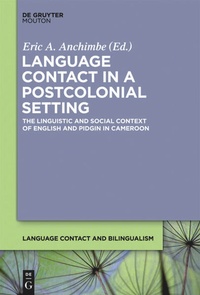
Language Contact in a Postcolonial Setting
Description

This timely book brings together research on the features and evolution of Cameroon English and Cameroon Pidgin English, approached from a variety of innovative multilingual frameworks that focus on the emergence of mother tongue speakers. The authors illustrate how language and population contact, history (colonialism), multilingualism, translation, and indigenization have contributed to shaping the norms of postcolonial Englishes and Pidgins. Employing naturalistic data, the volume provides a new fascinating perspective that better situates and supplements existing research in the fields of African Englishes and Creolistics. It is particularly of key interest to sociolinguists, contact linguists, Africanists, Anglicists, creolists and historical linguists.
Reviews / Votes
"In sum, this volume sheds new light on different aspects of both CamE and CPE and provides the reader with original language samples. Moreover, the studies presented by the authors can be further used in the comparative analyses of, for example, aspect-tense-modality markers or reduplication found in pidgins and creoles, and therefore, this work opens new possibilities for further research on CamE, CPE, and other related pidgins and creoles and world Englishes, which is what each new contribution to any field of science should do."Marcin Walczynski in: Linguist List 24.993More details
Other editions
Additional editions
Person
Content
2 - Introduction [Seite 11]
2.1 - Chapter 1. Language contact in a postcolonial setting: Research approaches to Cameroon English and Cameroon Pidgin English [Seite 13]
3 - Part I. Cameroon English: Properties and frameworks [Seite 37]
3.1 - Chapter 2. The expression of modality in Cameroon English [Seite 39]
3.2 - Chapter 3. A cognitive sociolinguistic approach to the lexicon of Cameroon English and other world Englishes [Seite 73]
3.3 - Chapter 4. Reading the phonology Cameroon English through the Trilateral Process [Seite 87]
3.4 - Chapter 5. One variety, different ethnic tongues: A phonological perspective on Nso' English [Seite 109]
3.5 - Chapter 6. The filtration processes in Cameroon English [Seite 127]
3.6 - Chapter 7. Language choice, identity, and power in the Cameroonian parliament [Seite 151]
4 - Part II. Cameroon Pidgin English: Properties and history [Seite 173]
4.1 - Chapter 8. Tense and aspect in Cameroon Pidgin English [Seite 175]
4.2 - Chapter 9. Reduplication in Cameroon Pidgin English: Formal and functional perspectives [Seite 201]
4.3 - Chapter 10. Pronouns in Cameroon Pidgin English [Seite 225]
4.4 - Chapter 11. Gud Nyus fo Pidgin?: Bible translation as language elaboration in Cameroon Pidgin English [Seite 255]
4.5 - Chapter 12. German colonial influences on, and representations of, Cameroon Pidgin English [Seite 279]
5 - Part III. Texts and more texts [Seite 307]
5.1 - Written and oral samples of Cameroon English and Cameroon Pidgin English [Seite 309]
6 - Contributors [Seite 323]
7 - Author index [Seite 327]
8 - Subject index [Seite 329]
