

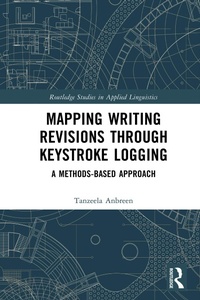
Mapping Writing Revisions through Keystroke Logging
A Methods-based Approach
Published on 29. December 2025
184 pages
978-1-040-42343-1 (ISBN)
Description

This book presents Keystroke Logging as a powerful methodological tool for investigating writers' revision processes in writing. The volume demonstrates the ways in which Keystroke Logging can be used to observe, record, and analyse writing revisions in real time, especially useful given the growing use of computer-facilitated academic writing.
Drawing on an integrated approach implementing both real-time observation and immediate stimulated recall, Anbreen seeks to bridge the gap between theory and practice by bringing together theoretical understandings of writing revisions with practical applications of Keystroke Logging. The work makes the case for the use of Keystroke Logging in computer-based writing research to better elucidate the cognitive processes L2 writers engage in during the revision process.
This book will be of interest to students, scholars, and relevant stakeholders in applied linguistics, second language writing, academic writing, language learning and teaching, and educational technology.
Drawing on an integrated approach implementing both real-time observation and immediate stimulated recall, Anbreen seeks to bridge the gap between theory and practice by bringing together theoretical understandings of writing revisions with practical applications of Keystroke Logging. The work makes the case for the use of Keystroke Logging in computer-based writing research to better elucidate the cognitive processes L2 writers engage in during the revision process.
This book will be of interest to students, scholars, and relevant stakeholders in applied linguistics, second language writing, academic writing, language learning and teaching, and educational technology.
Reviews / Votes
"This book is a valuable resource for language assessment researchers and practitioners who assess writing. It provides new perspectives on the cognitive processes used by L2 writers when revising their text through the use of Keystroke Logging. The research methodology elucidated in this book opens many fruitful avenues of research for L2 writing researchers."- Dr Susan Sheehan, Senior Lecturer in TESOL, Deputy REF Co-ordinator, University of Huddersfield, UK
"While the writing process has been studied in cognitive and social terms very well, the way technology shapes the writing process has not been studied adequately. Anbreen brings the expertise to analyse keystroke logging to elucidate the decisions writers make in composing. This book will prove important to understand how to integrate computers into writing pedagogy."
- Prof Suresh Canagarajah, Evan Pugh University Professor, Pennsylvania State University, USA
"Mapping Writing Revisions through Keystroke Logging: A Methods-based Approach by Tanzeela Anbreen offers a timely and insightful contribution to writing research. Recognising that writing is an intricate process often visible only through its final product, this book opens a crucial window into understanding the process itself. Through a clear and theoretically grounded presentation, supported by robust empirical analysis, Anbreen demonstrates how keystroke logging can make the invisible cognitive and revision behaviours of writers accessible to educators, language testers and students. The methodological rigour and innovative approach outlined in this volume not only advance research on writing and revision but also provide transferable tools and skills for anyone interested in examining and improving the processes that underpin effective written communication."
- Professor Vaclav Brezina, Professor in Corpus Linguistics, Co-Director of the ESRC Centre for Corpus Approaches to Social Science
"This important volume by Dr Anbreen showcases how Keystroke Logging can be meaningfully employed as a powerful tool to understand computer-based L2 writing revisions in real-time. The chapters demonstrate how Keystroke Logging can be systematically and practically used in process-oriented L2 writing pedagogy. The book will be valuable for L2 writing researchers and teachers alike."
- Dr Prithvi N. Shrestha, SFHEA, Academic Lead, Applied Linguistics & English Language, The Open University, UK
More details
Series
Language
English
Place of publication
London
United Kingdom
Publishing group
Taylor & Francis Ltd
Target group
College/higher education
Professional and scholarly
Product notice
Reflowable
Illustrations
31 Tables, black and white; 7 Line drawings, black and white; 5 Halftones, black and white; 12 Illustrations, black and white
File size
2,44 MB
ISBN-13
978-1-040-42343-1 (9781040423431)
Copyright in bibliographic data and cover images is held by Nielsen Book Services Limited or by the publishers or by their respective licensors: all rights reserved.
Schweitzer Classification
Other editions
Additional editions
Book
approx. 12/2025
1st Edition
Routledge
€205.20
Not yet published
Person
Dr. Tanzeela Anbreen is a Faculty Lecturer at the University of Bedfordshire, where she earned her PhD in 2020. Her research focuses on L2 writing, digital writing assessment, social theory and corpus-based approaches to academic literacy. In addition to her teaching and research in the UK, she actively collaborates with higher education institutions around the globe including Vietnam, Sri Lanka, Pakistan, Nepal, Egypt, Maldives, Oman, Myanmar, Jordan, China, Hong Kong and Trinidad & Tobago. in Pakistan alone, she supports capacity building at Minhaj University Lahore, Islamia University of Bahawalpur and the University of Sindh.
Content
CHAPTER 1 - Exploring Revisions in Computer-Based L2 Writing: Framing the Study
Chapter 2 - Conceptual Framework: Revision Taxonomy in Utilising Keystroke Logging
Chapter 3- Research Design to Map Revisions Patterns & Purposes
Chapter 4 - Revision Evidence through Keystroke Logging Method
CHAPTER 5 - Writers' Understanding of Revision: Gap between Theory and Practice
Chapter 6 - Conclusion
References
Index
Chapter 2 - Conceptual Framework: Revision Taxonomy in Utilising Keystroke Logging
Chapter 3- Research Design to Map Revisions Patterns & Purposes
Chapter 4 - Revision Evidence through Keystroke Logging Method
CHAPTER 5 - Writers' Understanding of Revision: Gap between Theory and Practice
Chapter 6 - Conclusion
References
Index
