

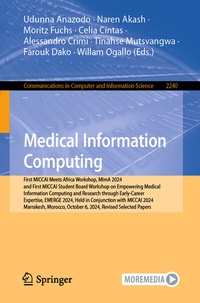
Medical Information Computing
Description

This book presents a series of revised papers selected from the First MICCAI Meets Africa Workshop, MImA 2024, and First MICCAI Workshop on Empowering Medical Information Computing and Research through Early-Career Expertise, EMERGE 2024, which was held in Marrakesh, Morocco, during October 6, 2024.
MImA 2024 accepted 21 full papers from 45 submissions; for EMERGE 8 papers are included from 9 submissions. They describe cutting-edge research from computational scientists and clinical researchers working on a variety of medical image computing challenges relevant to the African and broader global contexts, as well as emerging techniques for image computing methods tailored to low-resource settings.
More details
Other editions
Additional editions
Content
First MICCAI Meets Africa Workshop, MImA 2024.- EARLY DETECTION OF LIVER FIBROSIS.- Optimized Brain Tumor Segmentation for resource constrained settings: VGG-Infused U-Net Approach.- Optimizing Classification of Congestive Heart Failure Using Feature Weight Importance Correlation.- MCL: Multi-Level Consistency Learning for Medical Image Segmentation.- Trustworthiness for Deep Learning Based Breast Cancer Detection Using Point-of-Care Ultrasound Imaging in Low-Resource Settings.- Advancing the Reliability of Ultra-Low Field MRI Brain Volume Analysis using CycleGAN.- Deep Learning based Non-Invasive Meningitis Screening using High-Resolution Ultrasound in Neonates and Infants from Mozambique, Spain and Morocco.- Automated Segmentation of Ischemic Stroke Lesions in Non-Contrast Computed Tomography Images for Enhanced Early Treatment and Prognosis.- Spatial Attention-Enhanced Diffusion Model for Multiple Sclerosis MRI Synthesis.- An Automated Pipeline for the Identification of Liver Tissue in Ultrasound Video.- Democratizing AI in Africa: Federated Learning for Low-Resource Edge Devices.- Generative Style Transfer for MR Image Segmentation: A case of Glioma Segmentation in Sub-Saharan Africa.- Impact of Skin Tone Diversity on Out-of-Distribution Detection Methods in Dermatology.- Deployment and Evaluation of Intelligent DICOM Viewers in Low-Resource Settings: Orthanc Plugin for Semi-Automated Interpretation of Medical Images.- Enhancing Soil-transmitted Helminths Diagnosis through AI: A Self-Supervised Learning Approach with Smartphone-Based Digital Microscopy.- Capturing Complexity of the Foot Arch Bones: Evaluation of a Statistical Modelling Framework for Learning Shape, Pose and Intensity Features in a Continuous Domain.- Explainability-Guided Deep Learning Models For COVID-19 Detection Using Chest X-ray Images.- Feasibility of Open-Source Tracking-Based Metrics in Evaluating Ultrasound-Guided Needle Placement Skills in Senegal.- Automatic Segmentation of Medical Images for Ischemic Stroke in CT Scans for the Identification of Sulcal Effacement.- AfriBiobank: Empowering Africa's Medical Imaging Research and Practice Through Data Sharing and Governance.- Benchmarking Noise2Void: Superior Denoising of Medical Microscopic Images.- First MICCAI Workshop on Empowering Medical Information Computing and Research through Early-Career Expertise, EMERGE 2024.- Self-consistent deep approximation of retinal traits for robust and highly effcient vascular phenotyping of retinal colour fundus images.-Non-Parametric Neighborhood Test-Time Generalization: Application to Medical Image Classification.- Client Security Alone Fails in Federated Learning: 2D and 3D Attack Insights.-Context-Guided Medical Visual Question Answering.- GRAM: Graph Regularizable Assessment Metric.- Unsupervised Analysis of Alzheimer's Disease Signatures using 3D Deformable Autoencoders.- Deep Feature Fusion Framework for Alzheimer's Disease Staging using Neuroimaging Modalities.- Explainable Few-Shot Learning for Multiple Sclerosis Detection in Low-Data Regime.
