

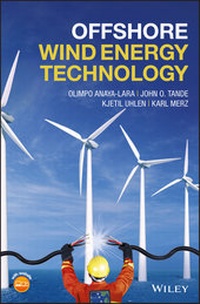
Offshore Wind Energy Technology
Description

Offshore Wind Energy Technology offers a reference based on the research material developed by the acclaimed Norwegian Research Centre for Offshore Wind Technology (NOWITECH) and material developed by the expert authors over the last 20 years. This comprehensive text covers critical topics such as wind energy conversion systems technology, control systems, grid connection and system integration, and novel structures including bottom-fixed and floating. The text also reviews the most current operation and maintenance strategies as well as technologies and design tools for novel offshore wind energy concepts.
The text contains a wealth of mathematical derivations, tables, graphs, worked examples, and illustrative case studies. Authoritative and accessible, Offshore Wind Energy Technology:
* Contains coverage of electricity markets for offshore wind energy and then discusses the challenges posed by the cost and limited opportunities
* Discusses novel offshore wind turbine structures and floaters
* Features an analysis of the stochastic dynamics of offshore/marine structures
* Describes the logistics of planning, designing, building, and connecting an offshore wind farm
Written for students and professionals in the field, Offshore Wind Energy Technology is a definitive resource that reviews all facets of offshore wind energy technology and grid connection.
More details
Other editions
Additional editions
Persons
OLIMPO ANAYA-LARA is a Reader in the Wind Energy and Control Centre at the University of Strathclyde, Glasgow, UK.
JOHN O. TANDE is a Chief Scientist with SINTEF Energy Research and Director of NOWITECH, Norway.
KJETIL UHLEN is a Professor in Electrical Power Systems at the Norwegian University of Science and Technology (NTNU), Norway.
KARL MERZ is a Research Scientist at SINTEF Energy Research, Norway.
Content
Notes on Contributors xiii
Foreword xvii
Preface xix
Acronyms xxi
Symbols (Individual Chapters) xxv
About the Companion Website xxxi
1 Introduction 1 John O. Tande
1.1 Development of Offshore Wind Energy 1
1.2 Offshore Wind Technology 5
1.3 Levelized Cost of Energy 6
1.4 Future Offshore Wind Development 9
1.5 References 10
2 Energy Conversion Systems for Offshore Wind Turbines 13 Olimpo Anaya-Lara
2.1 Background 13
2.2 Offshore Wind Turbine Technology Status 14
2.3 Offshore Wind Turbine Generator Technology 14
2.4 Wind Turbine Generator Architectures 17
2.4.1 Fixed-speed Wind Turbines 17
2.4.2 Variable-speed Wind Turbines 18
2.4.2.1 Type II Wind Turbine Generator 18
2.4.2.2 Type III DFIG Wind Turbine Generator 19
2.4.2.3 Type IV FRC Wind Turbine Generator 20
2.5 Generators for Offshore Wind Turbines 21
2.5.1 New Generator Technologies and Concepts 22
2.5.1.1 Direct-driven DFIG 22
2.5.1.2 Conventional Direct-driven RFPMSG 22
2.5.1.3 Direct-driven iPMSG 23
2.5.1.4 Superconducting Generator 23
2.5.1.5 High-Voltage Variable-Capacitance Direct Current Generator 23
2.6 Power Electronic Converters for MW Wind Turbine Generators 24
2.6.1 Technical and Operational Requirements 24
2.6.2 Back-to-back Connected Power Converters 25
2.6.2.1 LV Converters 25
2.6.2.2 MV Converters 27
2.6.3 Passive Generator-side Converters 28
2.6.4 Converters for Six-phase Generators 28
2.6.5 Power Converters Without DC-link - Matrix Converters 30
2.7 Wind Generators Compared to Conventional Power Plant 30
2.7.1 Local Impacts 31
2.7.1.1 Circuit Power Flows and Busbar Voltages 31
2.7.1.2 Protection Schemes, Fault Currents and Switchgear Rating 31
2.7.1.3 Power Quality 32
2.7.2 System-wide Impacts 32
2.7.2.1 Power System Dynamics and Stability 32
2.7.2.2 Reactive Power and Voltage Support 33
2.7.2.3 Frequency Support 33
2.8 Acknowledgements 33
2.9 References 34
3 Modelling and Analysis of Drivetrains in Offshore Wind Turbines 37 Amir Rasekhi Nejad
3.1 Introduction 37
3.2 Drivetrain Concepts 39
3.2.1 Gearbox Configurations, Cost and Efficiency 39
3.3 Gearbox Failures 42
3.4 State-of-the-art Wind Turbine Gearbox Design Codes 44
3.5 Drivetrain Modelling and Analysis 44
3.5.1 Decoupled Approach 46
3.5.2 Multibody System (MBS) Modelling 48
3.5.2.1 General 48
3.5.2.2 Gear Model in MBS 50
3.5.2.3 Bearing Model in MBS 51
3.5.3 Gear Stress Analysis 53
3.5.4 Bearings Fatigue Analysis 54
3.5.5 Effect of Geometrical Errors 55
3.5.6 Effect of Misalignments 55
3.5.7 Flexibility in the Planetary Stage 55
3.6 Limit State Design 56
3.6.1 FLS, ULS and ALS Design Check 57
3.6.2 Ultimate Limit State (ULS) Design Check 58
3.6.3 Fatigue Limit State (FLS) Design Check 60
3.6.3.1 Gears 60
3.6.4 Structural Reliability Analysis Method 63
3.6.4.1 Uncertainties 63
3.6.4.2 Model Uncertainties 64
3.6.4.3 Failure Function 66
3.6.4.4 ULS and FLS Structural Reliability Analysis 67
3.7 Drivetrains in Floating Wind Turbines 69
3.7.1 Gearbox on TLP, spar and semi-submersible turbines versus land-based wind turbines 69
3.8 Condition Monitoring and Inspection 77
3.8.1 Model-based Fault Detection 78
3.8.2 Gearbox Vulnerability Map 79
3.9 Drivetrains in Fault Conditions 82
3.10 5-MW Reference Offshore Drivetrain 88
3.11 References 94
4 Fixed and Floating Offshore Wind Turbine Support Structures 103 Erin E. Bachynski
4.1 Introduction 103
4.2 Bottom-fixed Support Structures 104
4.3 Floating Support Structures 107
4.4 Design Considerations 109
4.5 Conceptual Design 111
4.5.1 Initial Design Criteria 111
4.5.2 Design by Upscaling 114
4.5.3 Preliminary Analysis 115
4.6 Loads in the Marine Environment 119
4.6.1 Aerodynamic Loads 119
4.6.2 Hydrodynamic Loads 122
4.6.3 Additional Marine Loads 125
4.7 Global Dynamic Analysis of Offshore Wind Turbines 126
4.7.1 Short-term Numerical Global Analysis 127
4.7.2 Long-term Numerical Global Analysis 131
4.7.3 Experimental Analysis of OWTs 132
4.8 Conclusions 135
4.9 References 136
5 Offshore Wind Turbine Controls 143 Karl Merz and Morten D. Pedersen
5.1 Control Objectives, Sensors and Actuators 145
5.1.1 Control Objectives 145
5.1.1.1 Power Production and Rotor Speed Control 145
5.1.1.2 Load Reduction, Load Rejection and Active Damping 147
5.1.1.3 Power Command Tracking 149
5.1.1.4 Supervisory Control Functions and Fault Handling 149
5.1.2 Available Control Actions and Sensors 150
5.2 Control Algorithms 151
5.2.1 Overview of Algorithms 152
5.2.1.1 Single-input, Single-output Controls 152
5.2.1.2 Advanced Controls 152
5.2.2 Realization of a Controller for a 10-MW Wind Turbine 155
5.3 A Linear Aeroelastic Loads Model for Closed-loop System Dynamics 159
5.3.1 Aerodynamic Model 159
5.3.2 Structural Model 161
5.3.3 Electrical Systems 164
5.3.3.1 Generator 165
5.3.3.2 Converter 165
5.3.3.3 DC-Link 167
5.3.3.4 Transformer 167
5.3.4 Pitch Actuators 167
5.3.5 A Unified, Linear, Time-invariant State-Space Model 168
5.3.6 Comments on Linearity 169
5.4 Basic Rotor Speed Control in Operating Regions I and II 175
5.4.1 Region I 175
5.4.1.1 Stability and Performance of the MPPT Algorithm 175
5.4.1.2 Structural Flexibility 179
5.4.1.3 Region I Control of the ORT, with Reduced-order Dynamics 180
5.4.2 Region II 186
5.4.2.1 Region II Control of the ORT 187
5.5 Active Damping and Load Reduction 197
5.5.1 A Virtual Induction Generator for Edgewise Stability 198
5.5.2 Tower Side-to-side Damping Using the Generator 201
5.5.3 Tower Fore-aft Damping Using Blade Pitch 211
5.5.4 Individual Blade Pitch Control 216
5.6 Power Command Tracking 222
5.6.1 Operating Strategy 223
5.6.2 Tuning the Converter Control of Generator Power 226
5.6.3 Power Tracking Performance 230
5.7 Conclusions 232
5.8 References 233
6 Offshore Wind Farm Technology and Electrical Design 239 David Campos-Gaona, Olimpo Anaya-Lara and John O. Tande
6.1 AC Collectors for Offshore Wind Turbines 240
6.1.1 Radial Cluster Topology 241
6.1.2 Single-sided Ring Clustered Topology 241
6.1.3 Double-sided Ring Topology 242
6.1.4 Star Topology 243
6.1.5 Multiring Topology 243
6.1.6 Summary of the Characteristics of Different AC Topologies 244
6.1.7 Example of an AC Collector Topology for a Low-power Offshore Wind Farm: Horns Rev 1 244
6.1.8 Example of an AC Collector Topology for a High Power Offshore Wind Farm: the Greater Gabbard 245
6.2 DC Collectors for Offshore Wind Turbines 247
6.2.1 Parallel DC Collector System 247
6.2.2 DC Collectors for Series Connections 247
6.2.3 Hybrid Topology 249
6.3 Connection Layout Options for a Cluster of Offshore Wind Farms 249
6.3.1 The Offshore AC Hub 250
6.3.2 Multiterminal HVDC Option: The DC General Ring Topology 251
6.3.3 Multiterminal HVDC Option: The DC Star Topology 252
6.3.4 Multiterminal HVDC Option: The DC Star with a General Ring Topology 252
6.3.5 Multiterminal HVDC Option: The Wind Farm Ring Topology 253
6.4 Protection of Offshore Wind Farms 255
6.4.1 Switchgear at Substation Level 255
6.4.2 Switchgear at Array Level 256
6.4.3 Grounding of Offshore Wind Farms 257
6.4.4 Protection Zones in Offshore Wind Farms 259
6.4.4.1 Wind Generator Protection Zone 260
6.4.4.2 Feeder Protection Zone 263
6.4.4.3 Busbar Protection Zone 264
6.4.4.4 High Voltage Transformer Protection Zone 266
6.5 Acknowledgements 266
6.6 References 266
7 Operation and Maintenance Modelling 269 Thomas Michael Welte, Iver Bakken Sperstad, Elin Espeland Halvorsen-Weare, Øyvind Netland, Lars Magne Nonås, and Magnus Stålhane
7.1 Introduction 270
7.2 O&M Modelling for Offshore Wind Farms 272
7.2.1 Classification of Models 272
7.2.2 State-of-the-art in Modelling 275
7.2.3 Decision Problems and Model Application 278
7.3 Decision Support Tools Developed by NOWITECH 278
7.3.1 NOWIcob 280
7.3.2 Vessel Fleet Optimization Models 283
7.3.3 Routing and Scheduling 284
7.3.4 Use of Different Models and Synergetic Interactions 288
7.3.5 Model Validation and Verification 289
7.4 Application of Models - Examples and Case Studies 291
7.4.1 Cost-Benefit Evaluation of Remote Inspection 291
7.4.1.1 Simulation Cases in NOWIcob 293
7.4.1.2 Results of the Cost-Benefit Analysis 293
7.4.1.3 Laboratory Evaluation 294
7.4.1.4 Remote Inspection after NOWITECH 295
7.4.2 O&M Vessel Fleet Optimization 296
7.5 Outlook 297
7.6 References 300
8 Supervisory Wind Farm Control 305 Karl Merz, Olimpo Anaya-Lara, William E. Leithead and Sung-ho Hur
8.1 Background 305
8.2 Control Objectives 306
8.3 Sensory Systems 307
8.4 Wind Farm System Model 308
8.4.1 Wind and Wakes 308
8.4.1.1 Stochastic Wind Field Models 309
8.4.1.2 Wake Propagation Models 309
8.4.1.3 CFD Models 310
8.4.1.4 Comments on Wind Field Models 310
8.4.2 Ocean Waves 311
8.4.3 Structures 311
8.4.4 Electrical System 312
8.5 Control Strategies 313
8.5.1 Control at the PCC 313
8.5.1.1 HVAC Transmission 314
8.5.1.2 HVDC Transmission 316
8.5.1.3 Comments on Controlling Output at the PCC 317
8.5.2 Dispatch of Power Set-Points in Response to TSO Requirements 317
8.5.2.1 Proportional Dispatch 318
8.5.2.2 Optimum Dispatch 319
8.5.3 Power Dispatch in Response to Wakes and Gusts 320
8.5.3.1 Heat and Flux (ECN) 321
8.5.3.2 Load Reduction 322
8.5.4 Operation as a Function of Electricity Price 325
8.5.5 Including Operation and Maintenance Aspects in the Cost Function 326
8.6 Wind Farm Controller for Improved Asset Management 327
8.6.1 Power Adjusting Controller (PAC) 329
8.6.2 Rules and Operation for Power Output Curtailment 331
8.6.3 Case Study 334
8.7 Acknowledgements 338
8.8 References 338
9 Offshore Transmission Technology 345 Olimpo Anaya-Lara and John O. Tande
9.1 Introduction 345
9.2 HVAC Transmission 346
9.3 VSC-HVDC Transmission 349
9.3.1 Components of a Typical VSC-HVDC 350
9.3.1.1 VSC Converter 350
9.3.1.2 Coupling Transformers 351
9.3.1.3 Smoothing Reactors 351
9.3.1.4 AC Harmonic Filters 351
9.3.1.5 DC Capacitors 351
9.3.1.6 DC Cables 351
9.3.2 VSC-HVDC Steady-state Model 352
9.3.3 VSC-HVDC Dynamic Model 354
9.3.4 VSC-HVDC Control System 356
9.3.4.1 Inner Controller Design 357
9.3.4.2 Outer Controller Design 359
9.4 Offshore Grid Systems 360
9.4.1 Multiterminal VSC-HVDC Networks 360
9.4.2 Configurations of Multiterminal DC Transmission Systems 362
9.5 Low-Frequency Alternating Current (LFAC) 362
9.6 Offshore Substations 367
9.7 Reactive Power Compensation Equipment 369
9.7.1 Static VAR Compensator (SVC) 369
9.7.2 Static Compensator (STATCOM) 372
9.8 Subsea Cables 373
9.8.1 AC Subsea Cables 375
9.8.2 DC Subsea Cables 375
9.8.3 Modelling of Underground and Subsea Cables 375
9.9 Acknowledgement 376
9.10 References 376
10 Grid Integration and Control for Power System Operation Support 381 Kjetil Uhlen
10.1 Power System Interconnection 381
10.2 Operation and Control 383
10.2.1 Power Balancing Control (Frequency and Voltage Control) 383
10.2.2 Power System Security (and Congestion Management) 385
10.3 Performance Requirements and System Services (Including Grid Codes) 386
10.4 Provision of System Services from Offshore Wind Farms 389
10.4.1 Power Quality 390
10.4.2 Fault Ride Through 391
10.4.3 Frequency Control 391
10.4.3.1 Inertia 392
10.4.3.2 Power System Stabilizer 393
10.4.4 Voltage Control 394
10.4.5 Energy Storage, Secondary Control and System Protection 395
10.5 References 395
11 Market Integration and System Operation 397 Kjetil Uhlen
11.1 Purpose and Overview of Electricity Markets 397
11.1.1 Forward/Future Market 398
11.1.2 Day-ahead Market 398
11.1.3 Intra-day Market 399
11.1.4 Real-time Balancing Markets 399
11.1.5 Other Market Arrangements 400
11.1.5.1 Capacity Markets 400
11.1.5.2 Secondary Control and AGC 400
11.2 Market Coupling and Transmission Allocation 400
11.3 Offshore Wind as a Market Participant 402
11.4 Support Schemes in an Integrated Market 402
11.5 Challenges for Future Market Design 404
11.6 References 405
Appendix 407
Index 415
Notes on Contributors
Olimpo Anaya-Lara is a Reader in the Wind Energy and Control Centre at the University of Strathclyde, UK. Over the course of his career, he has successfully undertaken research on power electronic equipment, control systems design and stability and control of power systems with increased wind energy penetration. Dr Anaya-Lara is a key participant to the wind integration subprogramme of the European Energy Research Alliance (EERA) Joint Programme Wind (JP Wind), leading Strathclyde's involvement and contribution to this subprogramme. He leads the research activity of power systems and grid integration on EERA projects Design Tools for Offshore Clusters (DTOC) and Integrated Research Project Wind (IRPWIND). Dr Anaya-Lara is a member of the Scientific Advisory Board of the Norwegian Centre for Offshore Wind Technology (Trondheim). He was appointed to the post of Visiting Professor in Wind Energy at the Norwegian University of Science and Technology (NTNU), Trondheim, Norway, funded by Det Norske Veritas (2010-2011). He was a member of the International Energy Annexes XXI, Dynamic models of wind farms for power system studies, and XXIII, Offshore wind energy technology development. He was also a member of the CIGRE Working Group B4-39, The connection, transmission and distribution of bulk wind power using power electronic-based applications, where he contributed Chapter 10, Future Trends and Concepts, to the final report. He has published four technical books as well as over 150 papers in international journals and conference proceedings.
Erin E. Bachynski has been an Associate Professor of marine structures in the Department of Marine Technology at the Norwegian University of Science and Technology (NTNU) since 2016. She holds bachelor and masters degrees in naval architecture and marine engineering from the University of Michigan, and a PhD from NTNU, with a thesis titled 'Design and Dynamic Analysis of Tension Leg Platform Wind Turbines'. Associate Professor Bachynski's main research areas are numerical and experimental modelling of offshore wind turbine structures, including hydroelasticity, nonlinear wave loads and structural response modelling. Previous projects include development of numerical simulation tools for offshore wind turbines, including consideration of the faults, drivetrain responses, and higher-order hydrodynamic loads, as well as real-time hybrid testing of a semisubmersible wind turbine.
David Campos-Gaona received his PhD degree in electrical engineering from Instituto Tecnológico de Morelia, Morelia, México, in 2012. From 2014-2016, he was a Postdoctoral Research Fellow with the Department of Electrical and Computer Engineering, University of British Columbia, Vancouver, Canada. Since August 2016, he has been a Research Associate with the University of Strathclyde, Glasgow, UK. His research interests include wind farm power integration, HVDC transmission systems and real-time digital control of power-electronic-based devices. Dr Campos-Gaona has been author/co-author of one book, seven journal papers and several conference papers in the area of electrical engineering and wind power systems.
Elin Espeland Halvorsen-Weare is a Research Scientist in the Maritime Transport Systems group at SINTEF Ocean, department of Maritime. She earned her MSc in Industrial Economics and Technology Management in 2007 and her PhD on Maritime Fleet Planning and Optimization under Uncertainty in 2012, both from the Norwegian University of Science and Technology (NTNU). Between 2011 and 2014 she held a position as postdoctoral fellow on the topic of discrete optimization methods for transportation problems at SINTEF ICT. Dr Halvorsen-Weare has mainly been working on optimization problems related to maritime logistics, but her interests also cover other related problems within transport and logistics. Her focus is on a broad range of solution methods, including exact optimization techniques, heuristics and multi-objective optimization and how to treat uncertainty in real-life logistic problems for the maritime industry.
Sung-ho Hur received a BEng degree in Electronics and Electrical Engineering (EEE) from the University of Glasgow in 2004 and an MSc (with Distinction) in EEE from the University of Strathclyde in 2005. He then worked as a research assistant in the Industrial Control Centre (ICC) within the Department of EEE at the University of Strathclyde before undertaking a PhD at the ICC in 2006. During his PhD, he conducted research on modelling, cross-directional control and fault monitoring of DuPont Teijin Films' plastic film manufacturing process. Since completing his PhD in 2010, he has been working as a Research Associate in the ICC, researching in control, modelling and anomaly detection of wind turbines and farms. Sung-ho Hur's primary research interests include control, modelling and condition monitoring, with particular interest in wind turbines and farms. Further interests include cross-directional processes, such as plastic film manufacturing processes.
William E. Leithead leads the wind energy research group and is the Director of the Industrial Control Centre at the University of Strathclyde. Professor Leithead is the Chair and Management Hub of the EPSRC Supergen Wind Energy Technologies Consortium. He is the Director of the EPSRC Centre for Doctoral Training in Wind Energy Systems and is also a member of the Executive Committee of the EPSRC Industrial Doctoral Centre in Offshore Renewable Energy. He is a member of the European Academy of Wind Energy Executive Committee, European Energy Research Alliance Joint Programme Wind Steering Committee, Scientific Advisory Board of the Norwegian Centre for Offshore Wind Technology (Trondheim), Scientific Advisory Board of the Norwegian Centre for Offshore Wind Energy (Bergen), Strategy Advisory Group of the Energy Technology Institute, Energy Technology Institute Wind Strategy Advisory Group and Wind Energy Coordinator of the Energy Technology Partnership. His research interests in wind energy include the dynamic analysis of wind turbines, their dynamic modelling and simulation, control system design and optimization of wind turbine design. Professor Leithead has strong links to all aspects of the wind energy industry and has been involved in many collaborative projects related to the design of controllers and wind turbines. He has been the recipient of more than 40 research grants and is the author of more than 200 academic publications.
Karl Merz has been a researcher in the field of offshore renewable energy since 2008. His PhD thesis was on the design of optimal stall-regulated rotors for offshore wind turbines. After joining SINTEF Energy in 2012, he has focused on the dynamics and control of offshore wind turbines and power plants. Highlights include the design of a control system for the Deepwind floating vertical-axis wind turbine and the development of the STAS wind power plant analysis program, which is a unified state-space model including aerodynamic, hydrodynamic, structural, electrical and control systems. Prior to his career in renewable energy, Karl Merz worked at Boeing Commercial Airplanes, where he developed analysis methods used to design and certify composite structures on the 787 aircraft.
Amir Rasekhi Nejad is an associate professor at the Marine Technology Department, Norwegian University of Science and Technology (NTNU). He lectures 'Machinery and Maintenance', 'Wind Energy' and 'mechatronics' courses at NTNU. Prior to joining NTNU, he worked in different industries, such as industrial machinery design, mechanical power transmission systems, gear industry, offshore oil and gas and third party design verification, for more than ten years. He has carried out extensive research on drivetrains in offshore wind turbines, both fixed and floating ones. His current research interests include design, dynamic modelling, reliability analysis, fault detection and condition monitoring of mechanical systems in marine and renewable applications. Dr Nejad holds a PhD in Marine Engineering, MSc in Subsea Engineering and BSc in Mechanical Engineering. He is a member of the 'Norwegian Standard committee on vibration and shock' and 'ISO committee on condition monitoring and diagnostics of wind turbines'.
Øyvind Netland has an MSc and a PhD, both from the Department of Engineering Cybernetics at the Norwegian University of Science and Technology (NTNU), Trondheim, Norway. The PhD was funded through the Norwegian Research Centre for Offshore Wind Technology (NOWITECH). He is currently working with Norsk Automatisering AS (NAAS), which is a participant in the LEANWIND project, and as a postdoctoral researcher at the Department of Mechanical and Industrial Engineering at NTNU. His research interests include embedded systems, real-time systems and robotics.
Lars Magne Nonås is a Senior Research Scientist in the Maritime Transport Systems group at SINTEF Ocean, department of Maritime. He holds an MSc in Optimization from the Department of Informatics, University of Bergen (2002), and gained his PhD in Operational Research at the Department of Finance and Management Science at the Norwegian School of Business (NHH). Lars Magne Nonås has over 10 years of national and international research experience within maritime transport and logistics problems (shipping, oil and gas, and offshore wind), and nine years within the offshore wind...
