

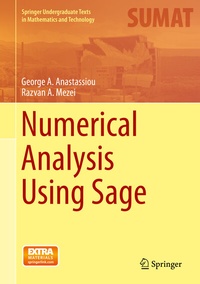
Numerical Analysis Using Sage
Description

This is the first numerical analysis text to use Sage for the implementation of algorithms and can be used in a one-semester course for undergraduates in mathematics, math education, computer science/information technology, engineering, and physical sciences. The primary aim of this text is to simplify understanding of the theories and ideas from a numerical analysis/numerical methods course via a modern programming language like Sage. Aside from the presentation of fundamental theoretical notions of numerical analysis throughout the text, each chapter concludes with several exercises that are oriented to real-world application. Answers may be verified using Sage.
The presented code, written in core components of Sage, are backward compatible, i.e., easily applicable to other software systems such as Mathematica ®. Sage is open source software and uses Python-like syntax. Previous Python programming experience is not a requirement for the reader, though familiarity withany programming language is a plus. Moreover, the code can be written using any web browser and is therefore useful with Laptops, Tablets, iPhones, Smartphones, etc. All Sage code that is presented in the text is openly available on SpringerLink.com.
Reviews / Votes
"The book covers the basics of nonlinear root finding, numerical differentiation and integration, interpolation, and the numerical solution of initial value problems for ordinary differential equations. . it should be accessible to any student with a background in single-variable calculus. . Numerical Analysis Using Sage is a clearly written, accessible introduction to numerical analysis that seamlessly weaves together the mathematics and computer implementation of the numerical methods it covers." (Jason M. Graham, MAA Reviews, maa.org, May, 2016)
More details
Other editions
Additional editions

Persons
George Anastassiou is Professor at the University of Memphis. Research interests include Computational analysis, approximation theory, probability, theory of moments. Professor Anastassiou has authored and edited several publications with Springer including "Fractional Differentiation Inequalities" (c) 2009, "Fuzzy Mathematics: Approximation Theory" (c) 2010, "Intelligent Systems: Approximation by Artificial Neural Networks" (c) 2014, "The History of Approximation Theory" (c) 2005, "Modern Differential Geometry in Gauge Theories" (c) 2006, and more.
Razvan Alex Mezei received his PhD from the University of Memphis and currently holds an assistant professorship and Lenoir-Rhyne University, Hickory, North Carolina. He teaches mathematics as well as computer science/IT courses to undergraduates and is a computing sciences program coordinator. Mezei has extensive experience in computer programming and software development and has written several publications with George Anastassiou.
