

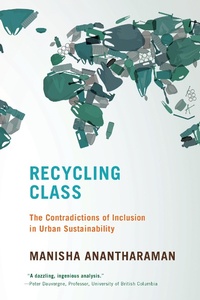
Recycling Class
The Contradictions of Inclusion in Urban Sustainability
Published on 2. January 2024
296 pages
978-0-262-37698-3 (ISBN)
Description

An ethnographic and community-engaged study of the class, caste, and gender politics of environmental mobilizations around Bengaluru, India's discards.
In Recycling Class, Manisha Anantharaman examines the ideas, flows, and relationships around unmanaged discards in Bengaluru, India, itself a massive environmental problem of planetary proportions, to help us understand what types of coalitions deliver social justice within sustainability initiatives. Recycling Class links middle-class, sustainable consumption with the environmental labor of the working poor to offer a relational analysis of urban sustainability politics and practice. Through ethnographic, community-based research, Anantharaman shows how diverse social groups adopt, contest, and modify neoliberal sustainability's emphasis on market-based solutions, behavior change, and the aesthetic conflation of "clean" with "green."
Tracing garbage politics in Bengaluru for over a decade, Anantharaman argues that middle class "communal sustainability" efforts create new avenues for waste picker organizations to make claims for infrastructural inclusion. Coproduced "DIY infrastructures" serve as sites of citizenship and political negotiation, challenging the technocratic and growth-based logics of dominant sustainability policies. Yet, these configurations reproduce class, caste, and gender-based divisions of labor, demonstrating that inclusion without social reform can reproduce unjust distributions of risk and responsibility. Revealing the "win-win" fallacy of sustainability and foregrounding the agency of communities excluded from environmental policy, Recycling Class will appeal to scholars and activists alike who want to create a future with more transformative sustainability.
In Recycling Class, Manisha Anantharaman examines the ideas, flows, and relationships around unmanaged discards in Bengaluru, India, itself a massive environmental problem of planetary proportions, to help us understand what types of coalitions deliver social justice within sustainability initiatives. Recycling Class links middle-class, sustainable consumption with the environmental labor of the working poor to offer a relational analysis of urban sustainability politics and practice. Through ethnographic, community-based research, Anantharaman shows how diverse social groups adopt, contest, and modify neoliberal sustainability's emphasis on market-based solutions, behavior change, and the aesthetic conflation of "clean" with "green."
Tracing garbage politics in Bengaluru for over a decade, Anantharaman argues that middle class "communal sustainability" efforts create new avenues for waste picker organizations to make claims for infrastructural inclusion. Coproduced "DIY infrastructures" serve as sites of citizenship and political negotiation, challenging the technocratic and growth-based logics of dominant sustainability policies. Yet, these configurations reproduce class, caste, and gender-based divisions of labor, demonstrating that inclusion without social reform can reproduce unjust distributions of risk and responsibility. Revealing the "win-win" fallacy of sustainability and foregrounding the agency of communities excluded from environmental policy, Recycling Class will appeal to scholars and activists alike who want to create a future with more transformative sustainability.
More details
Other editions
Additional editions
Book
01/2024
MIT Press
€41.10
Article exhausted; check different version
Person
Manisha Anantharaman is Assistant Professor at Sciences Po, Center for Sociology of Organisations (CSO), CNRS, Paris, and coeditor of The Circular Economy and the Global South.
Content
Acknowledgments ix
Introduction: Situating Sustainability in Bengaluru's Discards 1
1 Consuming the Clean and Green City 29
2 Communal Sustainability 55
3 Entrepreneurial Environmentalism 81
4 DIY Infrastructures 109
5 The Win-Win Fallacy 137
Conclusion: Beyond Inclusion, toward Reparation 163
Notes 185
References 215
Index 255
Introduction: Situating Sustainability in Bengaluru's Discards 1
1 Consuming the Clean and Green City 29
2 Communal Sustainability 55
3 Entrepreneurial Environmentalism 81
4 DIY Infrastructures 109
5 The Win-Win Fallacy 137
Conclusion: Beyond Inclusion, toward Reparation 163
Notes 185
References 215
Index 255
